- Animals
- ›Chordates
- ›Vertebrates
- ›Birds
- ›Hawks, Eagles, Kites, and Allies
- ›Hawks, Eagles, and Kites
- ›Buteonine Hawks, Kites, and allies
- ›Parabuteo
On eBird ↗
White-rumped Hawk
Live sightings near you, the range map, bar charts of when it is seen, and Macaulay Library photos and recordings.
White-rumped Hawk
Parabuteo leucorrhous
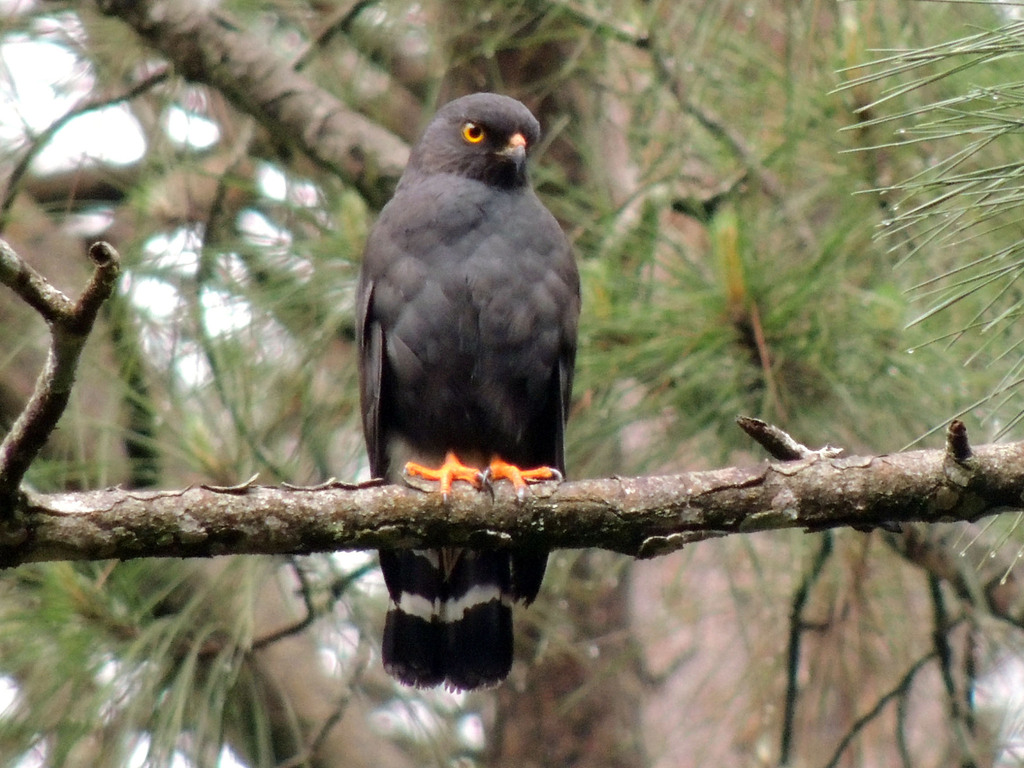
The white-rumped hawk (Parabuteo leucorrhous) is a species of bird of prey in the family Accipitridae. It is found in Argentina, Bolivia, Brazil, Colombia, Ecuador, Paraguay, Peru, and Venezuela. Its natural habitat is subtropical or tropical moist montane forests.
From the article White-rumped hawk on Wikipedia (CC BY-SA), quoted section by section
Description
The white-rumped hawk is 33 to 40 cm (13 to 16 in) long with a 67 to 79 cm (26 to 31 in) wingspan. One male weighed 290 g (10 oz) and one female 389 g (14 oz). Males and females have the same plumage. Adults are almost entirely black but with the namesake white rump and undertail coverts. Their tail has a narrow grayish-brown band at its midpoint and their thighs are feathered rufous. Their eye, cere, legs, and feet are yellow. Immatures have brown upperparts with rufous mottling and heavily mottled rufous underparts.
Range & habitat
The white-rumped hawk has two separate ranges. One is from the Andes and other mountains of Venezuela and Colombia south in the Andes through Ecuador into Peru, Bolivia, and northwestern Argentina. The other range is from southern Brazil through Paraguay into northeastern Argentina. The species inhabits the interior and edges of dense subtropical and tropical forest and also the Chaco in the east. In elevation it mostly occurs between 1,500 and 2,900 m (4,900 and 9,500 ft) in Colombia, between 1,650 and 2,500 m (5,400 and 8,200 ft) in Peru, and up to 3,500 m (11,500 ft) in Bolivia. It occurs at lower elevations in its eastern range.
Wikipedia: “Distribution and habitat”
What it does
The white-rumped hawk's hunting methods and diet are mostly unknown. It has been documented feeding on reptiles, frogs, insects, and rats.
Wikipedia: “Feeding”
Listen
Looking for field recordings…
Where it lives
Recorded sightings
—
geo-referenced records in GBIF, from museums, herbaria and field observers.
Drag the globe to turn it. Dots are where records exist, not a range map; darker means more records.
In the stacks
Searching the stacks…
Every page naming Parabuteo leucorrhous in the Biodiversity Heritage Library →
This page is assembled live from iNaturalist, GBIF, Wikipedia, the Source Library and the Internet Archive. It is not yet part of the hand-edited codex. iNaturalist taxon 201042.