- Animals
- ›Chordates
- ›Vertebrates
- ›Birds
- ›Hawks, Eagles, Kites, and Allies
- ›Hawks, Eagles, and Kites
- ›Typical Eagles and Hawk-Eagles
- ›Clanga
On eBird ↗
Greater Spotted Eagle
Live sightings near you, the range map, bar charts of when it is seen, and Macaulay Library photos and recordings.
Greater Spotted Eagle
Clanga clanga
The greater spotted eagle (Clanga clanga), also called the spotted eagle, is a large migratory bird of prey in the family Accipitridae.
It is a member of the subfamily Aquilinae, commonly known as "booted eagles". It was once classified as a member of the genus Aquila, but has been reclassified to the distinct genus Clanga, along with the two other species of spotted eagle.
From the article Greater spotted eagle on Wikipedia (CC BY-SA), quoted section by section
Description
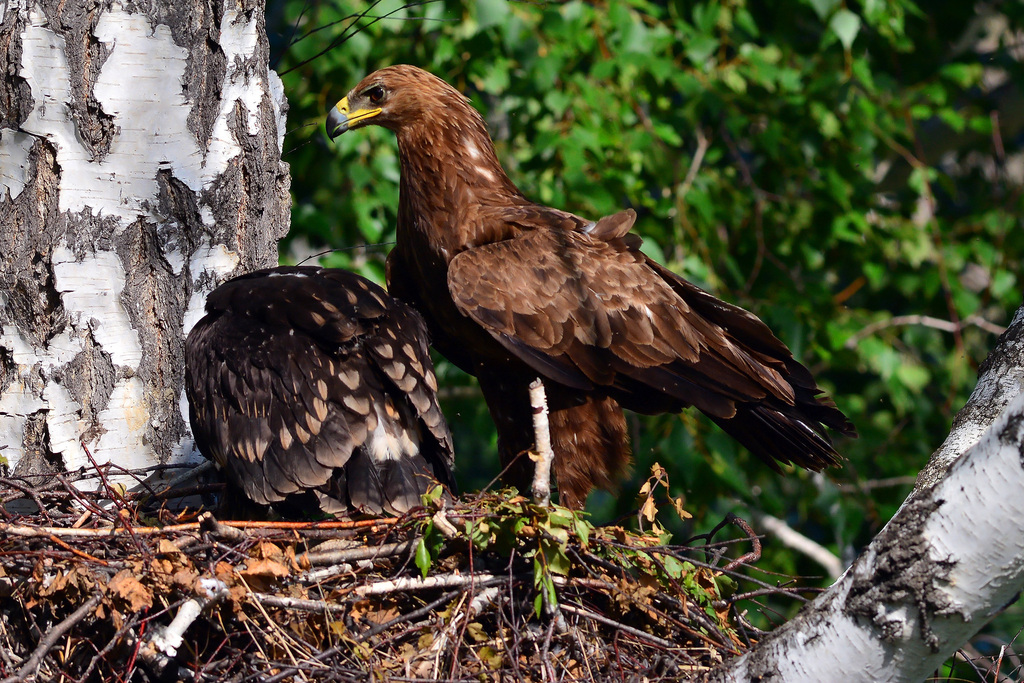
The greater spotted eagle is rather large and compact. Normally, it is black-brown with a contrasting yellow beak. This species has a short neck with a large and often shaggy-naped head, a strong beak, and a short gape-line with round nostrils. The wings are broad and long, reaching the tail tip. The tail is relatively short and rounded. The overall effect of the broad wings and short tail can give them an almost vulture-like silhouette. The feet are large, and the feathers covering the legs are less compactly arranged than on lesser spotted eagles. Greater spotted eagles tend to perch in the open. Most perches are on treetops at a forest edge, or more isolated vantage points such as a bush, utility pole, or steep riverbank. It is not uncommon for greater spotted eagles to forage from the ground, or rest there in a somewhat hunched posture. Adult greater spotted eagles are generally a rather uniform dark to blackish brown, though the coloration may appear purplish and glossy. They may appear more starkly contrasted when freshly moulted. The upperwing covert feathers are often a shade paler than the rest, though these eagles generally appear uniformly dark with two contrasting features: a pale beak and a narrow white U above the tail, though the latter is usually concealed at rest. The species is sexually dimorphic or even polymorphic. …
Range & habitat
This raptor breeds primarily in the Palearctic and the Indomalayan regions. It also breeds in central and southeastern Europe; however, it is highly restricted to small, non-contiguous pockets in Poland, Belarus, Ukraine, Bulgaria, Romania, Serbia, and Hungary. A more continuous breeding range begins in Eastern Europe and includes the eastern parts of Estonia, Latvia, and Lithuania, and central Belarus. An uncertain number of breeding birds spill over into the edge of eastern Finland. They are found broadly throughout European Russia, where habitat is favorable up through much of Arkhangelsk Oblast to as far as the lower coasts of the White Sea. They are found across much of Central Russia, with their probable northern limits being in Shuryshkarsky and Pitkyarantsky Districts. They are also found in a broad strip across southern Siberia reaching well into the Amur region. Their range outside Russia includes much of northern Kazakhstan, with isolated breeding areas known in the East Kazakhstan Region and in southern Kazakhstan. Greater spotted eagles also breed in an isolated area reaching from Kyrgyzstan and adjacent areas of Russia down to Xinjiang in China. At times, greater spotted eagles have been known to breed in the Indian subcontinent, reportedly from Gujarat northwards to Punjab, with recorded breeding as far south as Saurashtra and as far north as Maharashtra. …
Wikipedia: “Breeding range”
What it does
The greater spotted eagle is a slightly opportunistic predator but tends to favor rather particular prey types. Their diet tends to be composed mostly of small mammals. Despite some dietary similarities with the lesser spotted eagle, the greater spotted eagle's diet includes more birds and favors larger prey. Beyond mammals and birds, the greater spotted eagle will sometimes prey on amphibians, reptiles (mainly small-to-mid-sized snakes), and occasionally small fish and insects. Pellets are considered the most reliable way to determine the diets of greater spotted eagle, as prey remains alone can be biased towards birds. As can be expected by their habitat preferences, greater spotted eagles tend to eat vertebrates associated with water. Generally, its prey spectrum is somewhat diverse, at slightly fewer than 150 known prey species; this is more diverse than the known diet of the steppe eagle, similar in diversity to that of the lesser spotted eagle, and possibly about half as diverse of the diet of the eastern imperial eagle. Greater spotted eagles hunt mainly on the wing, quartering over relatively open ground (somewhat like a harrier) or soaring high above and dropping or diving steeply when prey is spotted. …
Wikipedia: “Dietary biology”
In human culture
Greater spotted eagles are members of the Aquilinae, or "booted eagles", subfamily, a monophyletic group within the larger Accipitridae family. All booted eagles have feathers covering their legs. Members of this diverse, wide-ranging family may be found on every continent except Antarctica. Thirty-eight species of booted eagle are recognized. Booted eagles are often grouped with the genera Buteo and Haliaeetus, and other more heavy-set Accipitridae, but they may be more closely related to the slenderer accipitrine hawks than previously believed. The greater spotted eagle's closest living relative is the lesser spotted eagle. They are believed to have diverged from their most recent common ancestor around the middle Pliocene, approximately 3.6 million years ago (mya). This "proto-spotted eagle" probably lived in the general region of modern-day Afghanistan, and split into northern and southern lineages when both glaciers and deserts advanced in Central Asia at the start of the last ice age. The northern lineage subsequently separated into the greater (eastern) and lesser (western) spotted eagle species of today, probably around the Pliocene–Pleistocene boundary, almost 2 mya. Spotted eagles were classified as part of the genus Aquila, along with several other mostly large, brownish eagles. …
Wikipedia: “Taxonomy and etymology”
Listen
Looking for field recordings…
Where it lives
Recorded sightings
—
geo-referenced records in GBIF, from museums, herbaria and field observers.
Drag the globe to turn it. Dots are where records exist, not a range map; darker means more records.
In the stacks
Searching the stacks…
Every page naming Clanga clanga in the Biodiversity Heritage Library →
This page is assembled live from iNaturalist, GBIF, Wikipedia, the Source Library and the Internet Archive. It is not yet part of the hand-edited codex. iNaturalist taxon 201035.