- Animals
- ›Chordates
- ›Vertebrates
- ›Birds
- ›Hawks, Eagles, Kites, and Allies
- ›Hawks, Eagles, and Kites
- ›Typical Eagles and Hawk-Eagles
- ›Clanga
On eBird ↗
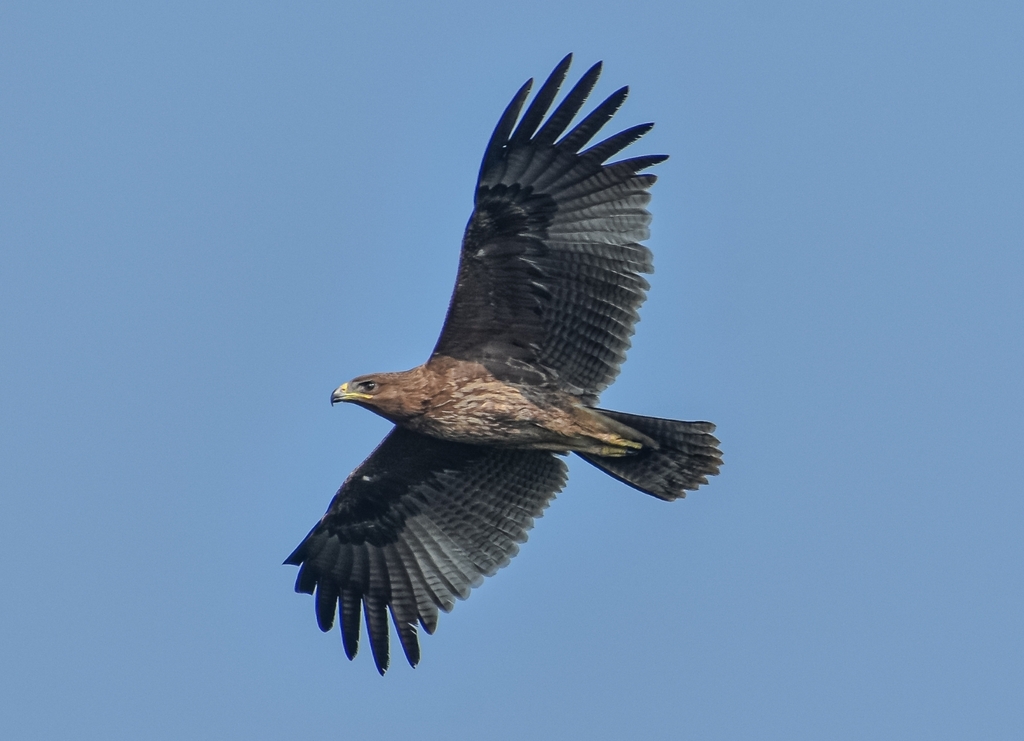
Indian Spotted Eagle
Live sightings near you, the range map, bar charts of when it is seen, and Macaulay Library photos and recordings.
Indian Spotted Eagle
Clanga hastata
The Indian spotted eagle (Clanga hastata) is a large bird of prey native to the Indian subcontinent. Like all typical eagles, it belongs to the family Accipitridae. The typical eagles are often united with the buteos, sea eagles and other more heavy-set Accipitridae, but more recently it appears as if they are less distinct from the more slender accipitrine hawks.
From the article Indian spotted eagle on Wikipedia (CC BY-SA), quoted section by section
Description
The Indian spotted eagle is about 60 cm (24 in) in length and has a wingspan of 150 cm (59 in). It is broad-headed, with the widest mouth of all spotted eagles. This species is a lighter overall compared to its relatives, with a darker iris that makes the eyes appear darker than the plumage (rather than the other way around as in the two northern spotted eagle species). Adults can be told apart from the greater spotted eagle by its lighter colour, darker eyes, and habitat preference. After about three or four months the young birds are glossy brown with the tips of the head and neck feathers being creamy and giving a spotted appearance. The upper tail coverts are light brown with white giving a barred appearance. The median coverts have large creamy spots. After about eighteen months the bird moults and becomes a darker shade and has less spots.
Range & habitat
The Indian spotted eagle is native to Bangladesh, Cambodia, India, Myanmar, Nepal, and (marginally) in Pakistan. It occurs in agricultural landscapes and tropical dry forests.
Wikipedia: “Distribution and habitat”
Listen
Looking for field recordings…
Where it lives
Recorded sightings
—
geo-referenced records in GBIF, from museums, herbaria and field observers.
Drag the globe to turn it. Dots are where records exist, not a range map; darker means more records.
In the stacks
Searching the stacks…
Every page naming Clanga hastata in the Biodiversity Heritage Library →
This page is assembled live from iNaturalist, GBIF, Wikipedia, the Source Library and the Internet Archive. It is not yet part of the hand-edited codex. iNaturalist taxon 201034.