- Animals
- ›Chordates
- ›Vertebrates
- ›Reptiles
- ›Snakes and Lizards
- ›Lizards
- ›Iguanas and Allies
- ›Dragons and Chameleons
- ›Dragons
- ›Agamas
- ›Phrynocephalus
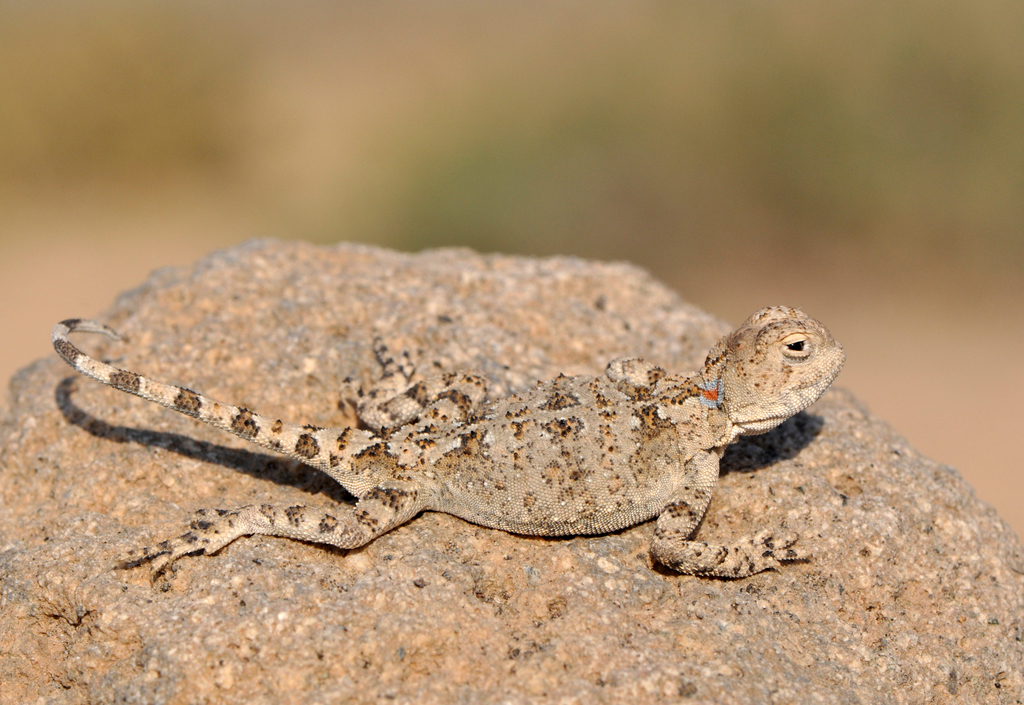
Horvath's Toad Headed Agama
Phrynocephalus persicus
Phrynocephalus persicus, commonly known as the Persian toad-headed agama, is a small diurnal desert lizard of the family Agamidae. It is the westernmost representative of the Central Asian genus of toad-headed agamas Phrynocephalus and is only known from deserts and semideserts of Iran and possibly Azerbaijan.
From the article Phrynocephalus persicus on Wikipedia (CC BY-SA), quoted section by section
Description
The snout-vent length of the body and weight ranges between 2.3 cm and 0.4 g in newborns and 7 cm and 7.8 g in adults. There is a sexual dimorphism in morphology (size, color) and behavior. Females are slightly larger than males. P. persicus appears to have a shorter tail compared to P. horvathi. Like its relatives, the species does not have visible ear-drums. Head and body are wide and covered with small scales. There is no large shield on the head as in Lacertidae lizards. Coloration is cryptic and usually corresponds to the color of the surrounding substrate, which makes the lizard almost invisible. Scales of different size, shape and color associated to create a mosaic pattern, which serves as camouflage allowing the lizard to blend in with a sandy substrate. Accumulations of conical scales create more or less symmetrically distributed dark spots of the color pattern. The dorsal pattern consists of transverse series of dark dots which form pronounced dark areas on the shoulders and the lumbar region of the body. The center of the back may carry 1–3 latitudinally spread groups of dark spots, or may be free of any pattern. There are usually 2–3 prolonged red surrounded by blue areas on the neck. Color of these areas serves as a "pregnancy indicator". In gravid females red coloration turns bluish-grey and areas become blue. …
Range & habitat
The species occurs in fragmented populations in the northwestern and western parts of the Central Plateau in Iran. Reports from Azerbaijan have not been confirmed in the past 50 years. The species inhabits semi-desert on plateaus at an elevation of up to 1,150m.
Wikipedia: “Distribution and habitat”
What it does
The life span of P. persicus is 2.5–3 years. Juveniles become adults at an age of less than one year. The species feeds on a variety of arthropods including ants, small spiders, beetles and orthopterans and even venomous arthropods such as spiders, bees and wasps. P. persicus is oviparous, i.e. a female lays eggs to reproduce. Females may make 1–3 clutches of 2–4 small eggs, depending on the duration of the warm season, which, in its turn, heavily depends on elevation of the local terrain. The female lays the eggs into a narrow around 30 cm deep burrow she has dug into the sand. During the period of gravidity, females demonstrate a specifically aggressive behavior towards conspecifics and other invaders as well. This behavior includes walking on extended rear limbs with an inflated abdomen, collateral rotations of the curved end of the tail, tail-markings on the sand, and open mouth attacks.
Wikipedia: “Ecology”
Where it lives
Recorded sightings
—
geo-referenced records in GBIF, from museums, herbaria and field observers.
Drag the globe to turn it. Dots are where records exist, not a range map; darker means more records.
In the stacks
Searching the stacks…
Every page naming Phrynocephalus persicus in the Biodiversity Heritage Library →
This page is assembled live from iNaturalist, GBIF, Wikipedia, the Source Library and the Internet Archive. It is not yet part of the hand-edited codex. iNaturalist taxon 200851.