On eBird ↗
Eastern Whip-poor-will
Live sightings near you, the range map, bar charts of when it is seen, and Macaulay Library photos and recordings.
Eastern Whip-poor-will
Antrostomus vociferus
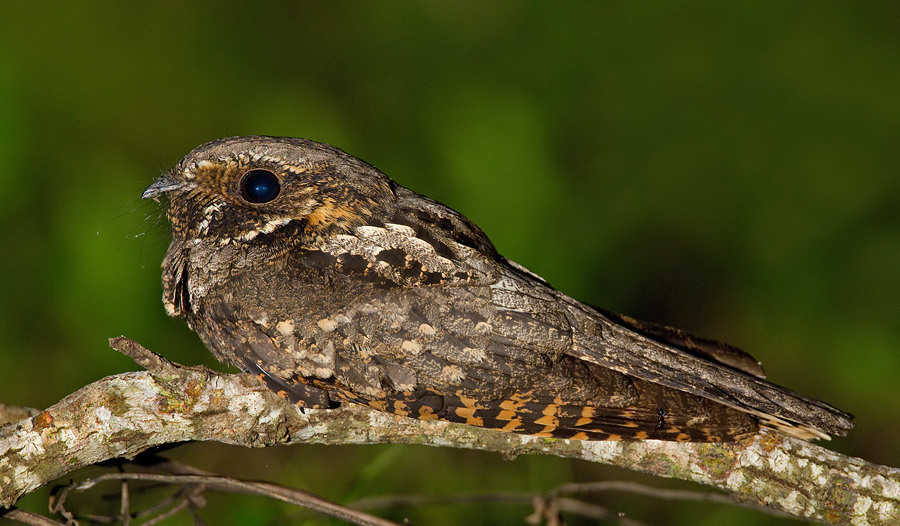
The eastern whip-poor-will (Antrostomus vociferus; also called "whip-o-will", "whip o' will", etc.) is a medium-sized (22–27 cm or 8.7–10.6 in) bird within the nightjar family, Caprimulgidae, from North America. The whip-poor-will is commonly heard within its range, but less often seen because of its camouflage. It is named onomatopoeically after its song.
From the article Eastern whip-poor-will on Wikipedia (CC BY-SA), quoted section by section
Description
This medium-sized nightjar measures 22–27 cm (8+1⁄2–10+1⁄2 in) in length, spans 45–50 cm (17+1⁄2–19+1⁄2 in) across the wings and weighs 42–69 g (1+1⁄2–2+7⁄16 oz). Further standard measurements are a wing chord of 14.7 to 16.9 cm (5+13⁄16 to 6+5⁄8 in), a tail of 10.5 to 12.8 cm (4+1⁄8 to 5+1⁄16 in), a bill of 1 to 1.4 cm (3⁄8 to 9⁄16 in) and a tarsus of 1.5 to 1.8 cm (9⁄16 to 11⁄16 in). Adults have mottled plumage: the upperparts are grey, black and brown; the lower parts are grey and black. They have a very short bill and a black throat. Males have a white patch below the throat and white tips on the outer tail feathers; in the female, these parts are light brown. This bird is sometimes confused with the related chuck-will's-widow (Antrostomus carolinensis) which has a similar but lower-pitched and slower call.
What it does
Eastern whip-poor-wills breed in deciduous or mixed woods across central and southeastern Canada and the eastern United States, and migrate to the southeastern United States and to eastern Mexico and Central America for the winter. These birds forage at night, catching insects in flight, and normally sleep during the day. Eastern whip-poor-wills nest on the ground, in shaded locations among dead leaves, and usually lay two eggs at a time. The bird will commonly remain on the nest unless almost stepped upon. Eastern whip-poor-will are typically socially monogamous. However, a male whip-poor-will was once recorded attending the nests of two different females, possibly because one female's previous mate had recently died. The whip-poor-will has been split into two species. Eastern populations are now referred to as the eastern whip-poor-will. The disjunct population in southwestern United States and Mexico is now referred to as the Mexican whip-poor-will, Antrostomus arizonae. The two populations were split based on range, different vocalizations, different egg coloration, and DNA sequencing showing differentiation.
Wikipedia: “Ecology”
Listen
Looking for field recordings…
Where it lives
Recorded sightings
—
geo-referenced records in GBIF, from museums, herbaria and field observers.
Drag the globe to turn it. Dots are where records exist, not a range map; darker means more records.
In the stacks
Searching the stacks…
Every page naming Antrostomus vociferus in the Biodiversity Heritage Library →
This page is assembled live from iNaturalist, GBIF, Wikipedia, the Source Library and the Internet Archive. It is not yet part of the hand-edited codex. iNaturalist taxon 199837.