On eBird ↗
Rufous-legged Owl
Live sightings near you, the range map, bar charts of when it is seen, and Macaulay Library photos and recordings.
Rufous-legged Owl
Strix rufipes
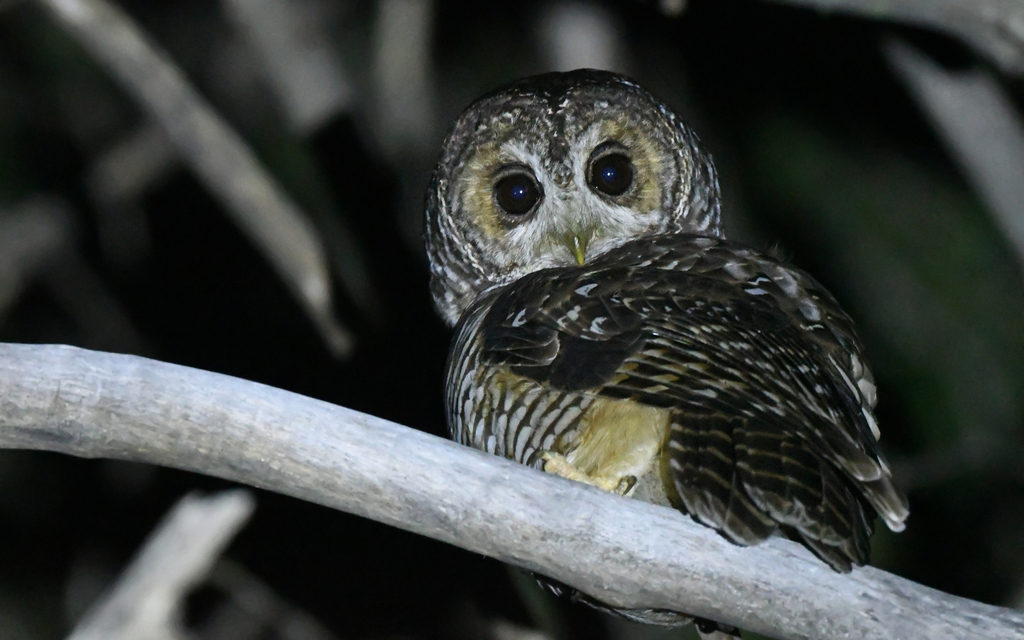
The rufous-legged owl (Strix rufipes) is a medium-sized owl with no ear tufts. Its upper parts are rufous brown barred with white with more white on the head and nape. It has a rufous facial disk and dark eyes, and its legs and feet are orange-brown to cinnamon. It reaches sizes of about 33–38 cm long and weighs about 300-400 grams. Its range stretches from central Chile and west Argentina to Tierra del Fuego and is occasionally...
From the article Rufous-legged owl on Wikipedia (CC BY-SA), quoted section by section
Description
The rufous-legged owl is compact, with a round head and no ear tufts. It is 33 to 38 cm (13 to 15 in) long and weighs about 350 g (12 oz); females are larger than males. Adults have a rusty facial disk, white "brows" over dark brown eyes, and white lores. Its upperparts are dark reddish brown with narrow orange-buff bars and spots. The tail is also reddish brown, with buff bars. The throat is white, most of the underparts are buffy white with many black bars, and the vent area is orange-buff. The legs and toes are covered with buffy feathers. The chick is downy off-white. The juvenile is a warm buff with faint dusky brown barring and a tawny face.
Range & habitat
The rufous-legged owl is found in Chile from approximately Valparaíso Province and in far western Argentina from approximately Mendoza Province south to the tip of Tierra del Fuego. The one specimen of S. r. sanborni was taken on Chiloé Island off the coast of south-central Chile. The species primarily inhabits moist old-growth forest with a closed canopy and a dense understory. It is also found in older secondary forest and semi-open forest. In elevation it ranges from sea level to at least 2,000 m (6,600 ft).
Wikipedia: “Distribution”
What it does
The rufous-legged owl is nocturnal and usually hunts from a perch. Its primary prey is small arboreal mammals. Birds, amphibians, and insects are also taken but account for only a small percentage of its diet.
Wikipedia: “Feeding”
Listen
Looking for field recordings…
Where it lives
Recorded sightings
—
geo-referenced records in GBIF, from museums, herbaria and field observers.
Drag the globe to turn it. Dots are where records exist, not a range map; darker means more records.
In the stacks
Searching the stacks…
Every page naming Strix rufipes in the Biodiversity Heritage Library →
This page is assembled live from iNaturalist, GBIF, Wikipedia, the Source Library and the Internet Archive. It is not yet part of the hand-edited codex. iNaturalist taxon 19948.