- Plants
- ›Vascular Plants
- ›flowering plants
- ›Dicots
- ›Sunflowers, Bellflowers, Fanflowers, and Allies
- ›Sunflowers, Daisies, Asters, and Allies
- ›Asteroideae
- ›bonesets, blazingstars, and allies
- ›Praxelinae
- ›Chromolaena
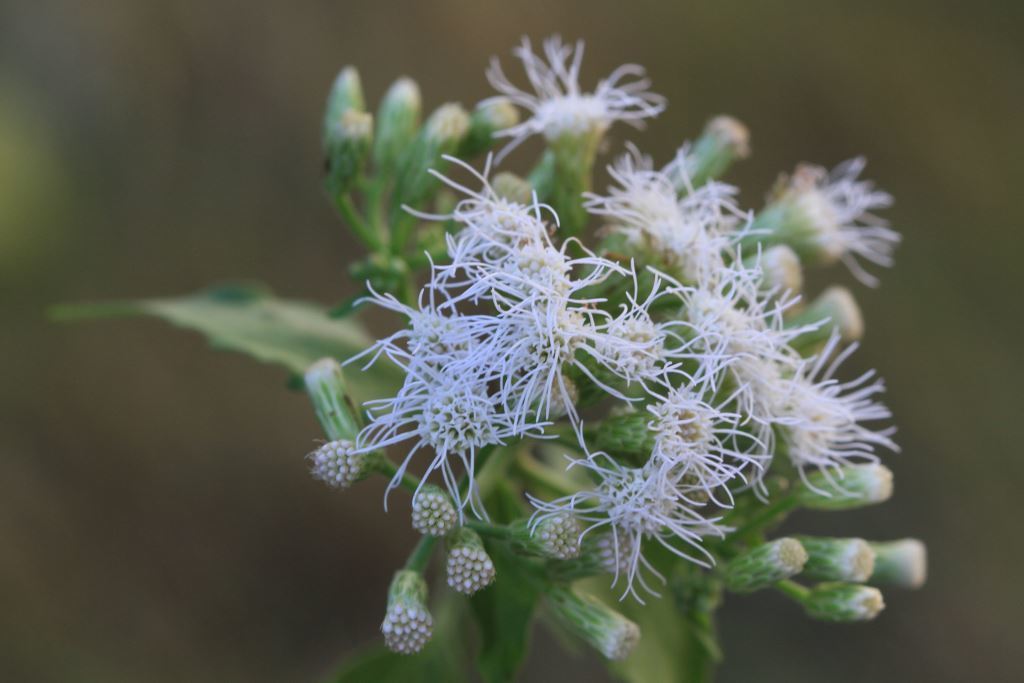
Siam weed
Chromolaena odorata
Chromolaena odorata is a tropical and subtropical species of flowering shrub in the sunflower family. It is native to the Americas, from Florida and Texas in the United States south through Mexico and the Caribbean to South America. It has been introduced to tropical Asia, west Africa, and parts of Australia. Common names include Siam weed, Christmas bush, devil weed, camfhur grass, common floss flower and triffid.
From the article Chromolaena odorata on Wikipedia (CC BY-SA), quoted section by section
Description
Chromolaena odorata is a rapidly growing perennial herb. It is a multi-stemmed shrub which grows up to 2.5 m (100 inches) tall in open areas. It has soft stems but the base of the shrub is woody. In shady areas it becomes etiolated and behaves as a creeper, growing on other vegetation. It can then become up to 10 m (33 feet) tall. The plant is hairy and glandular and the leaves give off a pungent, aromatic odour when crushed. The leaves are opposite, triangular to elliptical with serrated edges. Leaves are 4–10 cm long by 1–5 cm wide (up to 4 x 2 inches). Leaf petioles are 1–4 cm long. The white to pale pink tubular flowers are in panicles of 10 to 35 flowers that form at the ends of branches. The seeds are achenes and are somewhat hairy. They are mostly spread by the wind, but can also cling to fur, clothes and machinery, enabling long-distance dispersal. Seed production is about 80,000 to 90,000 per plant. Seeds need light to germinate. The plant can regenerate from the roots. In favorable conditions, the plant can grow more than 3 cm per day.
Common names. Common names include acheampong leaves, siam weed, rouge plant, Christmas bush, triffid, or jack in the box, among others according to region and language.
Toxicity
Chromolaena odorata is toxic to cattle and is larvicidal against all major mosquito vectors. It can also cause allergic reactions.
In human culture
In the 19th century, Chromolaena odorata escaped from the botanical gardens at Dacca (Bangladesh), Java (Indonesia) and Peradeniya (Sri Lanka). In Western Africa, the plant was accidentally introduced with forestry seeds. In Southern Africa, it was introduced as an ornamental, and in Ivory Coast in 1952 to control Imperata grasses. It was first found in Queensland, Australia in 1994 and was perhaps introduced with foreign pasture seeds. Chromolaena odorata was found on the eastern portion of the Big Island of Hawai'i in 2021.
Wikipedia: “History of introduction”
Where it lives
Recorded sightings
—
geo-referenced records in GBIF, from museums, herbaria and field observers.
Drag the globe to turn it. Dots are where records exist, not a range map; darker means more records.
In the stacks
Searching the stacks…
Every page naming Chromolaena odorata in the Biodiversity Heritage Library →
This page is assembled live from iNaturalist, GBIF, Wikipedia, the Source Library and the Internet Archive. It is not yet part of the hand-edited codex. iNaturalist taxon 199400.