On eBird ↗
Coral-billed Ground-Cuckoo
Live sightings near you, the range map, bar charts of when it is seen, and Macaulay Library photos and recordings.
Coral-billed Ground-Cuckoo
Carpococcyx renauldi
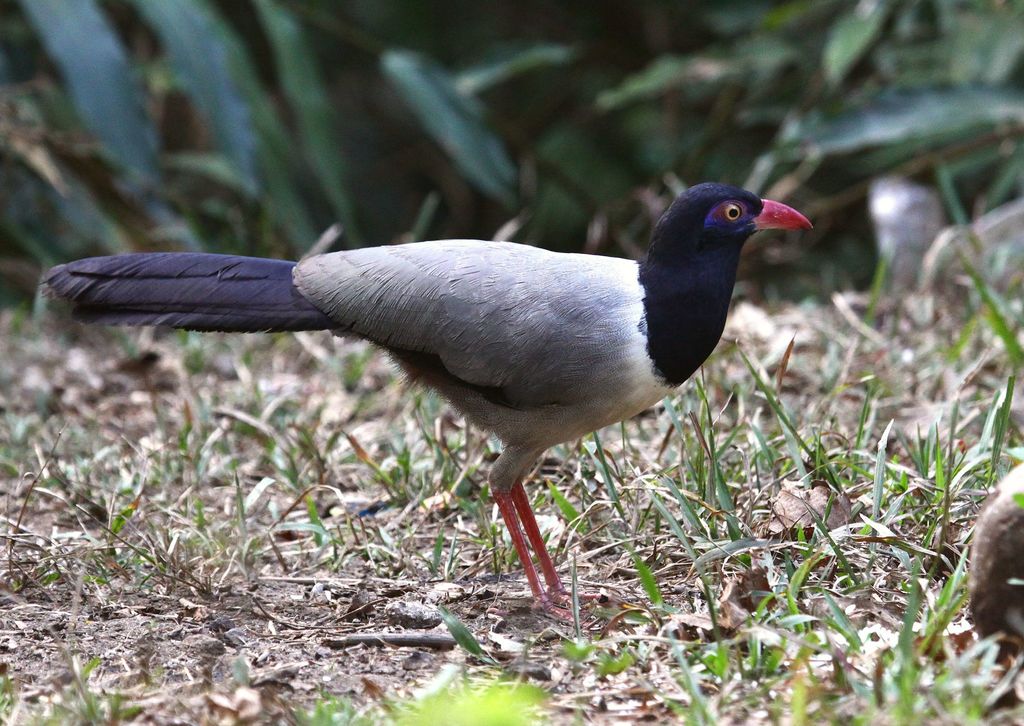
The coral-billed ground cuckoo (Carpococcyx renauldi), also known as Renauld's ground cuckoo, is a large terrestrial species of cuckoo in the family Cuculidae. It is found in Cambodia, Laos, Thailand, and Vietnam. Its natural habitat is tropical moist lowland forests. Its English name refers to its coral-red bill, which separates it from the two other members of the genus Carpococcyx.
From the article Coral-billed ground cuckoo on Wikipedia (CC BY-SA), quoted section by section
Description
The coral-billed ground cuckoo can grow up to 56-70 centimeters (22-28 inches) in length. One captive specimen was reported to weigh 400 grams (0.88 pounds) when close to being fully grown. Adults are sexually monomorphic. Their head, neck, upper breast, primaries, and tail are a glossy violet-black color, with a bare patch of red and violet-colored skin around the eyes. A white band sits below the neck, with the lower breast, flanks, belly, and undertail coverts being primarily white. Their back, rump, and secondaries are primarily grey, with the tips of the secondaries being violet. Their bill and legs are red. Juveniles have a primarily brown head, with a bare patch of grey skin around the eyes. Their back is dark grey with rufous barring, and the secondaries and upper wing coverts are gray with rufous tips. Their belly, chin, are grey, with the upper breast being grey to rufous-brown and a black tail. Their bill and legs are blackish-brown.
Range & habitat
The coral-billed ground cuckoo is found throughout Cambodia, Laos, Thailand, and Vietnam. Their natural habitat is broad-leaf evergreen forest with dense vegetation and ground cover.
Wikipedia: “Distribution and habitat”
What it does
The coral-billed ground cuckoo is primarily ground dwelling, occasionally perching in low trees. They are noted to rarely fly and are skittish, often fleeing from disturbance. They are omnivorous, feeding on insects, small reptiles, small mammals, and have been reported to consume food refuse from restaurants in Thailand. Captive specimens have been reported to consume meat, dead mice, baby rats, worms, insects, bread, and boiled maize.
Nesting and Reproduction. The coral-billed ground cuckoo nests in trees, creating a nest of large sticks; In captivity, some have been reported to create cup-like stick nests on both the ground and in trees. Eggs are laid from May to August, with both parents incubating for around 18-19 days; Both parents similarly feed and protect the young, with the young leaving the nest after 50-60 days. Specimens have been noted to adapt well to captive conditions, and have successfully reproduced in captivity.
Wikipedia: “Behavior and ecology”
Listen
Looking for field recordings…
Where it lives
Recorded sightings
—
geo-referenced records in GBIF, from museums, herbaria and field observers.
Drag the globe to turn it. Dots are where records exist, not a range map; darker means more records.
In the stacks
Searching the stacks…
Every page naming Carpococcyx renauldi in the Biodiversity Heritage Library →
This page is assembled live from iNaturalist, GBIF, Wikipedia, the Source Library and the Internet Archive. It is not yet part of the hand-edited codex. iNaturalist taxon 1994.