On eBird ↗
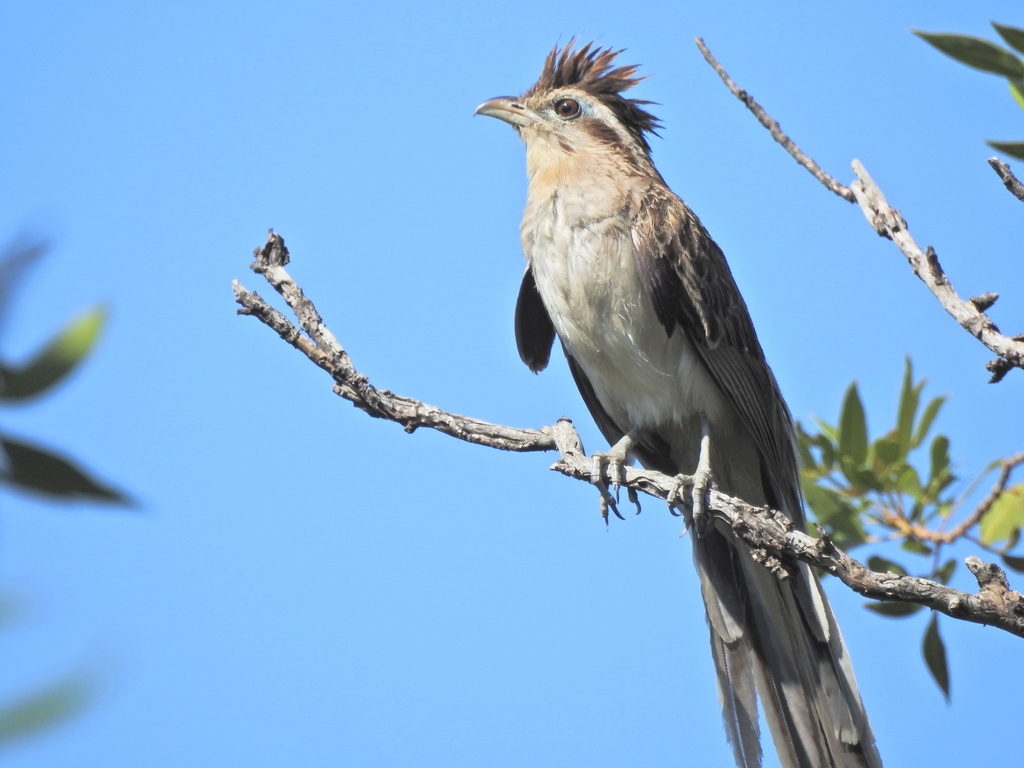
Striped Cuckoo
Live sightings near you, the range map, bar charts of when it is seen, and Macaulay Library photos and recordings.
Striped Cuckoo
Tapera naevia
The striped cuckoo (Tapera naevia) is a bird, the only member of the genus Tapera. This resident cuckoo is found from Mexico and Trinidad south to Bolivia and Argentina and Colombia.
The striped cuckoo is found in open country with trees or shrubs, and the edges of mangrove forests. It is among the very few brood parasitic cuckoos of the Americas (only other are Dromococcyx), and typical hosts are spinetails, but often also wrens, and other species with domed nests. The female cuckoo lays one, sometimes two, white or bluish eggs in the host's large stick nest. The eggs hatch in 15 days, with a further 18 days until the cuckoo fledges. The young spinetails disappear.
From the article Striped cuckoo on Wikipedia (CC BY-SA), quoted section by section
In human culture
This bird is very important in Brazilian folklore, being related to the legend of the saci, or matita-perê. Other than saci, the bird is also known as matinta-pereira, pitica (Pará), crispim, fenfém, martim-pererê, matimpererê, matintapereira, matintaperera, matitaperê, peitica, peito-ferido, roceiro-planta, seco-fico, sede-sede, saci-do-campo, sem-fim, fém-fém, tempo-quente, bulhões, bolinhas, feijão, feijoada, jotalhão, gansolino, peixe-frito (Bahia), e peixe-frito-seu-veríssimo. Matita-pereira is famously mentioned in Tom Jobim's song Águas de março.
Wikipedia: “Brazilian folklore”
Listen
Looking for field recordings…
Where it lives
Recorded sightings
—
geo-referenced records in GBIF, from museums, herbaria and field observers.
Drag the globe to turn it. Dots are where records exist, not a range map; darker means more records.
In the stacks
Searching the stacks…
Every page naming Tapera naevia in the Biodiversity Heritage Library →
This page is assembled live from iNaturalist, GBIF, Wikipedia, the Source Library and the Internet Archive. It is not yet part of the hand-edited codex. iNaturalist taxon 1989.