On eBird ↗
Eurasian Pygmy-Owl
Live sightings near you, the range map, bar charts of when it is seen, and Macaulay Library photos and recordings.
Eurasian Pygmy-Owl
Glaucidium passerinum
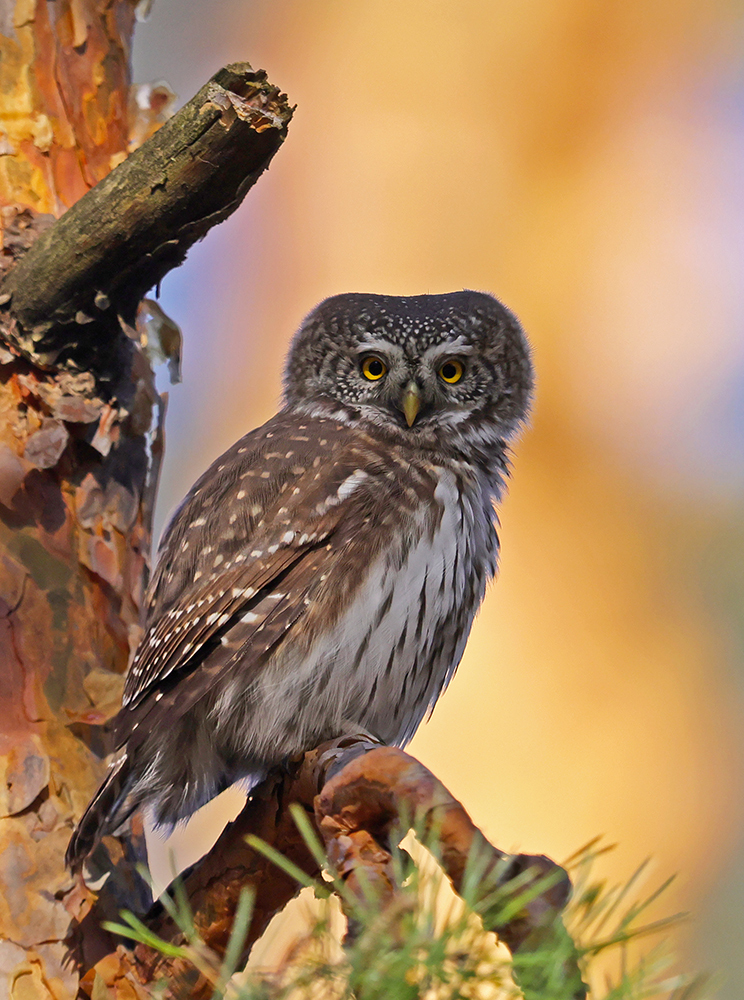
The Eurasian pygmy owl (Glaucidium passerinum) is the smallest owl in Europe. It is dark reddish to greyish-brown, with spotted sides and half of a white ring around the back of the neck. This species is found in the boreal forests of Northern and Central Europe to Siberia.
This is a sedentary species, meaning that adults are resident throughout the year in its range. The exception may be during harsh winters, when the adults may move south. Young of the species usually move in autumn or winter.
From the article Eurasian pygmy owl on Wikipedia (CC BY-SA), quoted section by section
Description
The Eurasian pygmy owl is usually red-tinged to a greyish-brown with dots on its back. The tail is generally darker than the body with five narrow, whitish bars. It has a small, short head with white to grey eyebrows and yellow eyes. It lacks the ear tufts that many other owls have. There is a white half-collar on the back of the neck. The belly is mostly white with brown speckles. The beak is a greyish-yellow and hook-shaped. In order to be able to carry larger vertebrate prey, it has evolved disproportionately large feet. The legs and toes are a brownish-yellow with black talons. Females are 17.4 to 19 cm (6.9 to 7.5 in) long, and males are generally smaller, measuring 15.2 to 17 cm (6.0 to 6.7 in) in length. Females are about 67 to 77 g (2.4 to 2.7 oz), and males are 50 to 65 g (1.8 to 2.3 oz) in weight.
Vocalisation. The call of the Eurasian pygmy owl is much higher in pitch than what is generally perceived as a normal owl "hoot". The call of the male is a monotonous chain of clear, fluted notes spaced by about two seconds. The call of the female is similar, but higher in pitch. Before and after the mating season, both males and females make a five to seven note rise on the pitch scale.
Range & habitat
This owl can be found primarily in coniferous forests of the taiga and higher mountainous regions with coniferous and mixed forests. These areas generally have cooler temperatures and higher rainfall than nearby lowland regions. The owl usually lives along the edges of clearings surrounded by moist or swampy land, generally with a water source nearby. It nests in old woodpecker holes, often those of the great spotted woodpecker.
Wikipedia: “Distribution and habitat”
What it does
This owl is crepuscular, being active during the daylight hours near sunrise and sunset.
Breeding. This owl nests in tree cavities, often in old woodpecker holes, and readily accepts artificial hollows made from logs and rectangular nest boxes. It shows a strong preference for deep cavities (15 – 30 cm depth) that offer protection from predators, with a front wall thickness of more than 5 cm and a prolonged entrance hole of 45 mm width. Nest boxes that do not have such a sufficiently thick front wall are seldom used for breeding and instead function as food storage. It prefers conifers but will occupy birches and beeches. Pairs form in autumn through early spring. During courtship the male leads the female through his territory. If he has obtained a nest hole, he leads her to it. The male will also feed the female. This species is serially monogamous, forming bonded pairs for one or more breeding seasons. The male is territorial and may use the same nesting territory for up to seven years. The female lays about four to seven eggs, generally in April. They are incubated for four weeks, starting when the third egg is laid. They hatch nearly simultaneously and the female remains with them for nine to ten days, being fed by the male. After three weeks the young are active and the female returns to the nest only to feed them and clean out waste. Fledging occurs at 30 to 34 days. …
Wikipedia: “Behaviour and ecology”
Listen
Looking for field recordings…
Where it lives
Recorded sightings
—
geo-referenced records in GBIF, from museums, herbaria and field observers.
Drag the globe to turn it. Dots are where records exist, not a range map; darker means more records.
In the stacks
Searching the stacks…
Every page naming Glaucidium passerinum in the Biodiversity Heritage Library →
This page is assembled live from iNaturalist, GBIF, Wikipedia, the Source Library and the Internet Archive. It is not yet part of the hand-edited codex. iNaturalist taxon 19848.