- Animals
- ›Chordates
- ›Vertebrates
- ›Birds
- ›Cuckoos
- ›Cuckoos
- ›Typical Cuckoos, Malkohas, and allies
- ›Phaenicophaeus
On eBird ↗
Red-faced Malkoha
Live sightings near you, the range map, bar charts of when it is seen, and Macaulay Library photos and recordings.
Red-faced Malkoha
Phaenicophaeus pyrrhocephalus
The red-faced malkoha (Phaenicophaeus pyrrhocephalus) is a member of the cuckoo order of birds, the Cuculiformes. This malkoha species is endemic to Sri Lanka
From the article Red-faced malkoha on Wikipedia (CC BY-SA), quoted section by section
Description
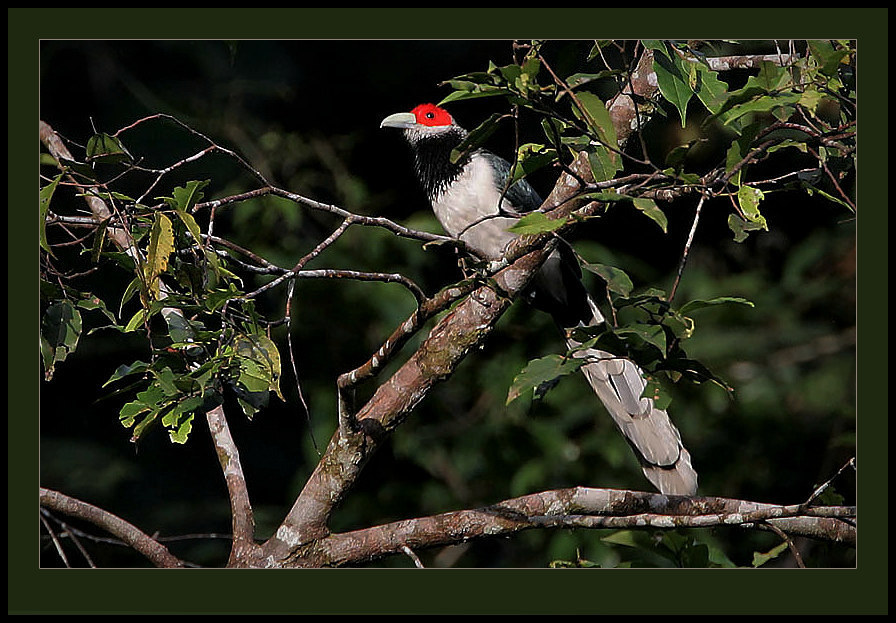
This is a large species at 46 cm (18 in) with a long graduated tail. Its back is dark green, and the uppertail is green edged with white. The belly and undertail are white, the latter being barred black. The crown and throat are black, and the lower face white. There is a large red patch around the eye and the bill is green. Sexual dimorphism present where males having dark brown iris and females are creamy white. Juveniles are with much duller plumage. The red-faced malkoha takes a variety of insects including caterpillars, giant stick insects, mantises and small vertebrates such as lizard. It occasionally may eat berries but this needs confirmation. Unlike most cuckoos, this is a quiet species, making only the odd soft grunt.
Range & habitat
It is endemic to Sri Lanka although some old records have apparently erroneously referred to its presence in southern India. According to Baker (1934), it is found in the 'South of Travancore, where it was obtained by Stewart together with its nests'. Later, Biddulph reported a red-faced malkoha in Madurai district, southern Tamil Nadu. Thilo Hoffmann later pointed out that this record would not stand up to a modern records committee, and it is now best disregarded. The presence of red-faced malkoha in the island is largely confined to the Sinharaja Forest Reserve and the surrounding vegetation, which is one of the biodiversity hotspots in the world.
Wikipedia: “Distribution”
What it does
They are found in nearly half of the mixed-species foraging flocks in the Sinharaja area. Most of the individuals of Red-faced Malkohas which participate in the mixed-species bird flocks tend to prefer in the front of the flock. There is a high probability to see this cryptic bird in the flock if you observe the front half of the flock.
Wikipedia: “Behaviour”
In human culture
The common name for this species malkoha is derived from the Sinhala vernacular name. 'Mal-Koha' translates to 'flower-cuckoo'. The red-faced malkoha appears on a 5 rupee Sri Lankan postal stamp.
Wikipedia: “In culture”
Listen
Looking for field recordings…
Where it lives
Recorded sightings
—
geo-referenced records in GBIF, from museums, herbaria and field observers.
Drag the globe to turn it. Dots are where records exist, not a range map; darker means more records.
In the stacks
This page is assembled live from iNaturalist, GBIF, Wikipedia, the Source Library and the Internet Archive. It is not yet part of the hand-edited codex. iNaturalist taxon 1984.