On eBird ↗
Asian Barred Owlet
Live sightings near you, the range map, bar charts of when it is seen, and Macaulay Library photos and recordings.
Asian Barred Owlet
Glaucidium cuculoides
The Asian barred owlet (Glaucidium cuculoides), also known as the cuckoo owlet, is a species of pygmy owl native to the forests and shrublands of mainland Southeast Asia to the foothills of the Himalayas of northern Pakistan. It is a smaller owl, measuring 22–25 cm (8.7–9.8 in), making it one of the larger pygmy owls. They are primarily insectivorous but will eat lizards, small rodents and birds as well.
From the article Asian barred owlet on Wikipedia (CC BY-SA), quoted section by section
Description
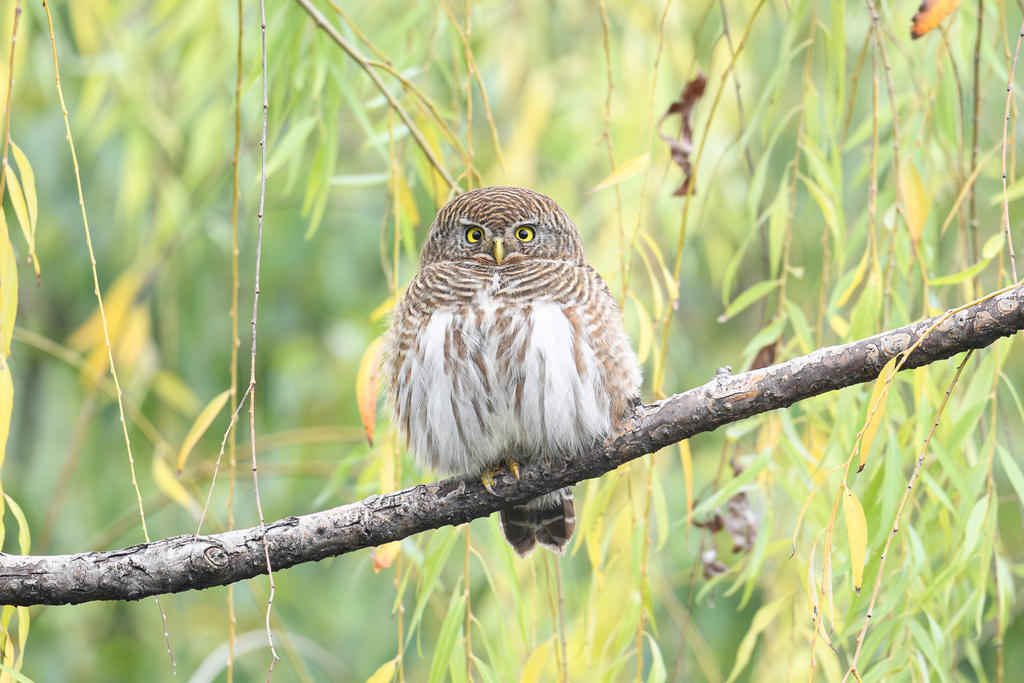
The Asian barred owlet is a small owl that sits at 22–25 cm (8.7–9.8 in). The males weigh 150–176 g (0.331–0.388 lb) and the females up to 240 g (0.53 lb). Like most owls in the true owl family, the females are usually larger than the males. They are dark brown or olive-brown with a white throat patch and are densely barred. Their breast and belly is whitish in colour with dark brown bars. Its tail and wings are dark brown with whitish bars. Unlike other pygmy owl species, they do not have false eyes on the back of their head. The juveniles have a streaked breast, not barred, and their head is a more ruddy brown colour. They are similar in appearance to the Javan owlet and collared owlet. The Asian barred owlet is mainly diurnal and will perch on bare branches to hunt freely throughout the day. Being more active during the day, they can often be mobbed by smaller birds and will sit still during the mobbing. Similar to other owlets, they have an undulating flight pattern, a series of rapid flaps then a pause with closed wings.
Range & habitat
Asian barred owlets are commonly found in woodland habitats such as forests of pine and oak, subtropical and tropical evergreen jungles at lower elevations. They can also be found in foothills to submontane regions 2,100 m (6,900 ft) in elevation. The highest recorded sighting was at 2,700 m (8,900 ft) in the Himalayas of north Pakistan. They also sometimes live around developed areas in gardens and parks. Asian barred owlets have also displayed a preference for secondary forests over primary forests in parts of their range. Asian barred owlets are widespread in the mainland of southeast Asia. They can be found in southeast China, Bhutan, Myanmar, Laos, Vietnam, Thailand, Nepal, Bangladesh, northeast India and the foothills of the Himalayas into Pakistan.
Wikipedia: “Habitat and distribution”
What it does
Their diet mainly consists of insects, such as beetles, grasshoppers and cicadas. They will also eat lizards, small rodents, such as mice, and small birds. They hunt from a perch and will catch birds in the air. They have been observed catching common quail (Coturnix coturnix) in flight, snatching them from the air if they fly past.
Wikipedia: “Diet”
Listen
Looking for field recordings…
Where it lives
Recorded sightings
—
geo-referenced records in GBIF, from museums, herbaria and field observers.
Drag the globe to turn it. Dots are where records exist, not a range map; darker means more records.
In the stacks
Searching the stacks…
Every page naming Glaucidium cuculoides in the Biodiversity Heritage Library →
This page is assembled live from iNaturalist, GBIF, Wikipedia, the Source Library and the Internet Archive. It is not yet part of the hand-edited codex. iNaturalist taxon 19839.