On eBird ↗
Ferruginous Pygmy-Owl
Live sightings near you, the range map, bar charts of when it is seen, and Macaulay Library photos and recordings.
Ferruginous Pygmy-Owl
Glaucidium brasilianum
The ferruginous pygmy owl (Glaucidium brasilianum) is a species of small owl found in the southwestern United States, extending south through Mexico, Central America, and into South America, including countries like Brazil, Bolivia, Paraguay and Argentina.
It is the most widely distributed species of pygmy owl in Central and South America and is believed to be one of the most common owls in these regions, where it lives in a variety of semi-open wooded habitats.
From the article Ferruginous pygmy owl on Wikipedia (CC BY-SA), quoted section by section
Description
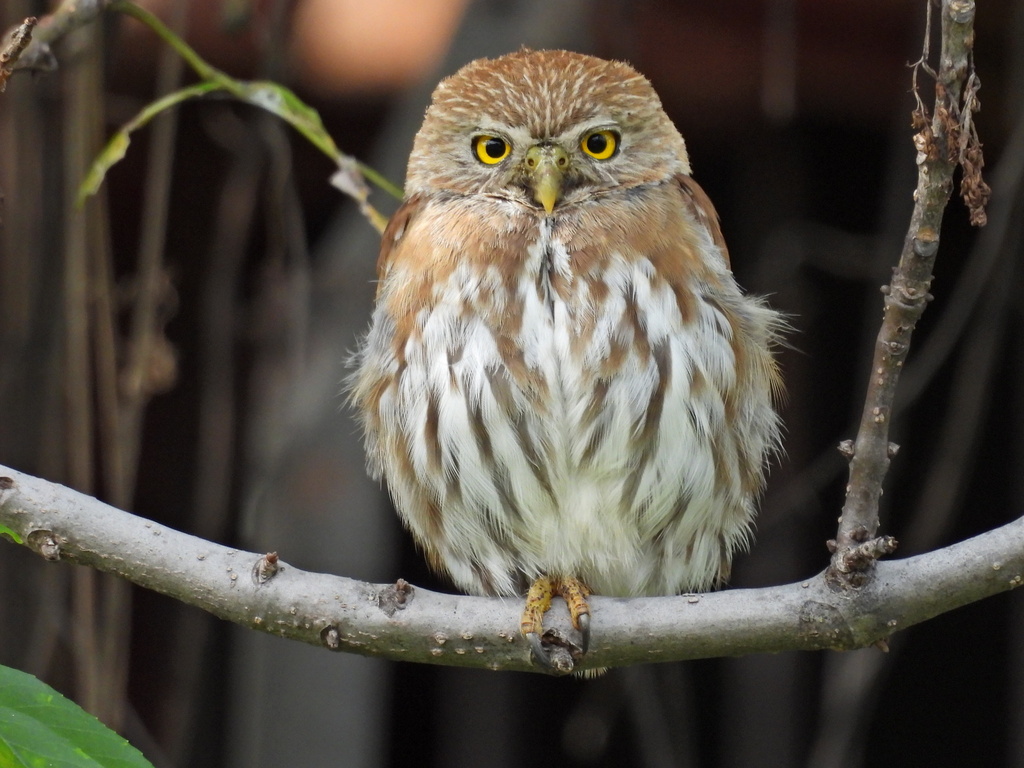
The ferruginous pygmy owl is small, typically 15 cm (5.9 in), and stocky with disproportionately large feet and talons. The crown has elongated white/buff streaks, the wing coverts have white spots, and the underparts are heavily streaked white. There are prominent white supercilia above the facial disc. There are two dark spots on the nape, often termed "false eyes" by birders. Otherwise, its overall color is highly variable, ranging from grey-brown with a black-and-white barred tail to rich rufous with a uniform rufous tail. Sexes are similar with females slightly larger and often more reddish. The flight is often undulating in motion, similar to that of many woodpecker species.
Call. The call is a rhythmic, whistled series of hoo-hoo-hoo-hoo, typically pitched in E flat. Its sound is easily mimicked by birdwatchers to draw out small songbirds intent on mobbing the owls.
What it does
The owl is often easily located by the activity of small songbirds that gather to mob it while it perches in the canopy. Observations have recorded up to 40 individual birds representing 11 species mobbing a single ferruginous pygmy owl.
Food and feeding. This species is primarily crepuscular, though it frequently hunts during daylight hours. Its diet consists of a wide range of invertebrates, reptiles, amphibians, birds and mammals. Documented prey includes insects such as grasshoppers, crickets, cicadas and scorpions. It also targets small reptiles like six-lined racerunners, four-lined skinks, Texas spotted whiptails, alongside birds including creamy-bellied thrushes, pale-breasted thrushes and eared doves.
Breeding. The breeding season occurs from late winter to early spring. As a cavity nesting species, it utilizes hollows in trees and columnar cacti to lay one to seven white eggs. Incubation lasts approximately 28 days, followed by a fledging period of 27 to 30 days.
Wikipedia: “Behavior and ecology”
Listen
Looking for field recordings…
Where it lives
Recorded sightings
—
geo-referenced records in GBIF, from museums, herbaria and field observers.
Drag the globe to turn it. Dots are where records exist, not a range map; darker means more records.
In the stacks
Searching the stacks…
Every page naming Glaucidium brasilianum in the Biodiversity Heritage Library →
This page is assembled live from iNaturalist, GBIF, Wikipedia, the Source Library and the Internet Archive. It is not yet part of the hand-edited codex. iNaturalist taxon 19822.