On eBird ↗
Cloud-forest Pygmy-Owl
Live sightings near you, the range map, bar charts of when it is seen, and Macaulay Library photos and recordings.
Cloud-forest Pygmy-Owl
Glaucidium nubicola
The cloud-forest pygmy owl or cloudforest pygmy owl (Glaucidium nubicola) is a short, muscular, small-sized species of owl found throughout the Andes of western Colombia and north-western Ecuador, being confined to cloud forests between 900–2000 m a.s.l. Below this altitudinal range the Central American pygmy owl (Glaucidium griseiceps) occurs; above it, the Andean pygmy owl (Glaucidium jardinii) occurs.
Its epithet nubicola is Latin for "cloud-inhabiting", because this species is restricted to very humid cloud forests.
From the article Cloud-forest pygmy owl on Wikipedia (CC BY-SA), quoted section by section
Description
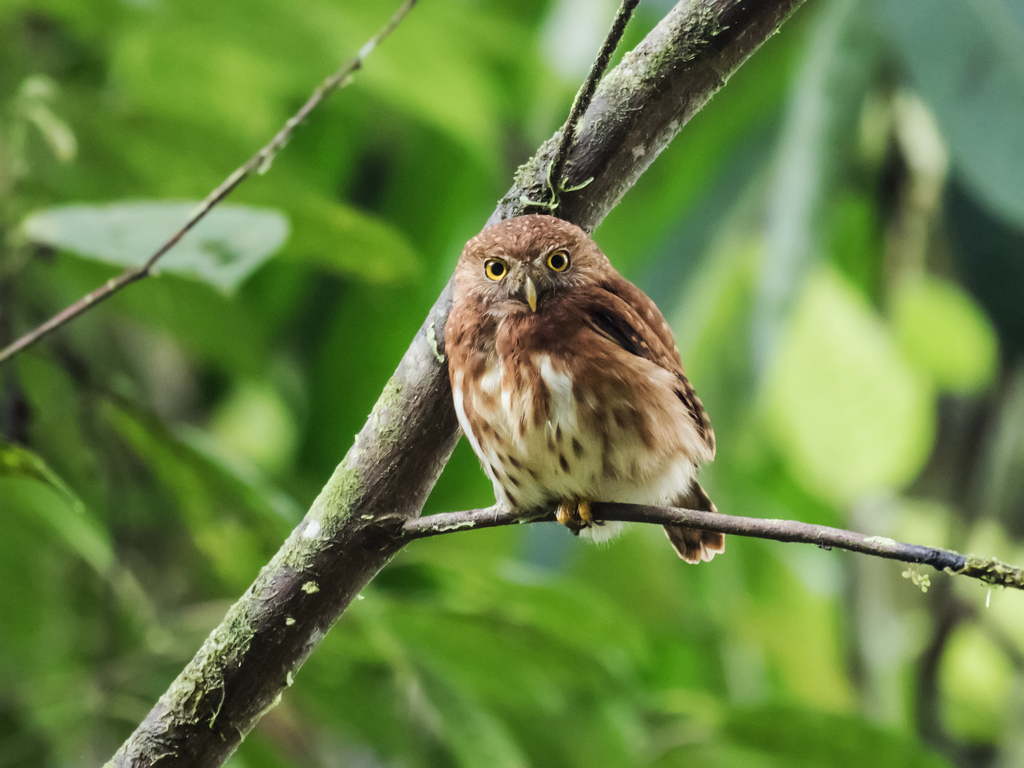
The cloud-forest pygmy owl is a small owl, 14.5 –16 cm (5.7–6.3 in) in length with a 92.8–96.3 cm (3.7–3.8 in) wingspan. Weight can range from 75.6 to 79.3 g (2.7 to 2.8 oz). The male and female have similar markings and plumage, but as in many birds of prey this pygmy owl may display sexual dimorphism in size, with the female being more than 3% larger and more than 3% heavier than the male. The standard linear measurements are: the tail measures 46.8 mm (1.8 in) and the bill (from cere to tip) measures 11.3 mm (0.4 in). (Note that all these measurements come from only three males and one female of Glaucidium nubicola.) This presumed sexual dimorphism is referred to as reversed sexual dimorphism (RSD). The cloud-forest pygmy owl has the typical Neotropical pygmy owl appearance. It is dark brown overall, but there are some individuals with a more rufous-brown wash. Its back, scapulars, upperwing-coverts are darker and its rump is washed dark rufous-brown and spotted white. It has whitish spots on primaries and secondaries which form an indistinct band. Its tail is blackish with five incomplete white bands. The chin, sides of throat and upper chest are white, while sides of the chest are rufous-brown. It has inconspicuous white spots on breast and more distinct streaks on lower underparts. Its rounded head lacks ear tufts. …
Range & habitat
The cloud-forest pygmy owl is endemic to the Andean portion of the Chocó biogeographic region. Its range extends from Alto de Pisones in Risaralda (Colombia) in the north, to northern Cotopaxi (Ecuador) in the south; with an apparently isolated population in south-west El Oro (Ecuador). This population represents the lower elevation limit for the species (900 m a.s.l.) and its most southerly record up to now. Juan F. Freile and Diego F. Castro have proposed that current distribution of the cloud-forest pygmy owl is continuous from northern to southern Cotopaxi, and along the Pacific slope in Azuay, El Oro and Loja. This potential distribution comprises roughly 2570 km2. This pygmy owl inhabits primary or slightly altered cloud forests in mountainous regions of high rainfall and steep slopes. It is not actually restricted to primary forests, and is at least capable of persisting in altered habitats. Its habitat can be of difficult access for humans, but can also be prone to natural fragmentation. Thus, like other species that are tied to cloud forest, it is known only from a very small range. It is found in low densities in the canopy and middle stratum of forest. Nevertheless, it can descend into the understory for feeding.
Wikipedia: “Distribution and habitat”
What it does
In common with other species of pygmy owls, this species is quite diurnal, and consumes both invertebrates and small vertebrates. Nevertheless, owing to its small size and retiring habits — generally being perched in dense evergreen trees — it is not often noticed.
Breeding. The cloud-forest pygmy owl breeds principally between February and June. This fact allows it to have chicks leaving the nest when there are large quantities of prey in the form of small birds' fledglings. In August 1999 a recently fledged juvenile of cloud-forest pygmy owl was reported in Tandayapa (Ecuador), suggesting that nesting takes place at least until August. This pygmy owl typically nests in a hole in a tree, but will also use old woodpecker cavities.
Feeding. The cloud-forest pygmy owl is an ambush predator, hunting its prey almost entirely during the daytime, probably watching from a perch before dropping or gliding down on its victim. This hunting style is also known as "sit-and-wait" or "perch-and-pounce", and is used by many owl species that live in forested habitats. This species takes a wide range of prey, mainly insects like grasshoppers, crickets, cicadas or bugs; but also small vertebrates like birds and lizards. Species of Glaucidium feed on reptiles to a greater degree than any other strigids. Flight is the main form of locomotion used during foraging. …
Wikipedia: “Behavior and ecology”
Listen
Looking for field recordings…
Where it lives
Recorded sightings
—
geo-referenced records in GBIF, from museums, herbaria and field observers.
Drag the globe to turn it. Dots are where records exist, not a range map; darker means more records.
In the stacks
Searching the stacks…
Every page naming Glaucidium nubicola in the Biodiversity Heritage Library →
This page is assembled live from iNaturalist, GBIF, Wikipedia, the Source Library and the Internet Archive. It is not yet part of the hand-edited codex. iNaturalist taxon 19808.