On eBird ↗
Costa Rican Pygmy-Owl
Live sightings near you, the range map, bar charts of when it is seen, and Macaulay Library photos and recordings.
Costa Rican Pygmy-Owl
Glaucidium costaricanum
The Costa Rican pygmy owl (Glaucidium costaricanum) is a small "typical owl" in subfamily Surniinae. It is found in Costa Rica and Panama.
From the article Costa Rican pygmy owl on Wikipedia (CC BY-SA), quoted section by section
Description
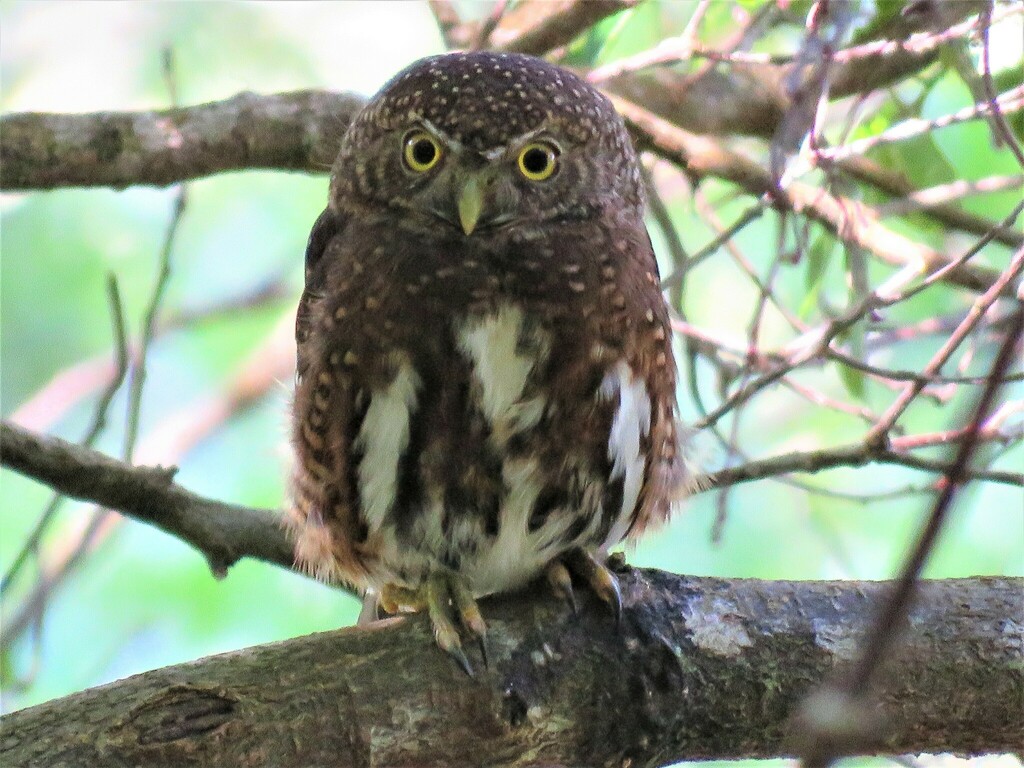
The Costa Rican pygmy owl is around 14.5 to 17 cm (5.7 to 6.7 in) long, with males weighing about 53 to 70 g (1.9 to 2.5 oz), while the larger females weigh as much as 99 g (3.5 oz). Adults have two color morphs; one is mostly brown and the other is rufous. The head and upper body parts are a basal color with lighter, paler spots; the tail is the same color, with four white bands and a white tip. The nape has a pair of blackish spots with pale borders that resemble "eyes" on the back of the head. The breast and belly are white and the flanks are the basal color. The facial disc is the basal color, with narrow buff and white marks, while the eyes and feet are yellow, the maxilla greenish yellow, and the mandible is a light brown with a yellow tip.
Range & habitat
The Costa Rican pygmy owl is typically found, at some elevation, within the Cordillera Central and Cordillera de Talamanca of Costa Rica, and (patchily) into western Panama, where it inhabits the canopy and edges of humid montane oak and evergreen forests. In its native Costa Rica, the species ranges from about 900 to 3,000 m (3,000 to 9,800 ft) above sea level, on the Caribbean slope, and from 1,200 to 3,000 m (3,900 to 9,800 ft) on the Pacific slope.
Wikipedia: “Distribution and habitat”
What it does
The Costa Rican pygmy owl forages both day and night. It hunts from a low perch in dense foliage and takes prey in "a short, swift dash". If the target is missed, the bird typically returns to the perch rather than pursuing. Its diet has not been defined in detail but is known to include birds, small mammals and other vertebrates, and large arthropods. Like other pygmy owls, they swish their tails from side to side when agitated.
Wikipedia: “Feeding”
Listen
Looking for field recordings…
Where it lives
Recorded sightings
—
geo-referenced records in GBIF, from museums, herbaria and field observers.
Drag the globe to turn it. Dots are where records exist, not a range map; darker means more records.
In the stacks
Searching the stacks…
Every page naming Glaucidium costaricanum in the Biodiversity Heritage Library →
This page is assembled live from iNaturalist, GBIF, Wikipedia, the Source Library and the Internet Archive. It is not yet part of the hand-edited codex. iNaturalist taxon 19806.