On eBird ↗
Eastern Screech-Owl
Live sightings near you, the range map, bar charts of when it is seen, and Macaulay Library photos and recordings.
Eastern Screech-Owl
Megascops asio
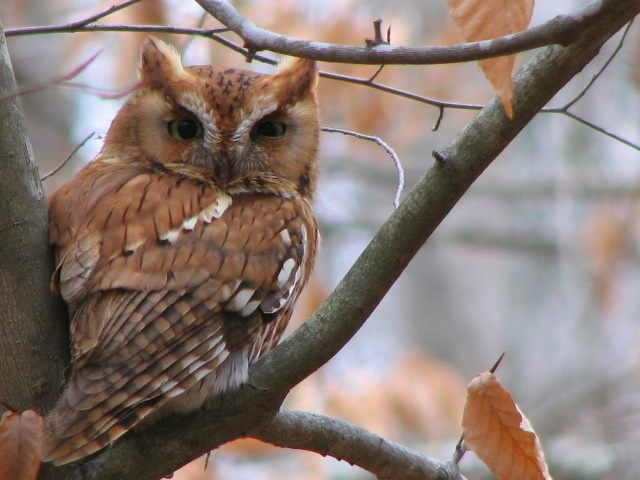
The eastern screech owl (Megascops asio) or eastern screech-owl is a stocky, short-tailed owl that is relatively common in Eastern North America, from Mexico to Canada. Mid-sized for a screech owl, the species resides in most types of woodland habitats across its range and is relatively adaptable to urban and developed areas compared to other owls. Although it often lives in close proximity to humans, the eastern screech owl frequently avoids detection due to its strictly nocturnal habits.
From the article Eastern screech owl on Wikipedia (CC BY-SA), quoted section by section
Description
Adults range from 16 to 25 cm (6+1⁄2 to 10 in) in length and weigh 121–244 g (4+1⁄4–8+5⁄8 oz). Among the differently sized races, length can average from 19.5 to 23.8 cm (7+11⁄16 to 9+3⁄8 in). The wingspan can range from 46 to 61 cm (18 to 24 in). In Ohio, male owls average 166 g (5+7⁄8 oz) and females 194 g (6+7⁄8 oz) while in central Texas, they average 157 g (5+1⁄2 oz) and 185 g (6+1⁄2 oz), respectively. They have either rusty or dark gray intricately patterned plumage with streaking on the underparts. Midsized by screech owl standards, these birds are stocky, short-tailed (tail averages from 6.6 to 8.6 cm (2+5⁄8 to 3+3⁄8 in) in length) and broad-winged (wing chord averages from 14.5 to 17 cm (5+3⁄4 to 6+3⁄4 in) in length) as is typical of the genus. They have a large, round head with prominent ear tufts, yellow eyes, and a yellowish beak, which measures on average 1.45 cm (9⁄16 in) in length. The feet are relatively large and powerful compared to more southern screech owls and are typically feathered down to the toes, although the southernmost populations only have remnant bristles rather than full feathering on the legs and feet. …
Range & habitat
Eastern screech owls inhabit open mixed woodlands, deciduous forests, parklands, wooded suburban areas, riparian woods along streams and wetlands (especially in drier areas), mature orchards, and woodlands near marshes, meadows, and fields. They try to avoid areas known to have regular activity of larger owls, especially great horned owls (Bubo virginianus). Their ability to live in heavily developed areas outranks even the great horned and certainly the barred owl (Strix varia); screech owls also are considerably more successful in the face of urbanization than American barn owls (Tyto furcata) following the conversion of what was once farmland. Due to the introduction of open woodland and cultivated strips in the Great Plains, the range of eastern screech owls there has expanded. Eastern screech owls have been reported living and nesting in spots such as along the border of a busy highway and on the top of a street light in the middle of a busy town square. They often nest in trees in neighborhoods and urban yards inhabited by humans. In such urban environments, they often meet their dietary needs via introduced species that live close to humans such as house sparrows (Passer domesticus) and house mice (Mus musculus). They also consume anole lizards and large insects such as cicadas. They occupy the greatest range of habitats of any owl east of the Rockies. …
Wikipedia: “Distribution and habitat”
What it does
Eastern screech owls are strictly nocturnal, roosting during the day in cavities or next to tree trunks. They are quite common and can often be found in residential areas. Due to their small size and camouflage, though, they are much more frequently heard than actually seen. These owls are frequently heard calling at night, especially during their spring breeding season. Despite their name, these owls do not truly screech. The eastern screech owl's call is a tremolo with a descending, whinny-like quality, like that of a miniature horse. They also produce a monotone purring trill lasting 3–5 seconds. Their voices are unmistakable and follow a noticeably different phrasing than that of the western screech owl.
Breeding. Their breeding habitat is deciduous or mixed woods in eastern North America. Usually solitary, they nest in a tree cavity, either natural or excavated by a woodpecker. Holes must have a 7 to 20 cm (3 to 8 in) entrance to accommodate this owl. Usually, they fit only in the holes excavated by northern flickers (Colaptes auratus) or pileated woodpeckers (Dryocopus pileatus), as apparently the midsized red-bellied woodpecker (Melanerpes carolinensis) make holes that are not large enough to accommodate them. …
Wikipedia: “Behavior”
Listen
Looking for field recordings…
Where it lives
Recorded sightings
—
geo-referenced records in GBIF, from museums, herbaria and field observers.
Drag the globe to turn it. Dots are where records exist, not a range map; darker means more records.
In the stacks
Searching the stacks…
Every page naming Megascops asio in the Biodiversity Heritage Library →
This page is assembled live from iNaturalist, GBIF, Wikipedia, the Source Library and the Internet Archive. It is not yet part of the hand-edited codex. iNaturalist taxon 19765.