On eBird ↗
Balsas Screech-Owl
Live sightings near you, the range map, bar charts of when it is seen, and Macaulay Library photos and recordings.
Balsas Screech-Owl
Megascops seductus
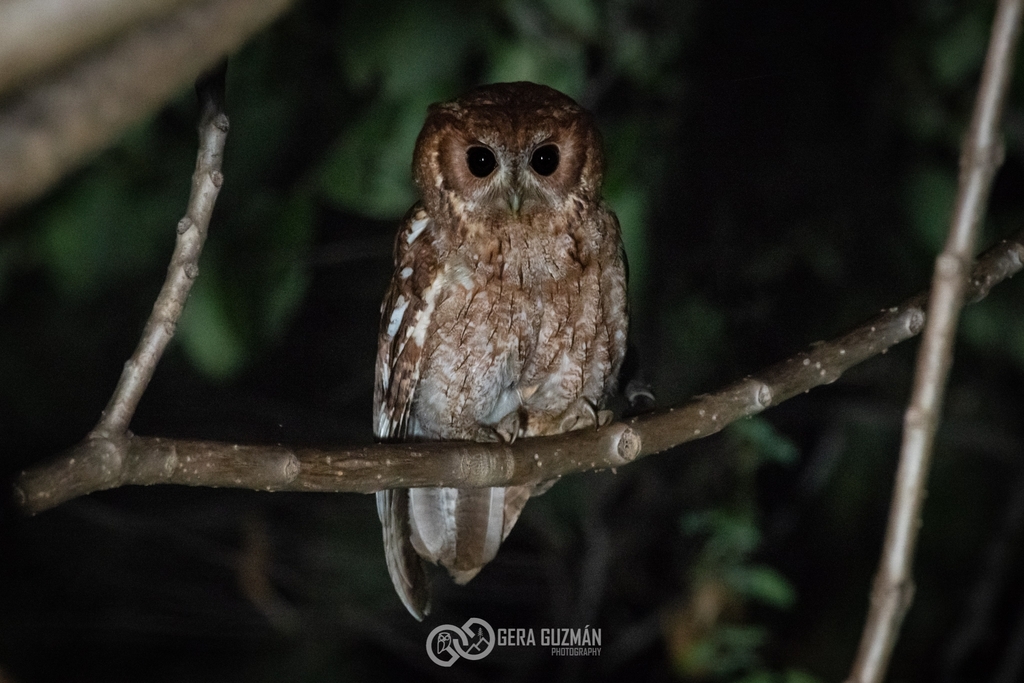
The Balsas screech owl (Megascops seductus) is a species of owl in the family Strigidae. It is endemic to Mexico.
From the article Balsas screech owl on Wikipedia (CC BY-SA), quoted section by section
Description
The Balsas screech owl is among the larger members of genus Megascops; it is 24 to 27 cm (9.4 to 10.6 in) long and weighs between 150 and 174 g (5.3 and 6.1 oz). Its facial disc is grayish brown with brownish markings and a darker border. Its "ear" tufts are short. The crown and upperparts are also grayish brown; the crown has darker streaks and the upperparts have a pinkish blush and dark streaks and other marks. The closed wing shows two bands of whitish spots. The underparts are paler than the upperparts and have narrow dark streaks and faint vermiculation.
Range & habitat
The Balsas screech owl is endemic to interior southwestern Mexico. Its range is centered on the valley of the Balsas River from southern Jalisco southeast into central Guerrero. It inhabits arid open and semi-open areas such as deciduous woodland with cactus, thorn forest, and secondary forest. It can also be found in tropical scrublands and the edges of cultivated areas. In elevation it ranges from 600 to 1,500 m (2,000 to 4,900 ft).
Wikipedia: “Distribution and habitat”
What it does
Like most other screech owls, the Basas screech owl is nocturnal. Its hunting methods have not been described, but its diet apparently includes insects, other arthropods, and small vertebrates.
Wikipedia: “Feeding”
Listen
Looking for field recordings…
Where it lives
Recorded sightings
—
geo-referenced records in GBIF, from museums, herbaria and field observers.
Drag the globe to turn it. Dots are where records exist, not a range map; darker means more records.
In the stacks
Searching the stacks…
Every page naming Megascops seductus in the Biodiversity Heritage Library →
This page is assembled live from iNaturalist, GBIF, Wikipedia, the Source Library and the Internet Archive. It is not yet part of the hand-edited codex. iNaturalist taxon 19739.