On eBird ↗
Greater Ani
Live sightings near you, the range map, bar charts of when it is seen, and Macaulay Library photos and recordings.
Greater Ani
Crotophaga major
The greater ani (Crotophaga major) is a large bird in the cuckoo family. It is a breeding species from Panama and Trinidad through tropical South America to northern Argentina. It is sometimes referred to as the black cuckoo.
From the article Greater ani on Wikipedia (CC BY-SA), quoted section by section
Description
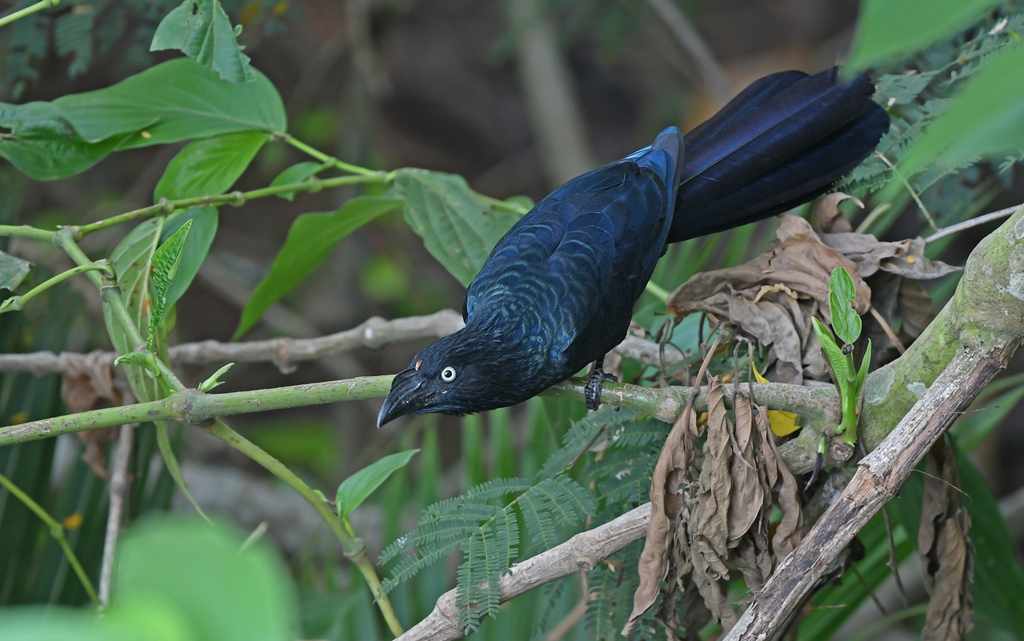
The greater ani is about 46 cm (18 in) in length. Males weigh around 162 g (5.7 oz), females 145 g (5.1 oz). The adult is mainly blue-glossed black, with a long tail, massive ridged black bill, and a white iris. Immature birds have a brown iris. The calls include croaking and turkey-like gobbling kro-koro.
Range & habitat
This ani is a breeding species from Panama and Trinidad through tropical South America to northern Argentina. It is found in mangrove swamps, semi-open woodland near water, and the edges of forests. It is a seasonal migrant in at least some parts of its range.
Wikipedia: “Distribution and habitat”
What it does
The greater ani feeds on large insects (such as beetles, grasshoppers and caterpillars) and even spiders, lizards, frogs, fruits, berries and Euphorbia seeds.
Wikipedia: “Feeding”
Listen
Looking for field recordings…
Where it lives
Recorded sightings
—
geo-referenced records in GBIF, from museums, herbaria and field observers.
Drag the globe to turn it. Dots are where records exist, not a range map; darker means more records.
In the stacks
Searching the stacks…
Every page naming Crotophaga major in the Biodiversity Heritage Library →
This page is assembled live from iNaturalist, GBIF, Wikipedia, the Source Library and the Internet Archive. It is not yet part of the hand-edited codex. iNaturalist taxon 1970.