On eBird ↗
Hodgson's Frogmouth
Live sightings near you, the range map, bar charts of when it is seen, and Macaulay Library photos and recordings.
Hodgson's Frogmouth
Batrachostomus hodgsoni
Hodgson's frogmouth (Batrachostomus hodgsoni) is a species of bird in the family Podargidae. It is found in Bangladesh, Bhutan, China, India, Laos, Myanmar, Thailand, Cambodia and Vietnam. Its natural habitat is temperate forests.
The common name is thought to commemorate the British naturalist Brian Houghton Hodgson.
From the article Hodgson's frogmouth on Wikipedia (CC BY-SA), quoted section by section
Description
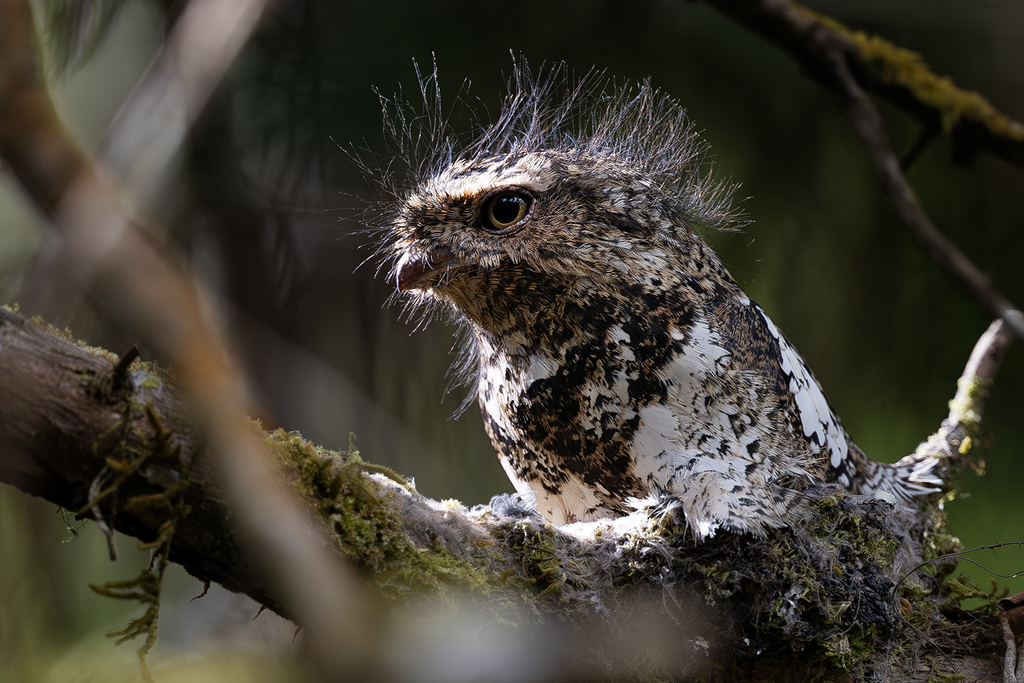
Hodgson's frogmouth is one of the smaller members of the family Podargidae. As an adult, its length ranges between 24.5 and 27.5 centimetres (9.6 and 10.8 in) and it weighs approximately 50 grams (1.8 oz). The plumage is mottled brown and gray, soft and cryptic, resembling tree bark. The physical appearance differs from other species by a heavier black marking above breast as well as no rufous on breast. Hodgson's frogmouth is the most well-marked sexual dichromatic of all frogmouths. The male is rufous brown. Upper parts are heavily marked with black, especially on the head, with irregular bold whitish markings particularly on scapular and upper mantle which forms a white collar. Underparts are heavily and regularly marked with black, white and rufous. The female is more uniformly rufous, with irregular black-tipped white spots on the upper mantle, scapular and underparts. Males are duller in color than females. Frogmouths are distinguishable by their large head and body compared to their small legs and feet. This feature blocks them from walking and make them exclusively arboreal. They have a thick large bill that takes the most part of their face and make them look like an angry old man. This strong bill is covered with rictal bristles at its base. The utility of the bristles on their face is much debated by biologists. …
Range & habitat
This arboreal species is an adept of broad leaves of evergreen or mixed coniferous tropical rain forests inside of which it will be found mainly on the middle and lower storeys. It is found in tropical regions of Asia at altitudes ranging from 300–1,900 metres (980–6,230 ft). The Podargidae is a non-migratory bird family as well as solitary individuals, the only social interaction happens during the breeding season where the individuals all converge in the Indian region between the month of April and June. The home range of the Hodgson's frogmouth consists of all tropical regions of Asia. Those region corresponds to the South of Asia, this is why it has been heard or seen in Sri Lanka, SE Asia, Indonesia, E Himalayas, NE India, Bangladesh, Laos, W, N, E Myanmar, NW Thailand, Laos, and C Annam. The first Hodgson's frogmouth in central Laos was recorded in 1994 during the month of April in a dry evergreen forest at 1000 m of altitude. The two subspecies are separated geographically between the Southeast and Southwest of Asia. B. h. hodgsoni lives more west in countries like Myanmar, India, and Bangladesh while B. h. indochinae dominates the region more east like Indonesia, Thailand and Laos. Species from the other genus Podargus are also located in Australia but that is not the case of the Batrachostomus species.
Wikipedia: “Distribution habitat”
What it does
Hodgson's frogmouth survives on a mainly insectivorous diet. It includes most of the time moths, beetles and other large insects. The nocturnal active bird catches prey on short flights from its perches using shrike-like or roller-like hunting method. Because of its small rounded wings and tail, it is not capable of hawking for insects on the wing. The Asian bird also likes to look for insects inside trunks or living tree branches which it can easily dig with its large strong bill set with rictal bristles at the base of it allowing the bird to detect insects.
Wikipedia: “Diet”
Listen
Looking for field recordings…
Where it lives
Recorded sightings
—
geo-referenced records in GBIF, from museums, herbaria and field observers.
Drag the globe to turn it. Dots are where records exist, not a range map; darker means more records.
In the stacks
Searching the stacks…
Every page naming Batrachostomus hodgsoni in the Biodiversity Heritage Library →
This page is assembled live from iNaturalist, GBIF, Wikipedia, the Source Library and the Internet Archive. It is not yet part of the hand-edited codex. iNaturalist taxon 19688.