On eBird ↗
Pearly-breasted Cuckoo
Live sightings near you, the range map, bar charts of when it is seen, and Macaulay Library photos and recordings.
Pearly-breasted Cuckoo
Coccyzus euleri
The pearly-breasted cuckoo (Coccyzus euleri) is a species of cuckoo in the family Cuculidae. It is found in Argentina, Bolivia, Brazil, Colombia, Ecuador, French Guiana, Guyana, Paraguay, Suriname, Peru and Venezuela. Its natural habitats are subtropical or tropical moist lowland forests and heavily degraded former forest. It does not occur above an elevation of 2000 meters.
From the article Pearly-breasted cuckoo on Wikipedia (CC BY-SA), quoted section by section
Description
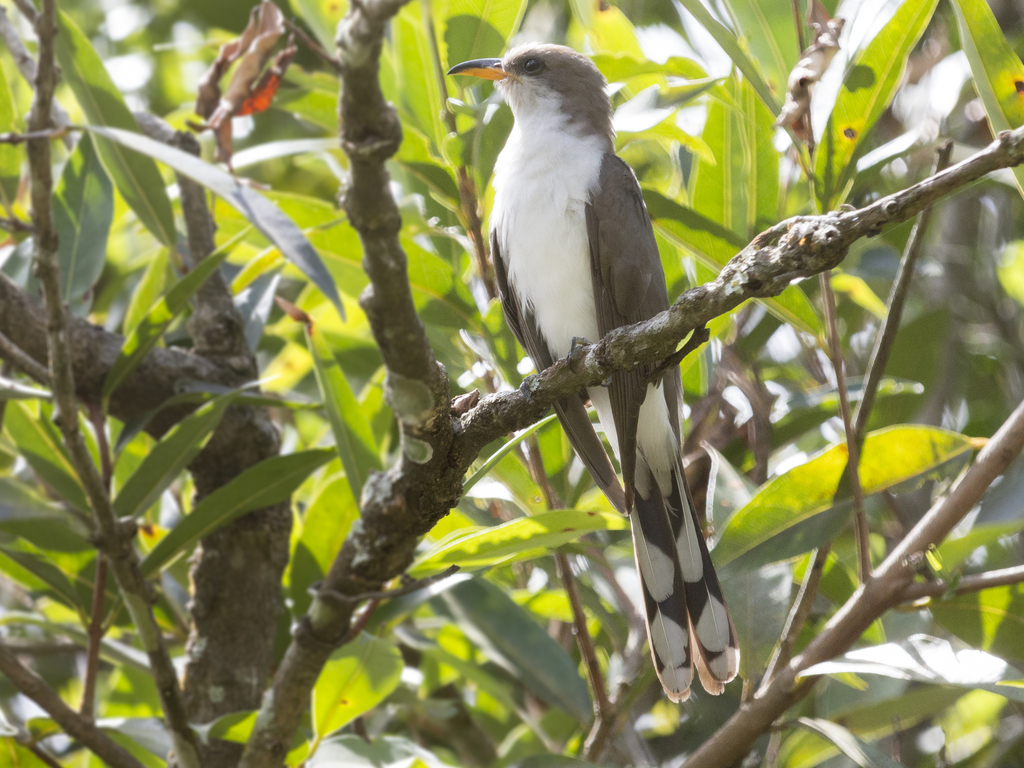
The pearly-breasted cuckoo is 25 to 28 cm (9.8 to 11 in) long, about half of which is the tail. Males weigh about 45 to 53 g (1.6 to 1.9 oz) and females about 54 to 61 g (1.9 to 2.2 oz). Their bill is stout and somewhat decurved. Its maxilla is brown to black with a yellow base and its mandible yellow to orange with a black tip. Males and females have the same plumage. Adults' upperparts are grayish brown with a light bronze gloss. Their wings are grayish brown with white on the primaries' inner webs. The upper surface of their tail is grayish brown; the underside of the central pair of feathers is brownish gray, the next pair blackish with narrow white spots on the tips, and the rest blackish with wide white spots on the tips. Their face has a wide dark gray "mask" past the eye, which is surrounded by a narrow ring of bare skin that is usually black but can be yellow or red. Their underparts are pearly grayish white from throat to breast, the belly white, and the undertail coverts light pearly gray. Juveniles are similar to adults but have fine pale edges on their wings, no facial mask, and only traces of white on the tail.
Range & habitat
The pearly-breasted cuckoo nests in Argentina, Brazil, French Guiana, Paraguay, and Venezuela, and is found in Bolivia, Ecuador, Guyana, and Suriname as a non-breeder. A sight record in Colombia leads the South American Classification Committee of the American Ornithological Society (AOS) to class it as hypothetical in that country. A record in Panama has apparently not been accepted by the North American Classification Committee of the AOS. The pearly-breasted cuckoo inhabits a very wide variety of landscapes, though most are wooded to some degree. Its principal breeding habitats are humid evergreen primary forest, gallery forest, and secondary forest. On much of its wintering grounds it is found in terra firme forest and other types with much Cecropia. On those grounds it can also be found in sandy-soil woodlands, scrublands, mangrove, cerrado, and semi-deciduous forest. The Columbia sighting was in a tropical dry forest and that in Panama in a secondary broadleaf forest. It elevation the species seldom exceeds 900 m (3,000 ft) but has been recorded as high as 1,200 m (3,900 ft).
Wikipedia: “Distribution and habitat”
What it does
The pearly-breasted cuckoo forages for its invertebrate prey from the forest mid-story to the canopy. It feeds primarily on caterpillars. It is usually solitary but sometimes joins mixed-species foraging flocks.
Wikipedia: “Feeding”
Listen
Looking for field recordings…
Where it lives
Recorded sightings
—
geo-referenced records in GBIF, from museums, herbaria and field observers.
Drag the globe to turn it. Dots are where records exist, not a range map; darker means more records.
In the stacks
Searching the stacks…
Every page naming Coccyzus euleri in the Biodiversity Heritage Library →
This page is assembled live from iNaturalist, GBIF, Wikipedia, the Source Library and the Internet Archive. It is not yet part of the hand-edited codex. iNaturalist taxon 1968.