 NL·0560
Herbarium of the Nature Library
- Name
- Nyctibius griseus
- Family
- Nyctibiidae
- Native to
- Southern Central America (Nicaragua and Costa Rica) through South America to northern Argentina and Uruguay; Trinidad and Tobago
- Habitat
- Tropical forest edge, Savanna woodland, Mangrove
On eBird ↗
Common Potoo
Live sightings near you, the range map, bar charts of when it is seen, and Macaulay Library photos and recordings.
Common potoo
Nyctibius griseus
Also calledUrutau (Guaraní / Portuguese) · Mãe-da-lua (Portuguese, 'mother of the moon') · Nictibio común (Spanish) · Poor-me-one (Trinidad English)
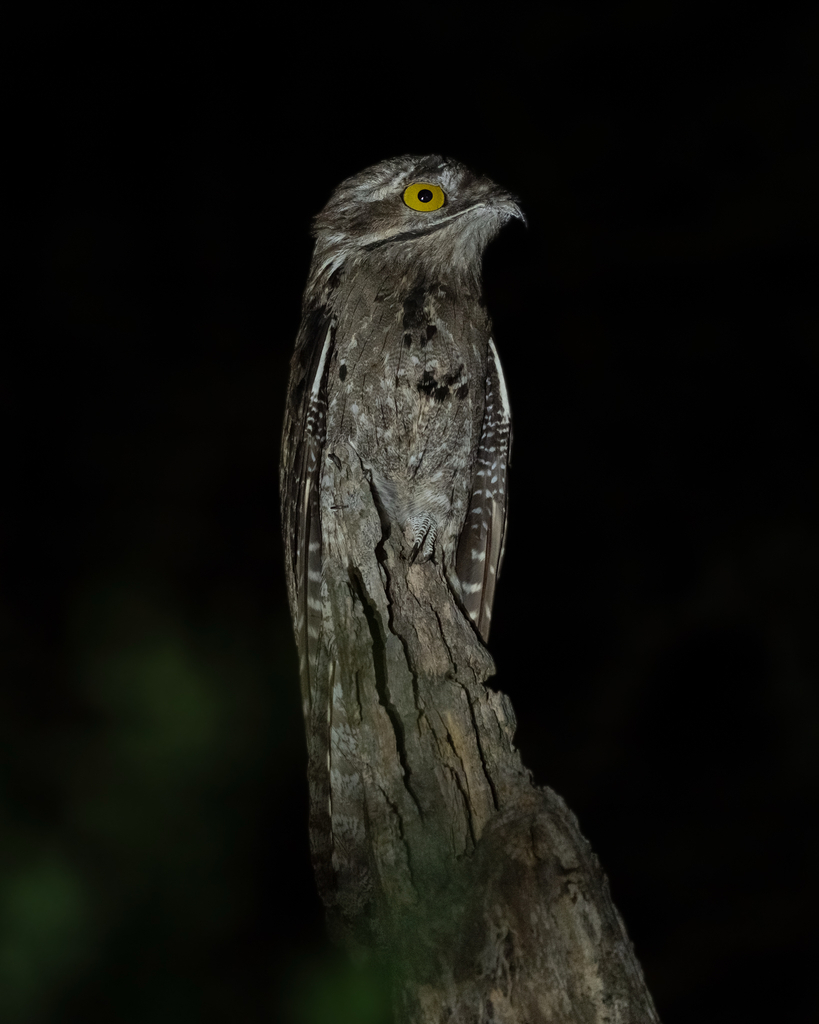
A nocturnal insect-eater that spends the day perched bolt upright on a broken branch, so perfectly camouflaged it looks like part of the tree. At night its mournful, falling song is one of the most haunting sounds of the Neotropics.
The common potoo, also known as the kakuy or urutaú, is one of seven species of birds within the genus Nyctibius. It is notable for its large, yellow eyes and a wide mouth. Potoos are nocturnal and are related to nightjars and frogmouths. They lack the characteristic bristles around the mouths of true nightjars. Wikipedia
What it can do
- iFreezes motionless on a stump with bill pointed skyward, mimicking a dead branch
- iiNotches in its eyelids let it watch for predators with eyes apparently closed
- iiiHuge gape catches large flying insects in sallies from a perch
- ivLays a single egg in a shallow depression on top of a broken branch, with no nest
In the field
Field marks
- aMottled grey-brown bark-like plumage
- bLarge yellow eyes; tiny bill above an enormous mouth
- cLong tail; upright posture on stumps
- dDark spots on the breast
- Voice
- A series of 5–8 loud, melancholy whistles falling in pitch and volume, like 'poor-me-one, poor-me-one'.
- Not to be confused with
- Northern Potoo (Mexico to Costa Rica, and Jamaica and Hispaniola) is nearly identical but gives a harsh, croaking call. Great Potoo is larger and paler with a growling roar. Nightjars perch lengthwise on branches or rest on the ground.
- Where to see it
- Pantanal (Brazil), Llanos (Venezuela), Asa Wright Nature Centre (Trinidad) and Amazonian lodges where guides know day roosts.
- When
- Resident; sings most on moonlit nights
Listen
Looking for field recordings…
Life & habits
- Diet
- Large flying insects — moths, beetles, katydids
- Habitat
- Open forest, edges, savanna, plantations and mangroves
- Size
- 33–38 cm
It returns to the same daytime perch for weeks, which makes it findable once located.
Where it lives
Recorded sightings
—
geo-referenced records in GBIF, from museums, herbaria and field observers.
Native range
Southern Central America (Nicaragua and Costa Rica) through South America to northern Argentina and Uruguay; Trinidad and Tobago
Drag the globe to turn it. Dots are where records exist, not a range map; darker means more records.
In the stacks
Searching the stacks…
Every page naming Nyctibius griseus in the Biodiversity Heritage Library →
Marginalia
A widespread Guaraní legend tells of a young woman whose lover was killed and who was turned into the urutau, forever crying her grief through the night.
Curiosity
Its Brazilian name 'mother of the moon' comes from its habit of calling on moonlit nights.
Kinship






Photographs: iNaturalist contributors under the licences shown. Records: GBIF.org. Historical plates: Source Library (CC BY-SA 4.0; originals public domain). Summary text: Nature Library editors and Wikipedia (CC BY-SA). Medicinal and edibility notes are historical and educational, not advice. iNaturalist taxon 19667.