On eBird ↗
Sickle-winged Nightjar
Live sightings near you, the range map, bar charts of when it is seen, and Macaulay Library photos and recordings.
Sickle-winged Nightjar
Eleothreptus anomalus
The sickle-winged nightjar (Eleothreptus anomalus) is a species of nightjar in a monotypic genus in the family Caprimulgidae. It is found in Argentina, Brazil, Paraguay and far northwestern Uruguay. Its natural habitats are subtropical or tropical moist lowland forests, dry savanna, moist savanna, and swamps. It is becoming rare due to habitat loss.
From the article Sickle-winged nightjar on Wikipedia (CC BY-SA), quoted section by section
Description
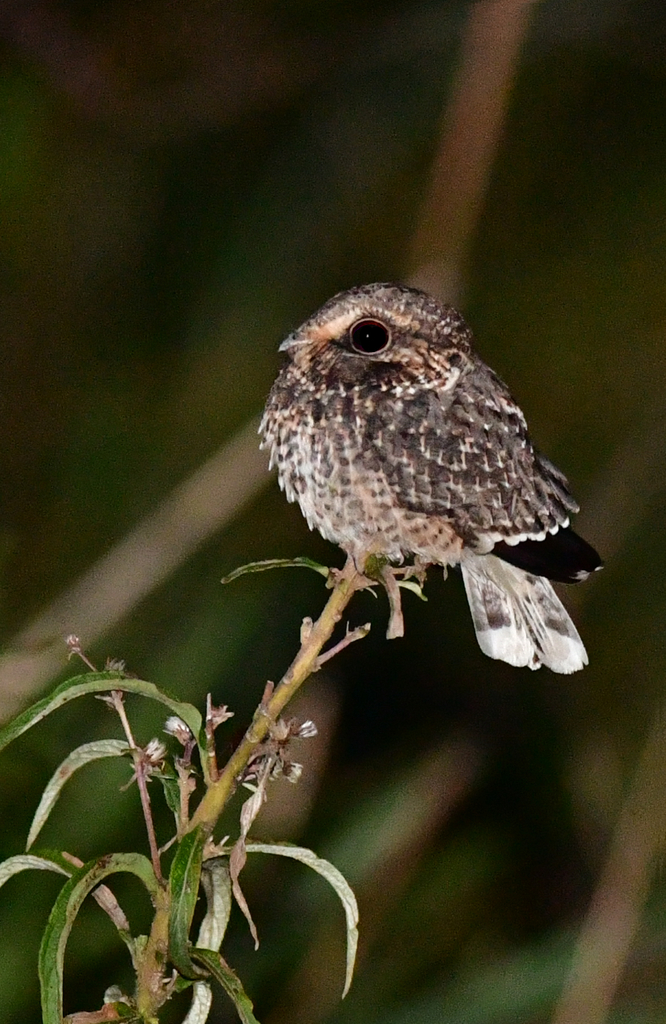
The sickle-winged nightjar is 18 to 20 cm (7.1 to 7.9 in) long; one male weighed 43.7 g (1.5 oz). The adult male's upperparts are grayish brown spotted with dark shades of brown. The wings have a hooked "sickle" appearance due to the shape of the primary flight feathers. They are generally grayish brown, with blackish brown, cinnamon, and white markings. The chin is buffish white with brown bars; the throat brown with a cinnamon tinge, brown bars, and buffy streaks; the breast brown with buff spots and streaks; and the belly and flanks pale buff with brown bars. The adult female is browner than the male and does not have the modified primaries. The pattern and shades of the spots and bars are somewhat different as well. Juveniles are similar to the female, with a cinnamon tinge to the upperparts.
Range & habitat
The sickle-winged nightjar's distribution is not fully understood. It is documented in northeastern Argentina, southern Paraguay, and southern Brazil. It is suspected to also inhabit Uruguay but there are no documented records there, and there are sight records from further north in Brazil than the documented range. It is believed to be resident in most or all of its range but there are suggestions that it migrates north from Argentina following the breeding season.
Wikipedia: “Distribution and habitat”
What it does
The sickle-winged nightjar is crepuscular and nocturnal. It forages by sallying from the ground and possibly during low continuous flight. Between sallies it sits on roads and trails or perches on low branches or wire fence. It flies " with slow, fluttering flaps and glides". Its prey is insects though the details are unknown.
Wikipedia: “Feeding”
Listen
Looking for field recordings…
Where it lives
Recorded sightings
—
geo-referenced records in GBIF, from museums, herbaria and field observers.
Drag the globe to turn it. Dots are where records exist, not a range map; darker means more records.
In the stacks
Searching the stacks…
Every page naming Eleothreptus anomalus in the Biodiversity Heritage Library →
This page is assembled live from iNaturalist, GBIF, Wikipedia, the Source Library and the Internet Archive. It is not yet part of the hand-edited codex. iNaturalist taxon 19653.