On eBird ↗
Yucatan Poorwill
Live sightings near you, the range map, bar charts of when it is seen, and Macaulay Library photos and recordings.
Yucatan Poorwill
Nyctiphrynus yucatanicus
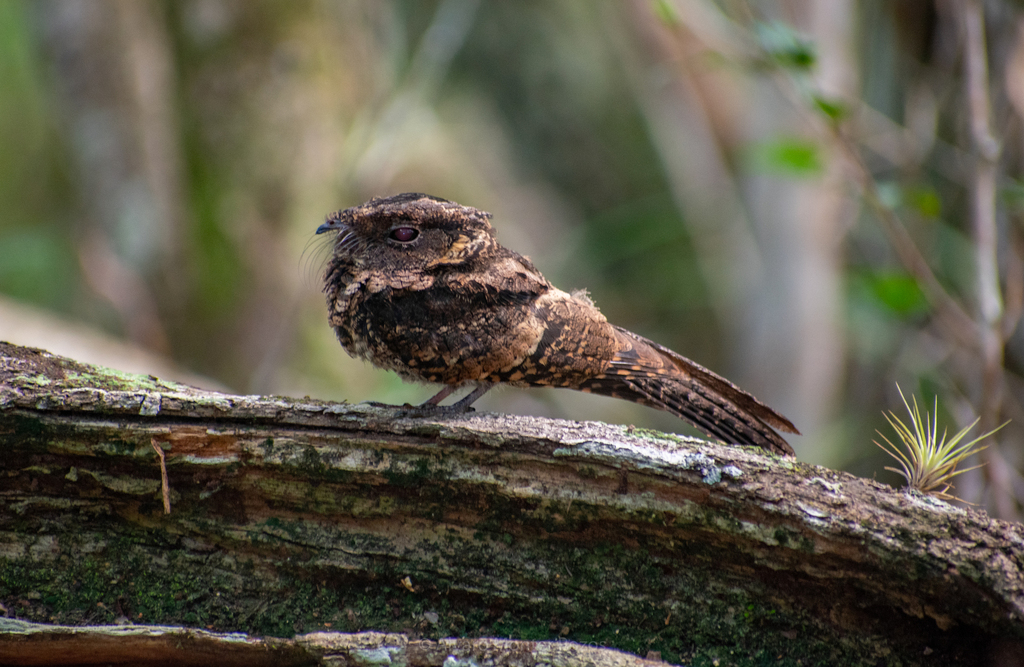
The Yucatan poorwill (Nyctiphrynus yucatanicus) is a species of nightjar in the family Caprimulgidae. It is found in the entire Yucatán Peninsula region except on the north coast, in a 50 km wide coastal strip that extends 700 km; the species ranges to south-central Belize, northeasternmost Guatemala, and southern regions Mexico. Its natural habitats are subtropical or tropical dry forests and subtropical or tropical dry shrubland.
From the article Yucatan poorwill on Wikipedia (CC BY-SA), quoted section by section
Description
The Yucatan poorwill is 19.5 to 22 cm (7.7 to 8.7 in) long, making it the smallest species of nightjar in the Yucatán Peninsula. One male weighed 21.3 g (0.75 oz) and one female 27.7 g (0.98 oz). Both sexes have a brown morph; there is also a rufous morph that is much more prevalent among females. The former is mostly dark grayish brown with a variety of dusky, gray, and black vermiculation and streaks. Its face is dark sooty brown to brownish black with brown vermiculation. It has a faint buffy collar on its nape and a white patch on the throat. The underparts are brown and gray vermiculation with black streaks. The tail is dull black with grayish buffy marks and the wing is rounded. The four outer pairs of feathers have broad white tips. The rufous morph replaces the grayish brown base color with reddish brown. However, the coloration of plumage of the species is diverse. A similar species, the eared poorwill (N. mcleodii), has longer wings, a distinct narrow collar on the hind neck, a rather plain upper body, a plainer lower body, and smaller white spots on the belly.
Range & habitat
The Yucatan poorwill is found in the Yucatán Peninsula. In Mexico it occurs in the states of Campeche, Yucatán (except the northern coastal strip), and Quintana Roo. Its range extends into northeastern Guatemala and northern Belize. In the Shipstern Wildlife Reserve area of Belize, the yucatan poorwill has been observed to be inhabiting all year round and is usually found in small groups (less than 10) in specific habitats. In elevation it ranges from sea level to about 250 m (820 ft). It inhabits a variety of landscapes including the interiors and edges of tropical, humid, and semi-humid forest as well as scrublands. It also appears to be abundant in deciduous forest, but one observation reveals that it is not commonly found in secondary shrubby forests in tropical rainforests. Its habitat is still not well known.
Wikipedia: “Distribution and habitat”
What it does
The Yucatan poorwill is crepuscular and nocturnal. It forages at night in an open area and forages by sallying from a perch in a tree and perhaps from the ground. Its prey is insects but details are not known.
Wikipedia: “Feeding”
Listen
Looking for field recordings…
Where it lives
Recorded sightings
—
geo-referenced records in GBIF, from museums, herbaria and field observers.
Drag the globe to turn it. Dots are where records exist, not a range map; darker means more records.
In the stacks
Searching the stacks…
Every page naming Nyctiphrynus yucatanicus in the Biodiversity Heritage Library →
This page is assembled live from iNaturalist, GBIF, Wikipedia, the Source Library and the Internet Archive. It is not yet part of the hand-edited codex. iNaturalist taxon 19642.