On eBird ↗
Mangrove Cuckoo
Live sightings near you, the range map, bar charts of when it is seen, and Macaulay Library photos and recordings.
Mangrove Cuckoo
Coccyzus minor
The mangrove cuckoo (Coccyzus minor) is a species of cuckoo that is native to the Neotropics.
From the article Mangrove cuckoo on Wikipedia (CC BY-SA), quoted section by section
Description
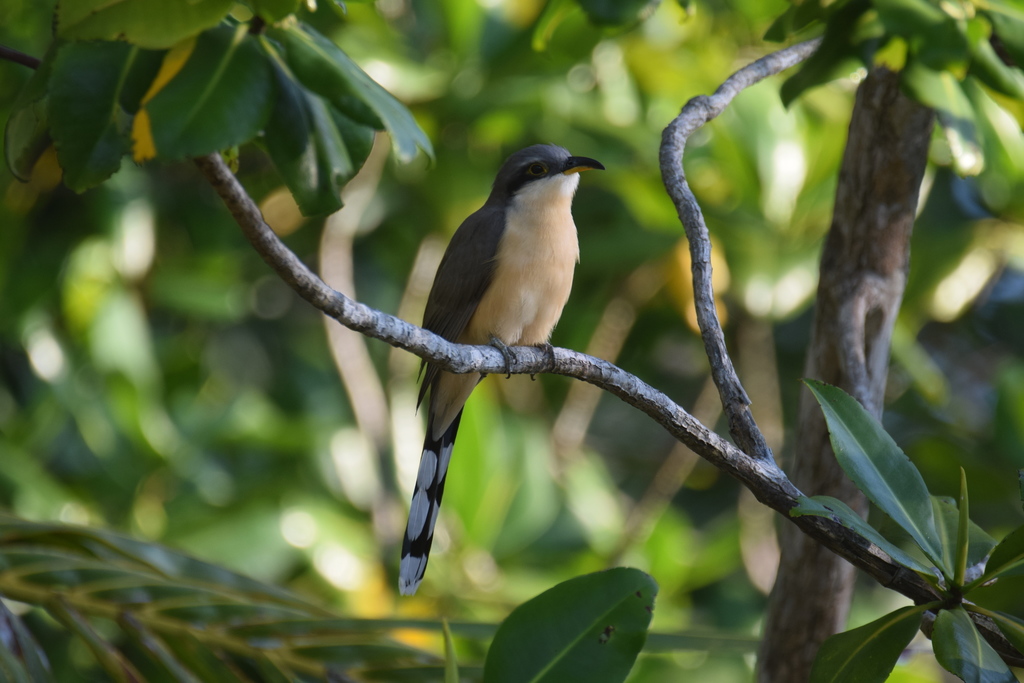
Adults have a long tail, brown above and black-and-white below, and a black curved bill with yellow on the lower mandible. The head and upper parts are brown. There is a yellow ring around the eye. This bird is best distinguished by its black facial mask and buffy underparts. Although the scientific name is minor (meaning "small"), this species is on average the largest of North America's three Coccyzus cuckoos. Adults measure 28–34 cm (11–13 in) in length, weigh 64–102 g (2.3–3.6 oz) and span 38–43 cm (15–17 in) across the wings. The most common call is a guttural "gawk gawk gawk gawk gauk gauk". It will also call a single "whit".
Range & habitat
The mangrove cuckoo is a resident of southern Florida in the United States, the Caribbean, both coasts of Mexico and Central America, and the Atlantic coast of South America as far south as the mouth of the Amazon River. It is found primarily in mangrove swamps and hammocks. The mangrove cuckoo is generally fairly common in its specialized range. This bird could be threatened by human development of mangrove habitat.
Wikipedia: “Distribution and habitat”
What it does
It prefers caterpillars and grasshoppers, but will also take other insects, insect larvae, spiders, snails, small lizards, bird eggs, nestlings of small birds, and fruit.
Wikipedia: “Food and feeding”
Listen
Looking for field recordings…
Where it lives
Recorded sightings
—
geo-referenced records in GBIF, from museums, herbaria and field observers.
Drag the globe to turn it. Dots are where records exist, not a range map; darker means more records.
In the stacks
Searching the stacks…
Every page naming Coccyzus minor in the Biodiversity Heritage Library →
This page is assembled live from iNaturalist, GBIF, Wikipedia, the Source Library and the Internet Archive. It is not yet part of the hand-edited codex. iNaturalist taxon 1964.