On eBird ↗
Montane Nightjar
Live sightings near you, the range map, bar charts of when it is seen, and Macaulay Library photos and recordings.
Montane Nightjar
Caprimulgus poliocephalus
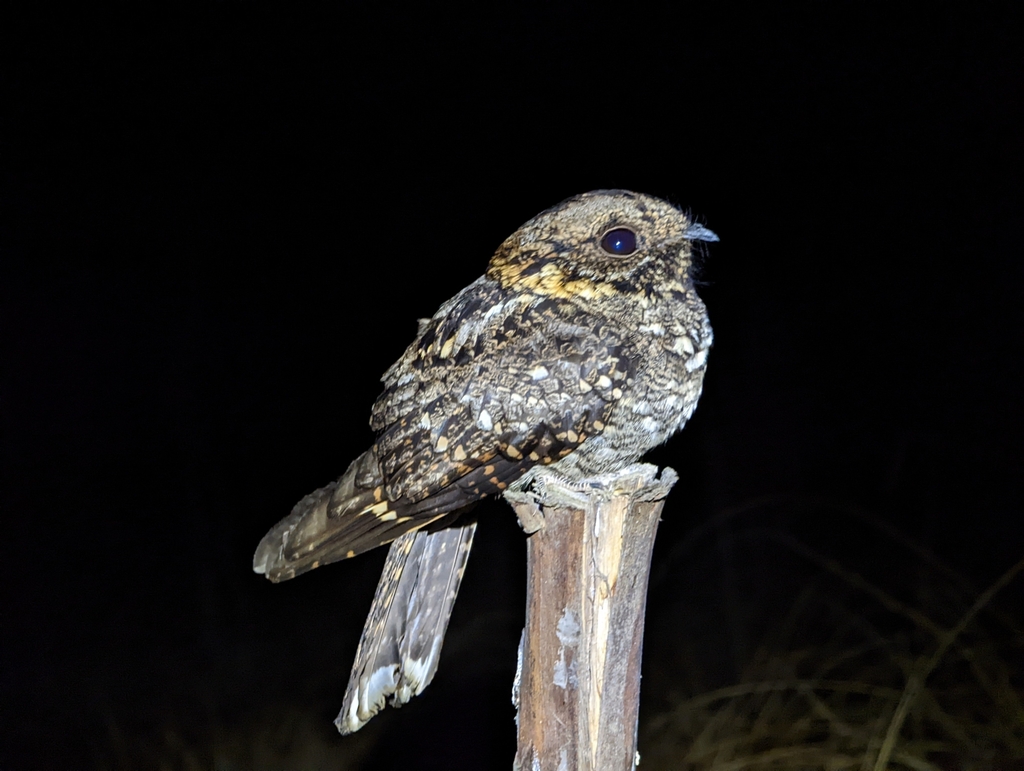
The montane nightjar (Caprimulgus poliocephalus), mountain nightjar or Abyssinian nightjar, is a species of nightjar in the family Caprimulgidae. It is native to upland regions of Central and Eastern Africa where it is a locally common species.
From the article Montane nightjar on Wikipedia (CC BY-SA), quoted section by section
Description
The montane nightjar is a rather dark nightjar growing to a length of about 23 cm (9.1 in). It has somewhat tawny, blackish or chocolate brown dappled plumage. The male has white spots on its four main primaries and the outer edge of the tail is white. The female has buff-coloured spots on its primaries and less white on the tail. The call is a nasal ank-ank-ank, often followed by a high-pitched whistle piiiyu-pirrr, the first syllable descending and then rising, and the second syllable tremulous and descending.
Range & habitat
The montane nightjar is native to Central and Eastern Africa. Its range includes Angola, Democratic Republic of the Congo, Eritrea, Ethiopia, Kenya, Malawi, Saudi Arabia, Sudan, Tanzania, Uganda and Zambia. It occurs at altitudes between about 1,000 and 3,350 m (3,300 and 11,000 ft). Like other nightjars, it is nocturnal, feeding on moths and other large insects. It is mostly a forest bird, but is also found in plantations, cultivated areas near forests, and in well-wooded urban areas.
Wikipedia: “Distribution and habitat”
Listen
Looking for field recordings…
Where it lives
Recorded sightings
—
geo-referenced records in GBIF, from museums, herbaria and field observers.
Drag the globe to turn it. Dots are where records exist, not a range map; darker means more records.
In the stacks
Searching the stacks…
Every page naming Caprimulgus poliocephalus in the Biodiversity Heritage Library →
This page is assembled live from iNaturalist, GBIF, Wikipedia, the Source Library and the Internet Archive. It is not yet part of the hand-edited codex. iNaturalist taxon 19518.