On eBird ↗
Jerdon's Nightjar
Live sightings near you, the range map, bar charts of when it is seen, and Macaulay Library photos and recordings.
Jerdon's Nightjar
Caprimulgus atripennis
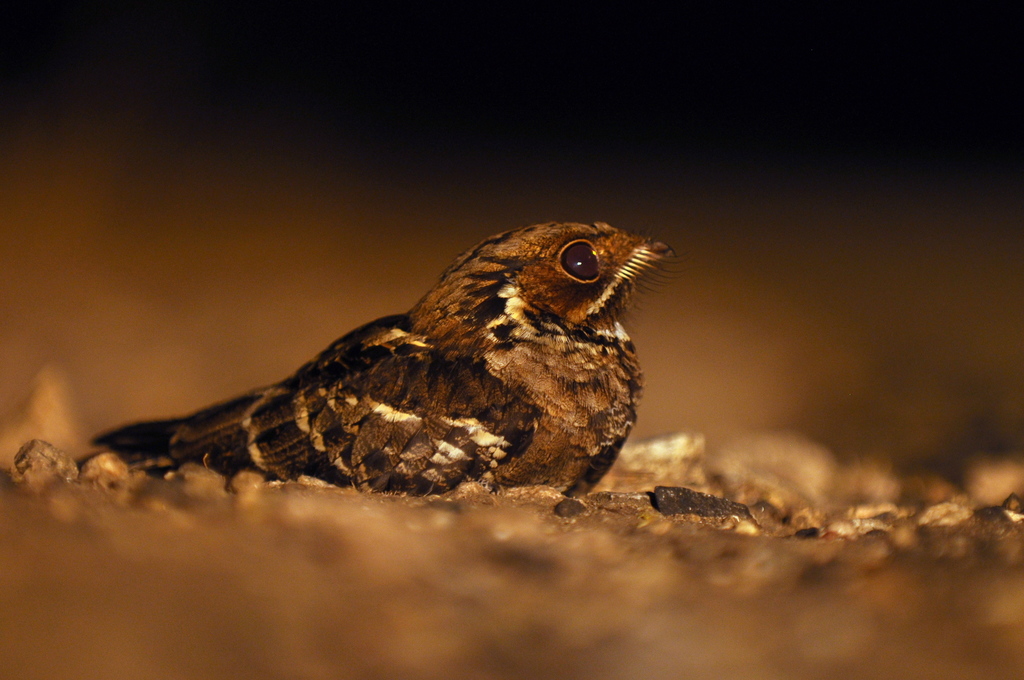
Jerdon's nightjar (Caprimulgus atripennis) is a medium-sized nightjar species which is found in southern India and Sri Lanka. Formerly considered as a subspecies of the long-tailed nightjar it is best recognized by its distinctive call which sounds like a wooden plank being beaten periodically with each note ending in a quaver. The common name commemorates the surgeon-naturalist Thomas C. Jerdon who described the species and it was called the Ghat nightjar in older literature.
From the article Jerdon's nightjar on Wikipedia (CC BY-SA), quoted section by section
Description
Like other nightjars, it has a wide gape, long wings, soft downy plumage and nocturnal habits. At 26 cm in overall length, it is almost a head's length larger than the Indian nightjar (C. asiaticus), and differs from that species in its barred tail, rufous rear neck, and wing bars. The vermiculations on the crown are fine giving it a nearly uniform shade. The collar is blackish. The male has a white patch on each wing. Otherwise, their cryptic plumage is mainly variegated buff and brown, as typical for the dark tropical woodland nightjars. This has an unbroken white gorget like the long-tailed nightjar but the tail is shorter. The Sri Lankan aequabilis is slightly smaller and darker. Its typical call is a fast repetitive ch-woo-woo. Another call is said to be a frog-like croak.
What it does
Open woodland, scrub, and cultivation is the habitat of this nocturnal bird. It flies after sundown with an easy, silent fluttering flight, appearing a bit like an outsized moth at a casual glance. During the day, Jerdon's nightjar lies silent upon the ground, concealed by its plumage; it is then difficult to detect, blending in with the soil. Nocturnal insects, such as moths, are its food. Unlike the Indian nightjar (C. asiaticus), this species rarely rests on roads during the night, preferring to alight on bushes. This makes it harder to spot, since it is not so readily seen in vehicle headlights. It however roosts on the ground although calling from the trees. The breeding season is March to July in India and February to May in Sri Lanka. No nest is made; the two marbled eggs are placed upon the bare ground. The brooding bird, covering them closely with its camouflage plumage, is their best protection. The chicks can crawl away from the nest soon after hatching and hide among leaves when alarmed.
Wikipedia: “Behaviour and ecology”
Listen
Looking for field recordings…
Where it lives
Recorded sightings
—
geo-referenced records in GBIF, from museums, herbaria and field observers.
Drag the globe to turn it. Dots are where records exist, not a range map; darker means more records.
In the stacks
Searching the stacks…
Every page naming Caprimulgus atripennis in the Biodiversity Heritage Library →
This page is assembled live from iNaturalist, GBIF, Wikipedia, the Source Library and the Internet Archive. It is not yet part of the hand-edited codex. iNaturalist taxon 19509.