On eBird ↗
White-winged Nightjar
Live sightings near you, the range map, bar charts of when it is seen, and Macaulay Library photos and recordings.
White-winged Nightjar
Eleothreptus candicans
The white-winged nightjar (Eleothreptus candicans) is a species of nightjar in the family Caprimulgidae native to Bolivia, Brazil and Paraguay, where it lives in open grassland with scattered trees. It is about 20 cm (8 in) long, with females being slightly larger than males. It is usually a silent bird, but the male calls during courtship. It breeds in the summer, with the female incubating the eggs and rearing the young. It has a wide range but the...
From the article White-winged nightjar on Wikipedia (CC BY-SA), quoted section by section
Description
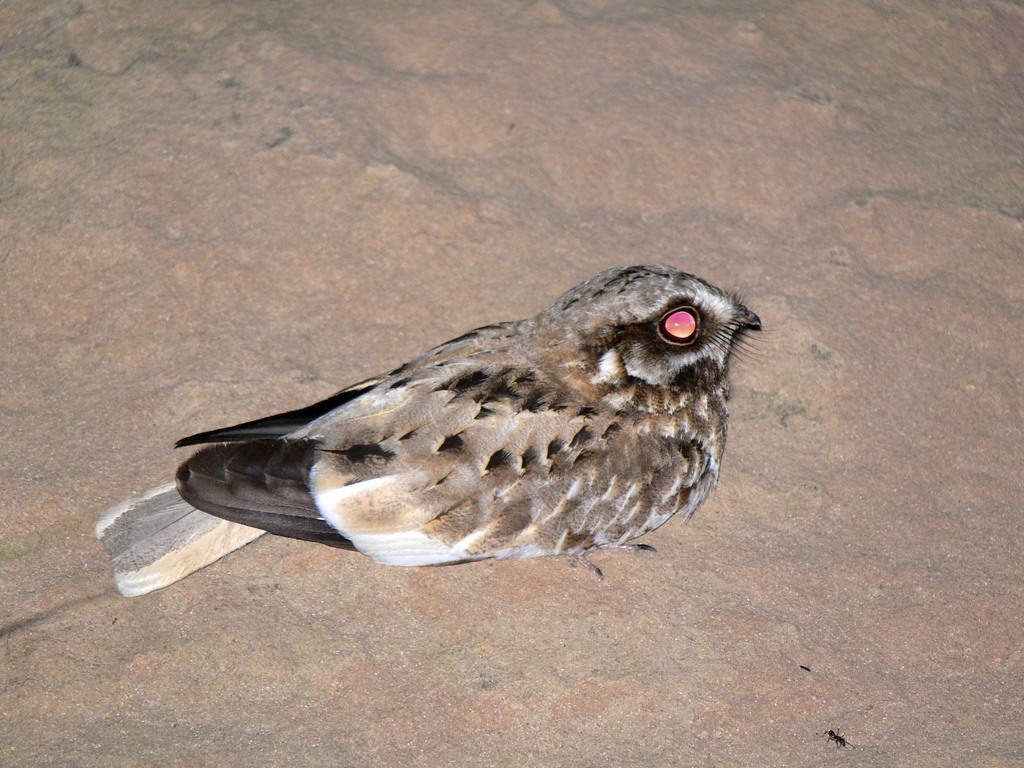
The white-winged nightjar is 19 to 23 cm (7.5 to 9.1 in) long. Adult males weigh 46 to 55 g (1.6 to 1.9 oz) and females 46 to 55 g (1.6 to 1.9 oz). The adult male's upperparts are pale grayish brown with bold blackish spots on the crown and brown streaks, bars, and speckles on most of the rest. Much of the face is brown, with a white supercilium and "moustache". The breast is grayish brown with a chestnut tinge and brown bars and speckles; the rest of the underparts are white. In flight the male shows whitish wings and a mostly white tail. Adult females have buffy underparts and no white in the plumage. Juveniles are browner rather than grayish.
Range & habitat
The white-winged nightjar is known from widely separated sites in northern Bolivia, south-central Brazil, and eastern Paraguay. There are also historical reports from sites in southern Brazil. It inhabits open grassland with scattered trees and bushes such as savanna and cerrado. In elevation it ranges from sea level to 210 m (690 ft).
Wikipedia: “Distribution and habitat”
What it does
The white-winged nightjar mostly forages in continuous low flight, though it has also been recorded sallying from low perches. Its flight is "typically slow and frequently interspersed by glides". It feeds on insects including beetles and moths.
Wikipedia: “Feeding”
Listen
Looking for field recordings…
Where it lives
Recorded sightings
—
geo-referenced records in GBIF, from museums, herbaria and field observers.
Drag the globe to turn it. Dots are where records exist, not a range map; darker means more records.
In the stacks
Searching the stacks…
Every page naming Eleothreptus candicans in the Biodiversity Heritage Library →
This page is assembled live from iNaturalist, GBIF, Wikipedia, the Source Library and the Internet Archive. It is not yet part of the hand-edited codex. iNaturalist taxon 19500.