- Animals
- ›Chordates
- ›Vertebrates
- ›Ray-finned Fishes
- ›Spiny-rayed fishes
- ›Rivulines, Killifishes, and Livebearers
- ›Cyprinodontoidei
- ›Live-bearers and Topminnows
- ›Typical Livebearers
- ›Poecilia
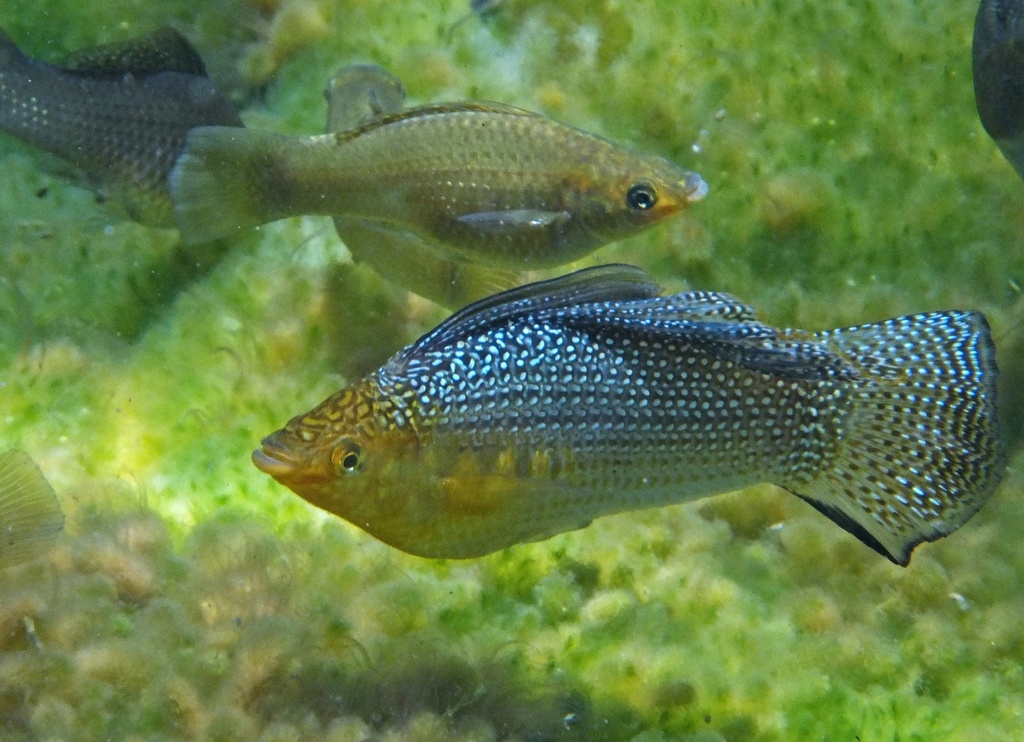
Yucatán Molly
Poecilia velifera
Poecilia velifera, commonly known as the Yucatán molly or giant sailfin molly, is a poeciliid fish native to the Yucatán Peninsula in Mexico. It is typically under 10 cm (3.9 in) in length but may reach 15 cm (5.9 in), with males somewhat larger than females. It belongs to a group of mollies known as sailfins, named for the large males' sail-like dorsal fin, a feature that is especially pronounced in P. velifera. The species occurs in a range of habitats, from coastal lagoons, estuaries, and salt marshes to freshwater pools in the interior of the peninsula; it is particularly associated with mangrove swamps and sinkholes known as cenotes.
Yucatán mollies are primarily herbivorous, but also consume small invertebrates, adjusting their diet to available resources. They are preyed upon by a variety of larger fish, birds, and crocodilians, and are host to a diverse parasite fauna. Much of their time is spent browsing for food and maintaining their bodies. Males are divided into size-based classes, which differ in appearance and behavior: the largest males flare their dorsal fin when they spar with other males and when they perform courtship displays for females; the smallest males remain hidden among females and mate through quick thrusts; and the intermediate males may employ either strategy. A few weeks after mating, females give birth to live young. P. velifera produces viable hybrids with other mollies, including the naturally occurring P. mexicana×P. velifera.
From the article Poecilia velifera on Wikipedia (CC BY-SA), quoted section by section
Description
The most distinctive feature of Poecilia velifera is its dorsal fin. It bears 15 to 21 rays, more than the dorsal fins of other sailfin mollies. This fin rises exceptionally high in males, surpassing that of any other molly. Its base is long, extending over much of the back, and its color is dark with numerous pale spots, including bluish-green markings edged in black; in males, a row of larger dark spots is often present near the outer edge. The anal fin contains 10 rays. The pectoral fins are about as long as the head, while the pelvic fins reach the front of the anal fin; in males, one pelvic ray is elongated and equals the length of the gonopodium (male reproductive appendage). The tail fin is normally rounded and nearly plain; the lower corner may be slightly extended, and the upper part may show spotting, while the lower part remains unmarked and edged in black.
As in most poeciliids, the body is elongated—though relatively deeper—and the head is wedge-shaped, with moderately sized eyes set widely apart. The overall body color is olive green. Along the back and sides run dark brown longitudinal stripes, with broader ones following the rows of scales and narrower ones between them. …
Range & habitat
Naturally occurring populations of Poecilia velifera are confined to the Yucatán Peninsula in Mexico, where they occur at elevations below roughly 20 m (66 ft) above sea level. The species' native range extends along the peninsula's northern coast from Tulum to a tidal stream located about 50 km (31 mi) southwest of San Francisco de Campeche (just north of latitude 19°30′ N); it encompasses the states of Campeche, Yucatán, and Quintana Roo, including the islands of Mujeres, Cozumel, and Contoy Island. P. velifera reaches higher population densities in and around two major protected areas in Yucatán: the Ría Lagartos Biosphere Reserve and the state reserve Ciénegas y Manglares de la Costa Norte de Yucatán. In addition to its coastal range, P. velifera is found in inland cenotes (sinkholes in the karst) in the vicinity of Mérida, the state capital of Yucatán. Most of these cenotes are artificial, and P. velifera was probably planted there by the International Health Board to control mosquitoes. Another inland locality is the Xlaká cenote, a natural formation associated with Maya ruins; the species' occurrence there is likely natural, although introduction by the pre-Columbian Maya remains a possibility. …
Wikipedia: “Range”
What it does
Poecilia velifera is a generalist feeder, browsing along substrates, stones, or other objects. Its preferred food items are filamentous algae and diatoms, but it also takes crustaceans and insects. In nutrient-poor waters such as El Aerolito cenote, P. velifera feeds on whatever organic material enters from outside the system, especially insects and plant matter. Its diet shifts with changing conditions, narrowing when certain resources are abundant and broadening when they are scarce. This flexibility allows it to persist where food availability is uneven and seasonal. Yucatán mollies fall prey to various species of cichlids and marine fish, including Lutjanus, Arius, Strongylura, Gobiomorus dormitor, and Megalops atlanticus. They are also preyed upon by wading birds, such as herons, egrets, and storks, and by reptiles, such as Morelet's and American crocodiles. Antipredator responses are rapid and stereotyped: when startled, particularly by the shadow of a bird passing overhead, individuals dart away from the surface and seek refuge in submerged cover. Poecilia velifera also hosts a diverse parasite fauna, including the roundworms Contracaecum and Cucullanus; the flukes Clinostomum complanatum, Saccocoelioides sogandaresi, Centrocestus formosanus, and Ascocotyle diminuta, A. macrostoma, A. megalocephala, A. nana, and A. …
Wikipedia: “Ecology”
Where it lives
Recorded sightings
—
geo-referenced records in GBIF, from museums, herbaria and field observers.
Drag the globe to turn it. Dots are where records exist, not a range map; darker means more records.
In the stacks
Searching the stacks…
Every page naming Poecilia velifera in the Biodiversity Heritage Library →
This page is assembled live from iNaturalist, GBIF, Wikipedia, the Source Library and the Internet Archive. It is not yet part of the hand-edited codex. iNaturalist taxon 194209.