On eBird ↗
Sykes's Nightjar
Live sightings near you, the range map, bar charts of when it is seen, and Macaulay Library photos and recordings.
Sykes's Nightjar
Caprimulgus mahrattensis
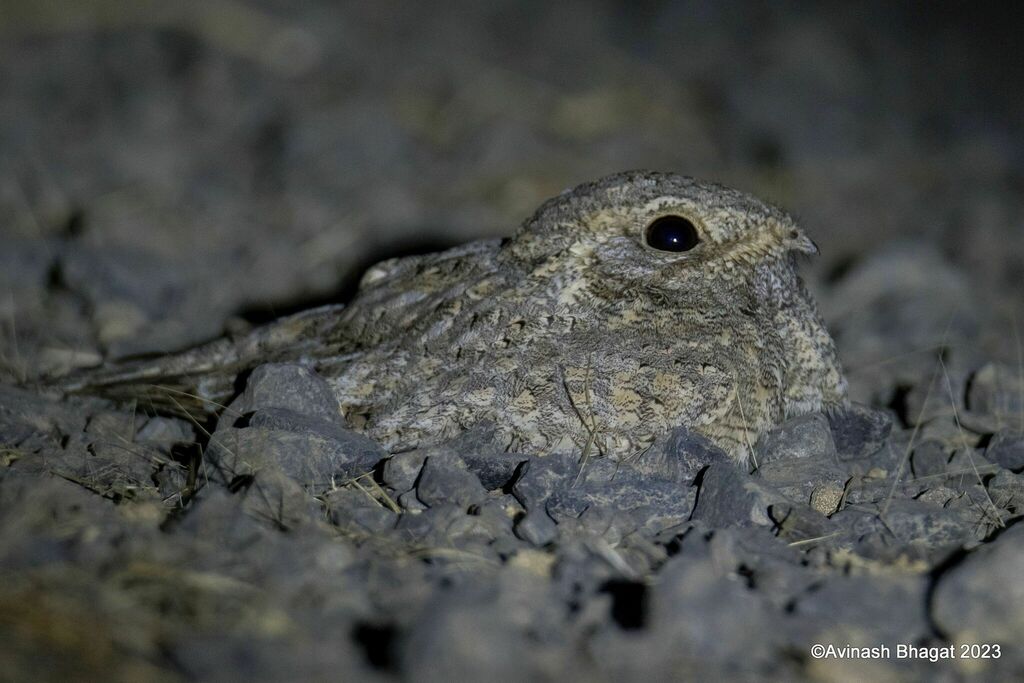
The Sykes's nightjar, Sykes' nightjar, Sind nightjar or Sindh nightjar (Caprimulgus mahrattensis) is a nightjar species found in northwestern South Asia. This species has a large range with stable population size and therefore has been listed as "Least Concern" with no prediction of substantial human influence on their habitats in the near future.
From the article Sykes's nightjar on Wikipedia (CC BY-SA), quoted section by section
Description
The Sykes's nightjar is a relatively small bird, measuring around 20-25 centimeters in length and weighing about 60 grams. They have a short bill, and dark blackish brown irises. The Sykes's nightjar's wings are long and narrow. The bird has a short, pale-gray bill with bristles around the mouth. They have small feet, only useful for perching and not effective at walking. Their plumage is mainly of brown and grey color, with upperparts having sandy coloration with blackish brown and pale brown spots all over their body, making their plumage resemble tree bark, leaf litter, or sandy ground, allowing them to camouflage with their environment, known as cryptic plumage. The Sykes's nightjar has a nuchal collar (nape) of buffish color with irregular buff spotting, along with a blackish-brown crown, whitish submoustachial stripe, and a large white patch on either side of their lower throat, sometimes extending across the entire throat. Their wing coverts are sandy grey with blackish brown streaks and vermiculation, along with buff spots, and their scapular contains blackish spots and cinnamon markings. They have a white band towards the wing tip of their three outermost primaries and broad white tips on their two outermost tail feathers. …
Range & habitat
The Sykes's nightjar is mainly found in the Indian subcontinent, predominantly in the countries of India, Nepal, Bhutan, Bangladesh, and Sri Lanka. Their distribution also includes Pakistan, Afghanistan, and Iran, with vagrant birds recorded in United Arab Emirates and Oman. The species is partially migratory, wintering in western and central India, visiting south-western Afghanistan in the summer, and breeding in Afghanistan, Pakistan, Iran, and India. The Sykes's nightjar is considered a resident species in Pakistan, south-eastern Iran, Sri Lanka.
Wikipedia: “Distribution”
What it does
Sykes's nightjar is active mostly in the late evening, early morning and at night. They are very agile and buoyant when foraging, flying low to the ground over open terrain.
Diet. The Sykes's nightjar feed primarily on large flying insects which are abundant during the night, such as moths, beetles, grasshoppers, locusts, crickets, cicadas, and other nocturnal insects. These insects are caught by the bird during flight, where they are scooped up by the nightjar's wide bill.
Vocalizations. The territorial call/song of Sykes's nightjar consists of long series of hard, knocking notes rapidly repeated, producing a prolonged churr, also described as a low trilling sound or rattle, which is given in bouts lasting 1-2 seconds and 3-4 minutes. This song is performed by a male from the ground, mainly at dusk and dawn, carrying through 200-300 meters, with each individual note being roughly equal in pitch and rate. Other calls include a series of soft "chuk-chuk" or "cluk-cluk" notes when the bird is startled to fly and during display. During display flights, males also produce mechanical wing-clapping sounds.
Reproduction. The breeding season for Sykes's nightjar usually begins in April and May, though it has been recorded as February to August in Pakistan, with a peak breeding period during March to May, and recorded as March to May in India. …
Wikipedia: “Behaviour”
Listen
Looking for field recordings…
Where it lives
Recorded sightings
—
geo-referenced records in GBIF, from museums, herbaria and field observers.
Drag the globe to turn it. Dots are where records exist, not a range map; darker means more records.
In the stacks
Searching the stacks…
Every page naming Caprimulgus mahrattensis in the Biodiversity Heritage Library →
This page is assembled live from iNaturalist, GBIF, Wikipedia, the Source Library and the Internet Archive. It is not yet part of the hand-edited codex. iNaturalist taxon 19391.