On eBird ↗
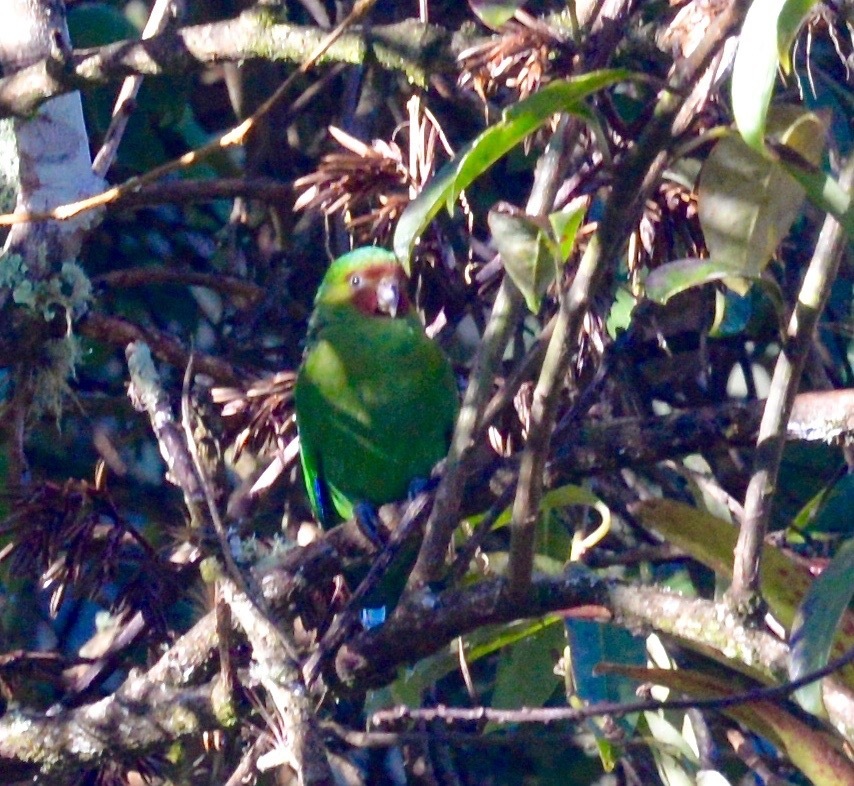
Red-faced Parrot
Live sightings near you, the range map, bar charts of when it is seen, and Macaulay Library photos and recordings.
Red-faced Parrot
Hapalopsittaca pyrrhops
The red-faced parrot (Hapalopsittaca pyrrhops) is a species of parrot in the family Psittacidae. It is found in Ecuador and Peru.
From the article Red-faced parrot on Wikipedia (CC BY-SA), quoted section by section
Range & habitat
Currently, the red-faced parrot has only been found in Ecuador and Peru, mostly between the eastern Andes mountain range of southern Ecuador and the northwest region of Peru. More specifically, they inhabit mild forests of the provinces of Azuay, Loja and Morona-Santiago and the Piura department in Peru. They are also found in Selva Alegre which has the largest population of red-faced parrots. Its natural habitat is subtropical or tropical moist montane forests. They have been noted to reside in shrubby growth next to páramo. This parrot is known to have vocalizations to find other flocks of birds in their area.
Wikipedia: “Habitat”
What it does
In the main habitat of the red-faced parrot, they feed on a variety of foods. These include flowers and seeds, miconia fruits, viburnum berries, Weinmannia shoots, and parts of ericaceous trees.
Wikipedia: “Diet and foraging”
Toxicity
The red-faced parrot is threatened by habitat loss. Due to a rapidly decreasing habitat, the red-faced parrot is now considered to be Endangered by BirdLife International and the IUCN, and is starting to go extinct. Studies conducted in southern Ecuador by Mark Jacobs and Jon Walker revealed that the red-faced parrot predominantly resides in the cloud forests of Selva Alegre. These cloud forests are facing ongoing destruction for grazing and agriculture, relieving the red-faced parrot species of a habitat. At this time, habitat loss is the primary source of endangerment for the red-faced parrot. The population of the red-faced parrot in Selva Alegre estimates from a minimum of 169 to a maximum of 734. Most of the time these birds stay in flocks of 20. They tend to stay in one area, which means that habitat loss can be very dangerous. This small population size puts the red-faced parrot species at risk, as there are less individuals to mate with. This decrease in birth rate makes the species even more vulnerable to the devastating effects of the Selva Alegre habitat loss.
Wikipedia: “Endangered species”
Listen
Looking for field recordings…
Where it lives
Recorded sightings
—
geo-referenced records in GBIF, from museums, herbaria and field observers.
Drag the globe to turn it. Dots are where records exist, not a range map; darker means more records.
In the stacks
Searching the stacks…
Every page naming Hapalopsittaca pyrrhops in the Biodiversity Heritage Library →
This page is assembled live from iNaturalist, GBIF, Wikipedia, the Source Library and the Internet Archive. It is not yet part of the hand-edited codex. iNaturalist taxon 19326.