- Animals
- ›Chordates
- ›Vertebrates
- ›Birds
- ›Parrots
- ›Old World Parrots
- ›Long-tailed Parrots and allies
- ›Micropsitta
On eBird ↗
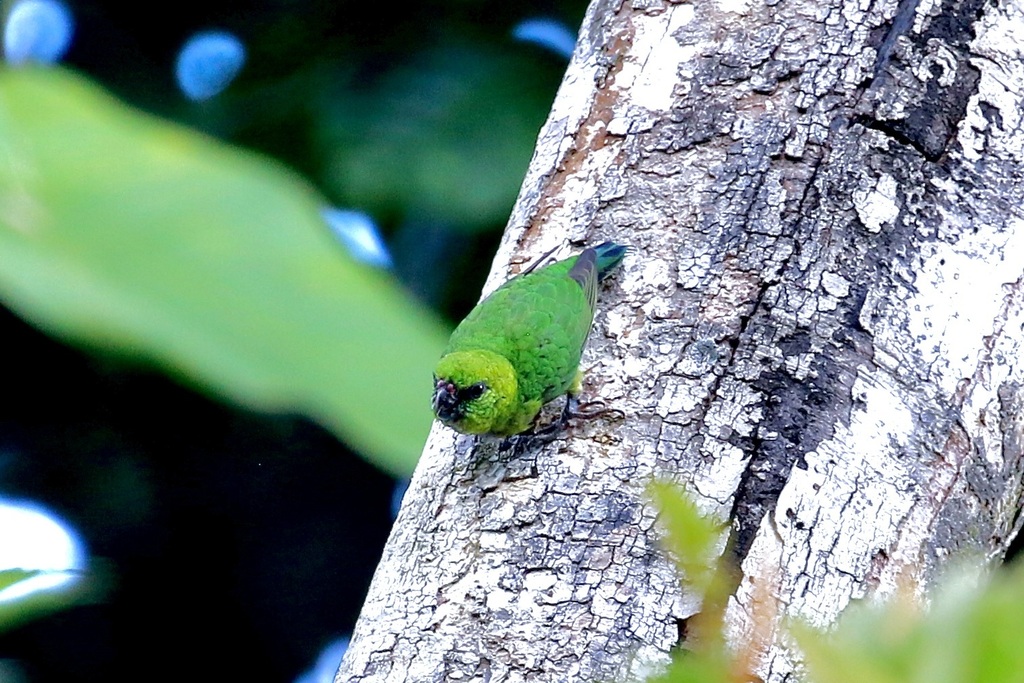
Finsch's Pygmy-Parrot
Live sightings near you, the range map, bar charts of when it is seen, and Macaulay Library photos and recordings.
Finsch's Pygmy-Parrot
Micropsitta finschii
Finsch's pygmy parrot (Micropsitta finschii), also known as the emerald pygmy parrot and green pygmy parrot, is a member of parrot family Psittaculidae inhabiting tropical rainforest regions of islands in Papua New Guinea, the Solomon Islands, and the Bismarck Archipelago.
The common name and scientific name commemorate the German ethnographer, naturalist, and colonial explorer Friedrich Hermann Otto Finsch .
From the article Finsch's pygmy parrot on Wikipedia (CC BY-SA), quoted section by section
Description
Finsch's pygmy parrot is characterized by a green head and neck (which is unique among species of the genus Micropsitta). The typical length of a green pygmy parrot is 9.5 cm (3.7 in) with an average weight of 12 g (0.42 oz). Male and female individuals can be identified by slight differences in coloration. For example, in one subspecies, males possess a blue patch around the lower section of the beak, whereas the female's patch is pink. The five recognized subspecies each inhabit a different range within the overall distribution of the species and each has different characteristics between sexes.
Range & habitat
The parrots are found in tropical rainforests (up to an elevation of 900 m (3,000 ft)). The birds are most often observed in the forest interior and in river edge vegetation. They are arboreal and have been observed nesting in old arboreal ant/termite mounds. The birds construct a tunnel into the mound, which is used also as a roost. The birds are described as being abundant in their habitats.
Wikipedia: “Habitat”
What it does
The birds find food by climbing tree bark vertically or by climbing along the bottom of branches while hanging upside-down. While foraging and feeding, the tail feathers are used as a prop against the tree surface. The parrot feeds on fungi and lichens found on the tree bark, as well as the seeds of the casuarina tree in which it is commonly found. Some birds apparently associate with slow-moving mixed bird flocks.
Wikipedia: “Diet”
Listen
Looking for field recordings…
Where it lives
Recorded sightings
—
geo-referenced records in GBIF, from museums, herbaria and field observers.
Drag the globe to turn it. Dots are where records exist, not a range map; darker means more records.
In the stacks
Searching the stacks…
Every page naming Micropsitta finschii in the Biodiversity Heritage Library →
This page is assembled live from iNaturalist, GBIF, Wikipedia, the Source Library and the Internet Archive. It is not yet part of the hand-edited codex. iNaturalist taxon 19294.