- Plants
- ›Vascular Plants
- ›flowering plants
- ›Dicots
- ›laurels, spicebushes, and allies
- ›laurels
- ›Eusideroxylon
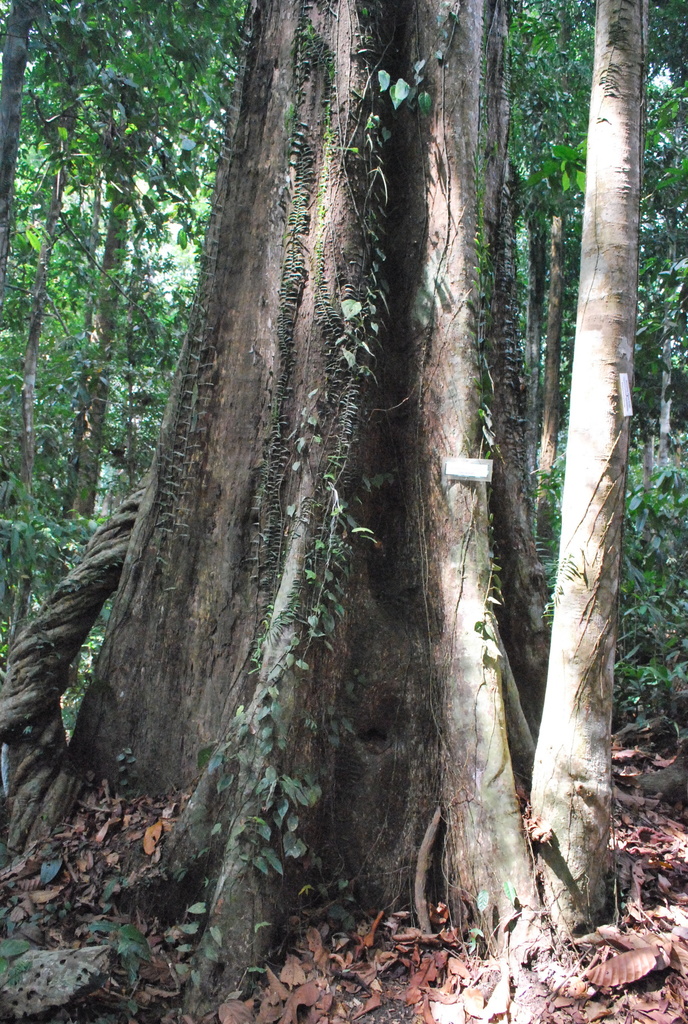
Bornean ironwood
Eusideroxylon zwageri
Eusideroxylon is a genus of evergreen trees of the family Lauraceae. The genus is monotypic, and includes one accepted species, Eusideroxylon zwageri. The species is commonly known as Bornean ironwood, or by the Malay names belian and ulin. It is predominantly found in Borneo and Sumatra, where it grows in lowland rainforests, but may also occur in the Philippines. The Bornean ironwood is an extremely slow growing tree, reaching up to 50 metres (160 ft) in height, with trunks over 2 metres (6 ft 7 in) in diameter.
Eusideroxylon is classified as a hardwood tree, producing commercially valuable timber known for its high durability, as well as resistance to termites, rot, and fungi. This wood can last up to 100 years in contact with the ground. Due to extensive logging, it is listed as vulnerable in the IUCN Red List.
From the article Eusideroxylon on Wikipedia (CC BY-SA), quoted section by section
Description
Eusideroxylon zwageri is a canopy tree species with erect or spreading branches and extremely durable and decay-resistant wood. They are slow growing (0.5 m (1 ft 8 in) per year) tall evergreen trees with a straight bole (usually host to Cassytha, a parasitic vine with leaves reduced to scales, up to half of the tree's height). It is slightly fluted at the base, up to 150 to 220 cm (59 to 87 in) in diameter. The trunk has many small, rounded "buttresses" that give the base an almost elephant-foot like appearance. Common commercially exploitable trees attain a height of around 30 m (98 ft), with trunk diameters of exploitable trees up to 92 cm (36 in). Protected trees are towering giants of the forest attaining a height of up to 50 m (160 ft) and a diameter of 220 cm – though height is routinely reduced by lightning strikes. An Ulin tree discovered in 1993 in Kutai National Park is one of the largest plants in Indonesia. It is an estimated 1,000 years old, and has increased its diameter from 241 to 247 cm (95 to 97 in) in the 20 years since its discovery. Its height was however reduced from about 30 m (98 ft) to only 20 m (66 ft) after a lightning strike. Another at Sangkimah in the west of the park has a diameter of 225 cm (89 in) and a height of some 45 m (148 ft). …
What it does
Eusideroxylon zwageri seedlings require some shade, while older trees need plenty of light. It can be found in valleys and on hillsides and even on low ridges when soil moisture is sufficient, throughout elevations between sea level and 650 m (2,130 ft). It may be found in secondary forests and a variety of soil types. The species is fire resistant, and is used for nesting by orangutans, hornbills, and raptors. The Malayan sun bear (Helarctos malayanus malayanus) is known to "shatter" the trunks of this species; generally, sun bears damage standing tree trunks in the pursuit of honey (of Apis dorsata, A. cerana indica, and Meliponini). Seed dispersal is accomplished by primates and rodents, for which the fruits are an important food source. Long-tailed porcupines may cache the seeds of this species; abandoned caches may allow the seeds to germinate. Megafauna such as the Bornean rhino and various extinct species may have dispersed them as well. The seeds may drift out to sea and have been found on offshore islands such as Maratua.
Wikipedia: “Ecology”
Where it lives
Recorded sightings
—
geo-referenced records in GBIF, from museums, herbaria and field observers.
Drag the globe to turn it. Dots are where records exist, not a range map; darker means more records.
In the stacks
Searching the stacks…
Every page naming Eusideroxylon zwageri in the Biodiversity Heritage Library →
This page is assembled live from iNaturalist, GBIF, Wikipedia, the Source Library and the Internet Archive. It is not yet part of the hand-edited codex. iNaturalist taxon 192894.