On eBird ↗
Painted Tiger-Parrot
Live sightings near you, the range map, bar charts of when it is seen, and Macaulay Library photos and recordings.
Painted Tiger Parrot
Psittacella picta
The painted tiger parrot (Psittacella picta) is a species of parrot in the family Psittaculidae.
It is mainly found in Papua New Guinea.
From the article Painted tiger parrot on Wikipedia (CC BY-SA), quoted section by section
Description
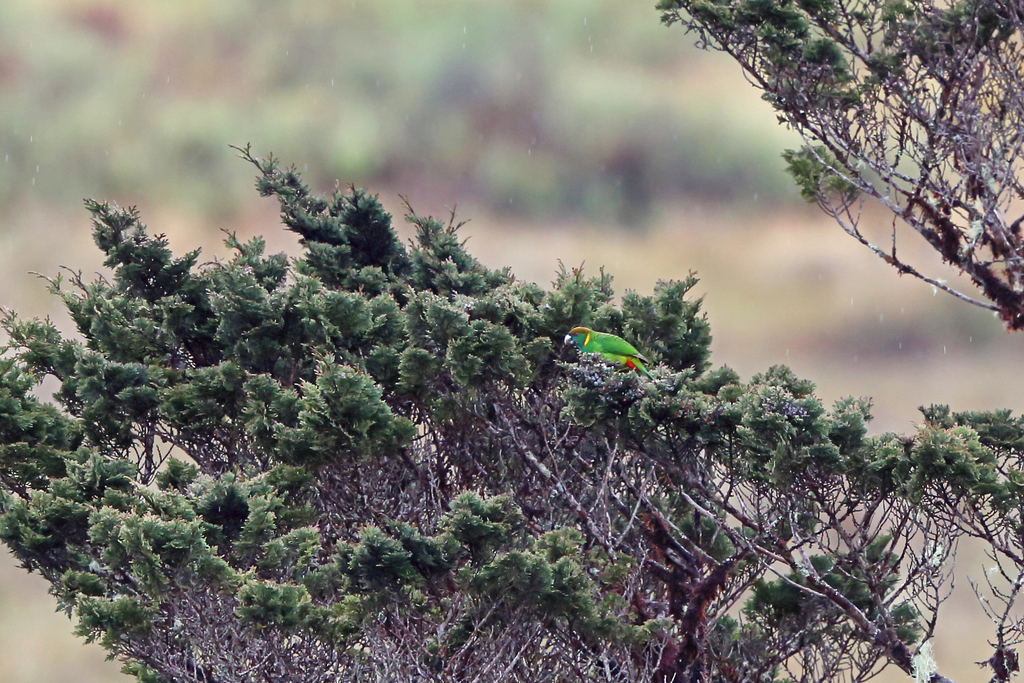
The painted tiger parrot has green wings and tail, red cap, yellow eye, red rump and tiger stripes on its back and belly.
Range & habitat
The total population of the painted tiger parrot is unknown, but wildlife surveys indicate that the population is stable and locally common. It is found throughout much of the Bismarck Range and Owen Stanley Range in the provinces of Western Province, Hela Province, Enga Province, Southern Highlands Province, Western Highlands Province, Chimbu Province, Eastern Highlands Province, Morobe Province, Central Province, Oro Province, and Milne Bay Province.
Wikipedia: “Distribution & population”
What it does
The painted tiger parrot occurs in montane and subalpine forests and shrub at elevations of 2,400-4,000 m. Often, this species is seen in cautiously feeding in low bushes, eating a variety of seeds, berries, and small fruits of dacrydium conifers. It is also known to feed alongside Madarasz's tiger parrot. When startled, it flies into the canopy. This species is usually seen in pairs of groups of up to six birds.
== References ==
Wikipedia: “Ecology”
Listen
Looking for field recordings…
Where it lives
Recorded sightings
—
geo-referenced records in GBIF, from museums, herbaria and field observers.
Drag the globe to turn it. Dots are where records exist, not a range map; darker means more records.
In the stacks
Searching the stacks…
Every page naming Psittacella picta in the Biodiversity Heritage Library →
This page is assembled live from iNaturalist, GBIF, Wikipedia, the Source Library and the Internet Archive. It is not yet part of the hand-edited codex. iNaturalist taxon 19288.