- Animals
- ›Chordates
- ›Vertebrates
- ›Birds
- ›Parrots
- ›Old World Parrots
- ›Broad-tailed Parrots and Allies
- ›Barnardius
On eBird ↗
Australian Ringneck
Live sightings near you, the range map, bar charts of when it is seen, and Macaulay Library photos and recordings.
Australian Ringneck
Barnardius zonarius
The Australian ringneck (Barnardius zonarius) is a parrot native to Australia. Except for extreme tropical and highland areas, the species has adapted to all conditions. Treatments of genus Barnardius have previously recognised two species, the Port Lincoln parrot (Barnardius zonarius) and the mallee ringneck (Barnardius barnardi), but due to these readily interbreeding at the contact zone they are usually regarded as a single species B. zonarius with subspecific descriptions. Currently, four subspecies are recognised, each with a distinct range.
In Western Australia, the ringneck competes for nesting space with the rainbow lorikeet, an introduced species. To protect the ringneck, culls of the lorikeet are sanctioned by authorities in this region. Overall, though, the ringneck is not a threatened species.
From the article Australian ringneck on Wikipedia (CC BY-SA), quoted section by section
Description
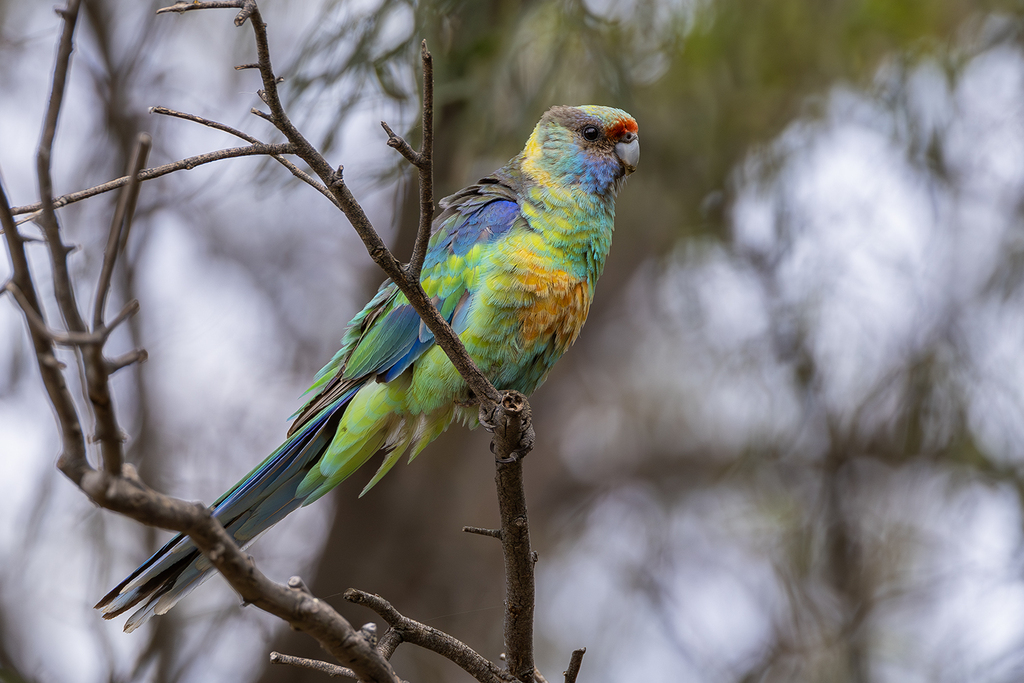
The subspecies of the Australian ringneck differ considerably in colouration. It is a medium size species around 33 cm (13 in) long. The basic colour is green, and all four subspecies have the characteristic yellow ring around the hindneck; wings and tail are a mixture of green and blue.
The B. z. zonarius and B. z. semitorquatus subspecies have a dull black head; back, rump and wings are brilliant green; throat and breast bluish-green. The difference between these two subspecies is that B. z. zonarius has a yellow abdomen while B. z. semitorquatus has a green abdomen; the latter has also a prominent crimson frontal band that the former lacks (the intermediate shown in the box has characteristics of both subspecies). The two other subspecies differ from these subspecies by the bright green crown and nape and blush cheek-patches. The underparts of B. z. barnardi are turquoise-green with an irregular orange-yellow band across the abdomen; the back and mantle are deep blackish-blue and this subspecies has a prominent red frontal band. The B. z. macgillivrayi is generally pale green, with no red frontal band, and a wide uniform pale yellow band across the abdomen. The calls of the Mallee ringneck and Cloncurry parrot have been described as "ringing", and the calls of the Port Lincoln ringneck and Twenty-eight parrot have been described as "strident". …
What it does
The Australian ringneck is active during the day and can be found in eucalypt woodlands and eucalypt-lined watercourses. The species is gregarious and depending on the conditions can be resident or nomadic. In trials of growing hybrid eucalypt trees in dry environments parrots, especially the Port Lincoln parrot, caused severe damage to the crowns of the younger trees during the research period between 2000–2003.
Feeding. This species eats a wide range of foods that include nectar, insects, seeds, fruit, and native and introduced bulbs. It will eat orchard-grown fruit and is sometimes seen as a pest by farmers.
Breeding. Breeding season for the northern populations starts in June or July, while the central and southern populations breed from August to December, but this can be delayed when climatic conditions are unfavourable. The nesting site is a hollow in a tree trunk. Generally four or five white oval eggs are laid measuring 29 mm x 23 mm, although a clutch may be as few as three and as many as six. Fledgling survival rates have been measured at 75%.
Wikipedia: “Behaviour”
Listen
Looking for field recordings…
Where it lives
Recorded sightings
—
geo-referenced records in GBIF, from museums, herbaria and field observers.
Drag the globe to turn it. Dots are where records exist, not a range map; darker means more records.
In the stacks
Searching the stacks…
Every page naming Barnardius zonarius in the Biodiversity Heritage Library →
This page is assembled live from iNaturalist, GBIF, Wikipedia, the Source Library and the Internet Archive. It is not yet part of the hand-edited codex. iNaturalist taxon 19265.