- Animals
- ›Chordates
- ›Vertebrates
- ›Birds
- ›Parrots
- ›Old World Parrots
- ›Long-tailed Parrots and allies
- ›Alisterus
On eBird ↗
Moluccan King-Parrot
Live sightings near you, the range map, bar charts of when it is seen, and Macaulay Library photos and recordings.
Moluccan King Parrot
Alisterus amboinensis
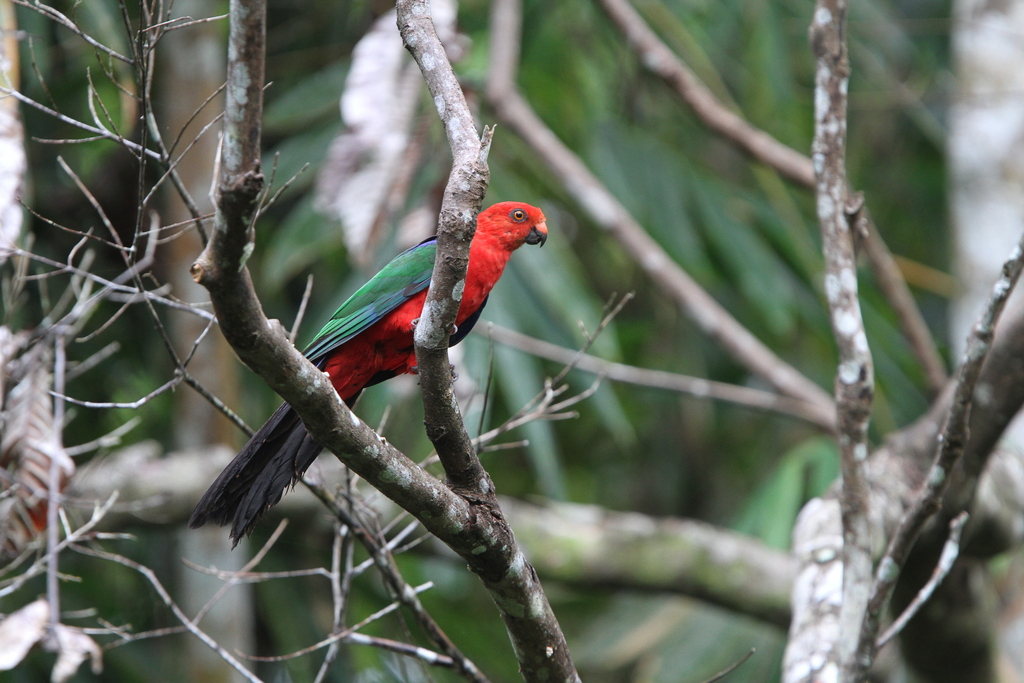
The Moluccan king parrot (Alisterus amboinensis) is a parrot endemic to Peleng Island, Maluku, and West Papua in Indonesia. It is sometimes referred to as the Ambon king parrot or Amboina king parrot, but this is potentially misleading, as it is found on numerous other islands than Ambon. The male and female are similar in appearance, with a predominantly red head and underparts, green wings (blue in one subspecies), and blue back and tail. Six subspecies are recognised, but only a few of these are regular in aviculture. In the wild, it inhabits rainforests and feeds on fruits, berries, seeds and buds.
From the article Moluccan king parrot on Wikipedia (CC BY-SA), quoted section by section
Description
An adult Moluccan king parrot measures 35–40 cm (14 in) in length and has a red head and chest, outer wings dull green (except in subspecies A. a. hypophonius, which are blue), mantle, lesser wing coverts and tail-coverts dark purple-blue. Tail darker blackish blue, irises orange, and the legs are dark grey. The lower mandible is blackish, and the upper mandible is orange-red with a blackish tip, except in the subspecies A. a. buruensis, where the entire bill is blackish. Unlike the other species of king parrots, the Moluccan king parrot does not display sexual dimorphism; that is, the sexes have similar plumage. Juvenile birds have a dark-brown bill tipped paler, greenish mantle, dark brown irises and red-tips to lateral tail feathers. Birds reach maturity in one year.
Range & habitat
The Moluccan king parrot inhabits rainforests, but sometimes enters nearby plantations and gardens. Exceptionally, it occurs at altitude up to 2100 m, but more commonly below 1200 m (New Guinea) or 1600 m (Maluku). It is generally uncommon due to habitat loss and capture for the parrot trade, but remains locally common at least on the Sula Islands, Halmahera, and Buru. Overall, the species is not believed to be in immediate danger, and consequently is listed as least concern by BirdLife International and IUCN. As most parrots, the Moluccan king parrot is listed in Appendix II of CITES.
Wikipedia: “Habitat and status”
What it does
Encountered alone or in pairs, occasionally in small groups, it mainly frequents dense cover in the lower and mid-levels of forests. It is inconspicuous and rather quiet, except in flight. It consumes fruit, berries, seeds and buds. Nesting takes place in a tree-hollow. The breeding season begins in February and March, although breeding has not been observed in the wild, in captivity the clutch consists of two eggs which are incubated for 19 days. After hatching the chicks are ready to fledge at nine weeks old.
Wikipedia: “Behavior”
In human culture
Until recently, only the subspecies A. a. amboinensis and A. a. hypophonius were regularly seen in aviculture, but A. a. buruensis and A. a. dorsalis are now also present, at least in zoos. It has regularly been bred in captivity, for example in Denmark.
Wikipedia: “Aviculture”
Listen
Looking for field recordings…
Where it lives
Recorded sightings
—
geo-referenced records in GBIF, from museums, herbaria and field observers.
Drag the globe to turn it. Dots are where records exist, not a range map; darker means more records.
In the stacks
Searching the stacks…
Every page naming Alisterus amboinensis in the Biodiversity Heritage Library →
This page is assembled live from iNaturalist, GBIF, Wikipedia, the Source Library and the Internet Archive. It is not yet part of the hand-edited codex. iNaturalist taxon 19198.