On eBird ↗
Green-cheeked Parakeet
Live sightings near you, the range map, bar charts of when it is seen, and Macaulay Library photos and recordings.
Green-cheeked Parakeet
Pyrrhura molinae
The green-cheeked parakeet (Pyrrhura molinae), also sometimes known as the green-cheeked conure in aviculture, is a species of bird in subfamily Arinae of the family Psittacidae, aka the parrots. It is found in Argentina, Bolivia, Brazil, and Paraguay. It is also a popular pet bird.
From the article Green-cheeked parakeet on Wikipedia (CC BY-SA), quoted section by section
Description
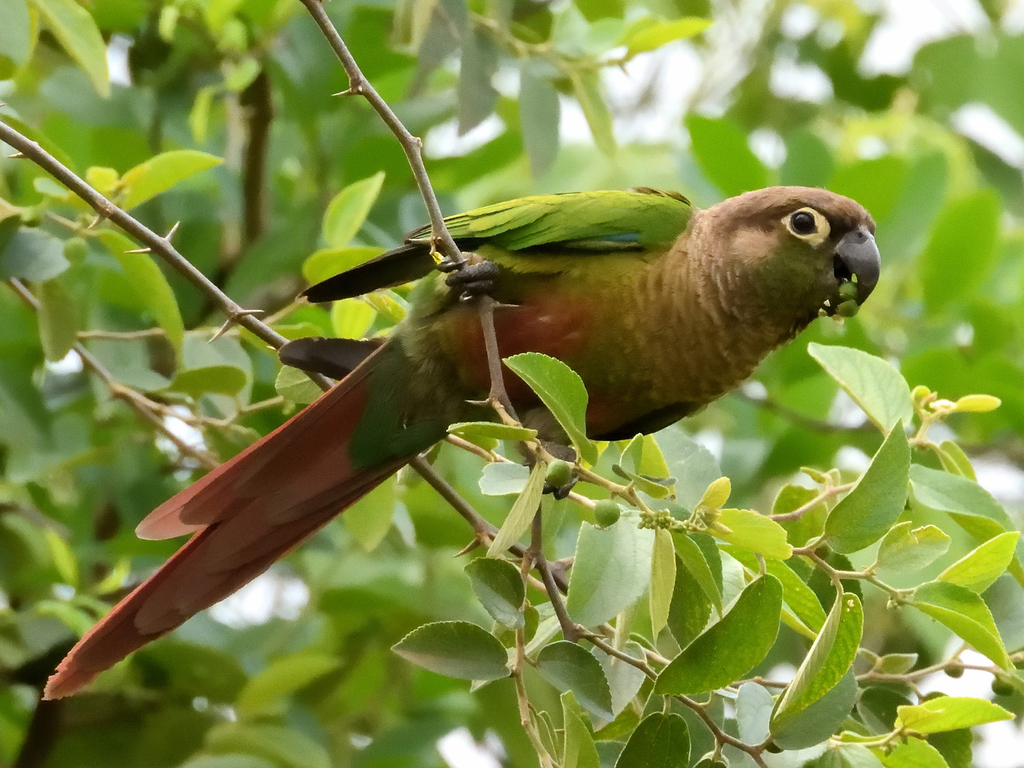
The green-cheeked parakeet is 25 to 26 cm (9.8 to 10 in) long and weighs 62 to 81 g (2.2 to 2.9 oz). The sexes are the same sizes. Adults of the nominate subspecies P. m. molinae are dull brown from forehead to nape and have green cheeks, ashy brown ear coverts, and a creamy white ring of bare skin around the eye. Their upperparts are green. Their chin, throat, and the sides of their neck are a scaly brown and whitish. Their belly is dull reddish and their lower flanks and vent area are green. Their wing is mostly green, with bluish flight feathers. Their tail is dull reddish. Immatures are similar to adults but without the red belly. Subspecies P. m. phoenicura is green on the upper surface of its tail's base. P. m. restricta has a blue collar, a blue tinge on its cheeks, and a smaller red belly patch than the nominate. P. m. hypoxantha has a paler crown and less distinct scaling on the breast than the nominate. P. m. australis is paler than the nominate and has a larger red belly patch. P. m. flavoptera is orange to red at the bend of the wing and on the carpal edge and is otherwise like the nominate. A small number of individuals of P. m. hypoxantha have mostly yellow underparts.
Range & habitat
The subspecies of the green-cheeked parakeet are found thus:
P. m. flavoptera, west-central Bolivia in southeastern La Paz and northwestern Cochabamba departments P. m. molinae, Bolivia between La Paz and Chuquisaca departments P. m. phoenicura, northeastern Santa Cruz Department in northeastern Bolivia and southwestern Mato Grosso in Brazil P. m. hypoxantha, eastern Santa Cruz Department in extreme eastern Bolivia, western Mato Grosso do Sul in southwestern Brazil, and northern Paraguay P. m. restricta, central Santa Cruz Department in east-central Bolivia P. m. australis, from southern Bolivia's Tarija Department into northwestern Argentina as far as Tucumán Province The green-cheeked parakeet inhabits lowland woodlands and forest (chiefly deciduous), secondary forest, and gallery forest in the lower elevations of the Pantanal and humid subtropical forest as high as 2,000 m (6,600 ft).
Wikipedia: “Distribution and habitat”
What it does
The green-cheeked parakeet has a varied diet that, in the wild, consists of fruits, seeds, flowers and, to a lesser extent, nectar and leaves.
Wikipedia: “Feeding”
In human culture
Green-cheeked parakeets are common in aviculture and are popular companion parrots. They are considered playful, affectionate and intelligent, known as having a "big personality in a small body". They can learn to talk, albeit with a limited vocabulary and a gravelly voice. Green-cheeked parakeets are relatively quiet for a domestic bird species, making them suitable for prospective bird owners who share walls with neighbours; they are the quietest of the conures. When cared for properly, captive green-cheeked parakeets can live 25–30 years. However, their average lifespan in captivity is closer to 10 years, due to frequent neglect and/or an incorrect diet.
Color variations. In addition to the natural color forms, color varieties have been selectively bred in aviculture:
Cinnamon are lime green and have a lighter, paler coloring. The head is tan and the tail feathers are a lighter maroon compared to normal green-cheeked parakeets. Yellow-sided have bright-colored breasts that graduate from red to yellow and dark gray heads. Rarely, they also possess a bright yellow feather on each side of the upper wing. This is a rare recessive character of which only one hatchling in approximately 10 clutches can be found to have. This feature often increases their value. Pineapple are a combination of the cinnamon and yellow-sided variations. …
Wikipedia: “In aviculture”
Listen
Looking for field recordings…
Where it lives
Recorded sightings
—
geo-referenced records in GBIF, from museums, herbaria and field observers.
Drag the globe to turn it. Dots are where records exist, not a range map; darker means more records.
In the stacks
Searching the stacks…
Every page naming Pyrrhura molinae in the Biodiversity Heritage Library →
This page is assembled live from iNaturalist, GBIF, Wikipedia, the Source Library and the Internet Archive. It is not yet part of the hand-edited codex. iNaturalist taxon 19152.