On eBird ↗
Short-tailed Parrot
Live sightings near you, the range map, bar charts of when it is seen, and Macaulay Library photos and recordings.
Short-tailed Parrot
Graydidascalus brachyurus
The short-tailed parrot (Graydidascalus brachyurus) is the only species of the genus Graydidascalus. It is found along both banks of the Amazon river and other major Amazonian rivers in Brazil, Colombia, Bolivia, Ecuador and Peru. As suggested by its range, it is associated with the specific forest and woodland types growing near major rivers, although it also extends into the coastal deltas of French Guiana and Amapá, Brazil.
From the article Short-tailed parrot on Wikipedia (CC BY-SA), quoted section by section
Description
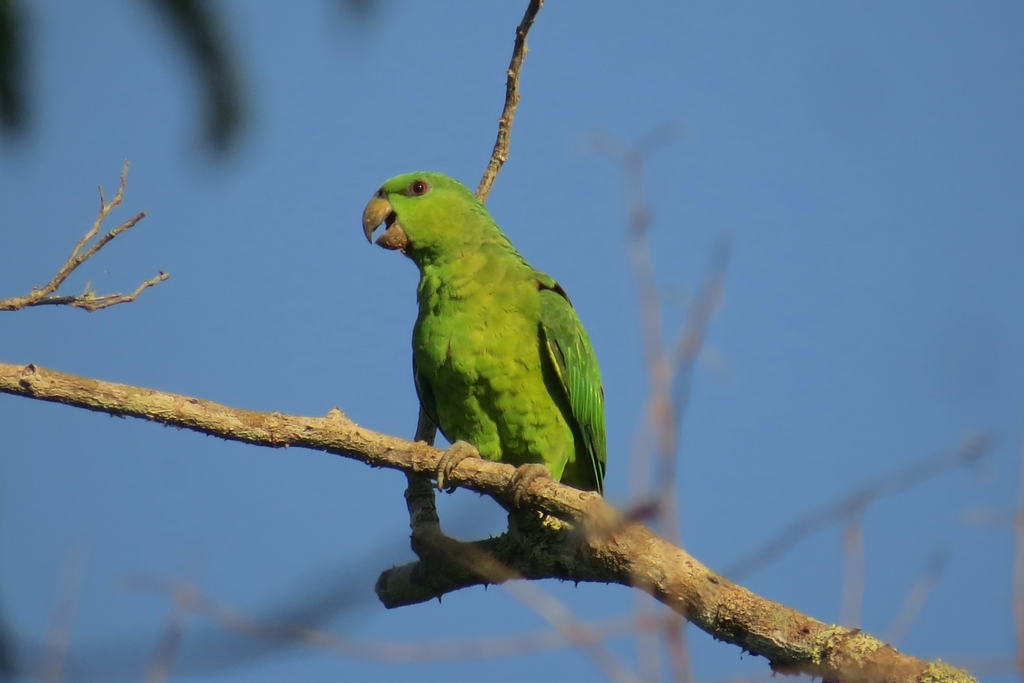
The short-tailed parrot is 24 to 25 cm (9.4 to 9.8 in) long and weighs 188 to 233 g (6.6 to 8.2 oz). It has a large head and, as suggested by its name, a very short tail. Adults are almost entirely green that is yellowish on their underparts and their uppertail coverts. Their lores are dark which continues behind the eye. Their primaries are a darker green and their wing coverts have yellow edges. Their shoulder is a reddish brown that is seldom visible except in flight. Their outer tail feathers have red bands at their base. Their bill ranges from light green to dark gray and their iris is orange-red. Immature birds are the same as adults except they have no red on their tail.
Range & habitat
The short-tailed parrot is found along the Amazon River and its tributaries from southern Colombia, northeastern Ecuador, and northeastern Peru to the Atlantic. Its range also extends north along the coast of Brazil into northeastern French Guiana. Along the rivers it inhabits várzea, swampy floodplains, and islands; on the coast it inhabits mangroves. It also locally ranges into cultivated areas. In elevation it ranges from sea level to about 400 m (1,310 ft).
Wikipedia: “Distribution and habitat”
What it does
The short-tailed parrot feeds on fruits, especially those of figs (Ficus), and on those of cultivated guava (Psidium guajava) and mango (Mangifera indica). It also feeds on seeds, nuts, berries, and the catkins of Cecropia.
Wikipedia: “Feeding”
Listen
Looking for field recordings…
Where it lives
Recorded sightings
—
geo-referenced records in GBIF, from museums, herbaria and field observers.
Drag the globe to turn it. Dots are where records exist, not a range map; darker means more records.
In the stacks
Searching the stacks…
Every page naming Graydidascalus brachyurus in the Biodiversity Heritage Library →
This page is assembled live from iNaturalist, GBIF, Wikipedia, the Source Library and the Internet Archive. It is not yet part of the hand-edited codex. iNaturalist taxon 19127.