- Plants
- ›Vascular Plants
- ›flowering plants
- ›Dicots
- ›Legumes, Milkworts, and Allies
- ›Legumes
- ›Peacock Flower Subfamily
- ›Caesalpinieae
- ›Cordeauxia
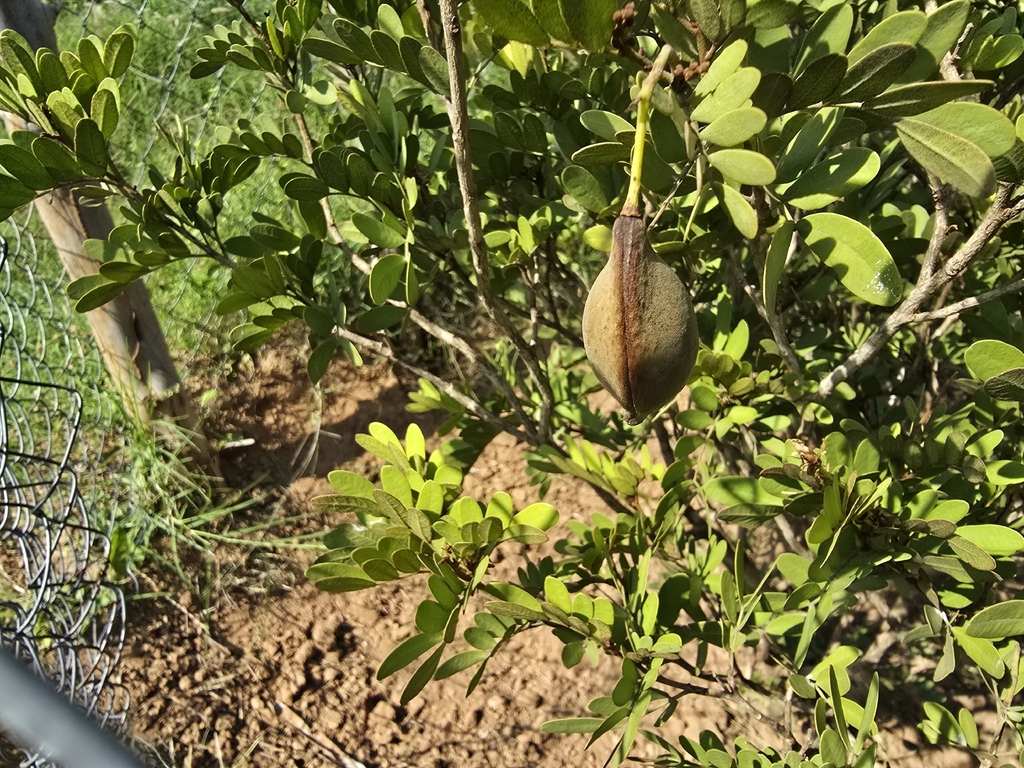
yeheb bush
Cordeauxia edulis
Cordeauxia edulis is a plant in the family Fabaceae and the sole species in the genus Cordeauxia. Known by the common name yeheb bush, it is one of the economically most important wild plants of the Horn of Africa, but it is little known outside of its distribution area. It is a multipurpose plant, which allows the survival of nomads by providing them with seeds. Further, the bush serves forage for livestock, firewood and dye. Its wild population is currently declining. Because it is potentially valuable for other hot, dry regions as a resource for food and fodder, it is recommended to take measures against its extinction.
From the article Cordeauxia on Wikipedia (CC BY-SA), quoted section by section
Range & habitat
The yeheb tree is native in the arid and semi-arid areas in Somalia (Ogaden). Its distribution has rapidly declined from 50% coverage down to only small locations nowadays. These regions are often semi-deserts or open bushy steppes located at altitudes from 100 to 300m. The rainfall rates are very low and frost does not occur. The ground is a very poor red sandy soils. The existence of C. edulis is threatened by war, over-utilization and by drought. Another cause for the decrease of C. edulis is the loss of seeds removed through the local people, eaten by wildlife and destroyed by insects. Its extinction would represent an irreplaceable loss for the long-term survival of the nomadic populations. In 1975, the National Range Agency of Somalia protected an area of about 50ha by prohibiting grazing. Since then, many other areas have been protected from grazing. In these areas and in all the native areas, the situation of Yeheb bush had considerably improved according to a 1983 study. However, a mission in 2015 found that the species had disappeared from the Haud plateau of Somaliland, although still to be found on the Ethiopian side of the border. It is exotic in Israel, Kenya, Sudan, Tanzania and in the Republic of Yemen. …
Wikipedia: “Distribution”
At the table
The seeds are rich in starch, sugar, protein and fat. The Suley variety shows higher protein and fat content than the Moqley variety. Their carbohydrate and protein contents are less than those of most other legumes eaten in the Horn of Africa. However, C. edulis grows where it is impossible for the usual legumes to grow. The amino-acid composition of C.edulis is close to that of the Papilionaceae (e.g. Methionine-deficient).
The seeds of yeheb are rich in sodium, potassium and phosphorus; thus they contain a small amount of calcium and magnesium.
Both varieties contain a lot of amino acids; yeheb seeds have a high content of the essential amino acids lysine and arginine, but are deficient in tryptophan and isoleucine. Phytohaemagglutinin, a toxic lectin often present in legumes, is absent in Yeheb seeds; this is an additional nutritional advantage.
== References ==
Wikipedia: “Nutritional aspects”
How it is grown
C. edulis is cultivated on a small scale in Somalia and near Voi in Kenya. It has only recently been a subject to domestication, therefore little knowledge about propagation, the agronomic practices and its potential for selection as well as breeding exists. The potential of this multipurpose plant is very promising, especially for other arid, hot regions as an important food and fodder resource.
Environmental requirements. C. edulis is a drought resistant plant and tolerant to desertification. For optimal plant development, average temperature and rainfall requirements are 25 °C and 250 - 400mm/year (two rainy seasons). Occasionally the Yeheb tree can also cope with minimal precipitation levels of 150–200 mm/year. It grows on red sandy soils (called Haud) with a low nitrogen content. The soils are alkaline and their texture is fine to coarse sand or grit to loamy sand. C. edulis prefers elevated stands, where no water accumulates. It grows in altitudes between 100–1000 m and is found in vegetation with acacia-commiphora deciduous bushland and thickets.
Sowing. The seed is often said to be viable for a few months only, but seed coated in wood ash and stored in a sack is reputed to remain viable for at least a year. The seeds should be sown on soils where the taproot can develop. There is no information available on optimal density and spacing. …
Wikipedia: “Cultivation”
In human culture
The yeheb nut bush has been known to the Somali nomads for centuries. The first Western record dates back to 1871, when the Italian explorer Luigi Robecchi Bricchetti noticed the plant when traversing Somalia to Bari. The bush has been named after Cordeaux, a botanic who first obtained botanical specimens in the Ogaden province (Somali Galbeed) which were found to be a leguminous plant belonging to a hitherto unknown genus in the Caesalpinaceae. Afterward, Hemsley gave the plant the generic name Cordeauxia, with the specific epithet edulis (edible). In 1929, the yeheb bush covered half of the vegetation of large territories in Somalia and Somali region. In 1983 the distribution has been reduced to small regions.
Wikipedia: “History”
Where it lives
Recorded sightings
—
geo-referenced records in GBIF, from museums, herbaria and field observers.
Drag the globe to turn it. Dots are where records exist, not a range map; darker means more records.
In the stacks
Searching the stacks…
Every page naming Cordeauxia edulis in the Biodiversity Heritage Library →
This page is assembled live from iNaturalist, GBIF, Wikipedia, the Source Library and the Internet Archive. It is not yet part of the hand-edited codex. iNaturalist taxon 190872.