- Animals
- ›Chordates
- ›Vertebrates
- ›Birds
- ›Parrots
- ›Old World Parrots
- ›Lovebirds and Hanging Parrots
- ›Agapornis
On eBird ↗
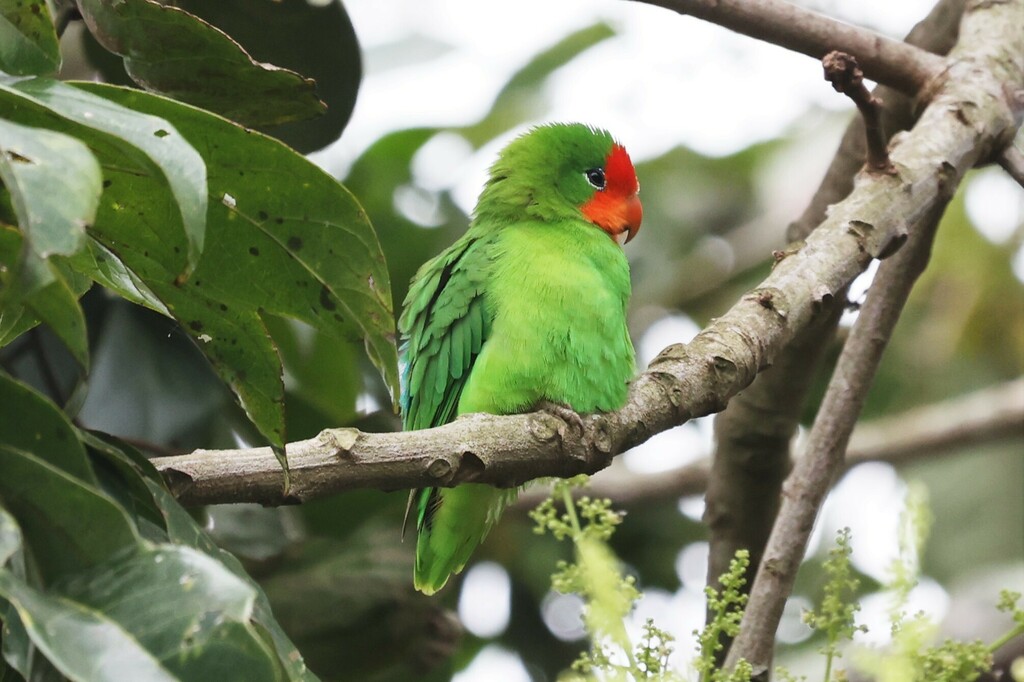
Red-headed Lovebird
Live sightings near you, the range map, bar charts of when it is seen, and Macaulay Library photos and recordings.
Red-headed Lovebird
Agapornis pullarius
The red-headed lovebird (Agapornis pullarius), also known as the red-faced lovebird, is a member of the genus Agapornis, a group commonly known as lovebirds. Like other lovebirds, it is native to Africa.
From the article Red-headed lovebird on Wikipedia (CC BY-SA), quoted section by section
Description
The red-headed lovebird is a 15 cm (6 inches) long, mostly green parrot. It has a well demarcated red area on its head extending from the top of the beak, over the forehead to mid-crown, and extending to the left and right up to the eyelid margins. It has grey feet. The underside of the wings is a lighter green. The female has orange head colouring, which is less well demarcated than the male's red head. The adult male has a red beak while the female's is a paler red.
In human culture
It is difficult to breed in captivity because it has to burrow to make its nest and the nest chamber needs to be heated to about 27 °C (81 °F); however, they can be induced to burrow into cork to build a nest. It is a very nervous species.
Wikipedia: “Aviculture”
Listen
Looking for field recordings…
Where it lives
Recorded sightings
—
geo-referenced records in GBIF, from museums, herbaria and field observers.
Drag the globe to turn it. Dots are where records exist, not a range map; darker means more records.
In the stacks
Searching the stacks…
Every page naming Agapornis pullarius in the Biodiversity Heritage Library →
This page is assembled live from iNaturalist, GBIF, Wikipedia, the Source Library and the Internet Archive. It is not yet part of the hand-edited codex. iNaturalist taxon 19072.