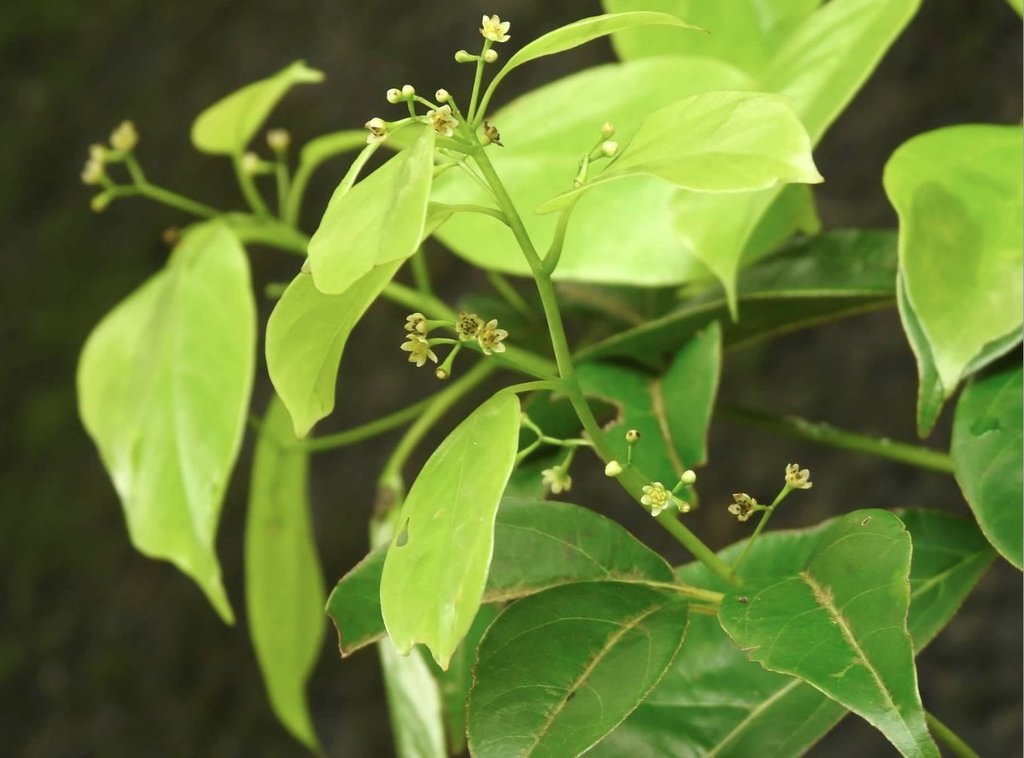
Martaban camphor wood
Cinnamomum parthenoxylon
Cinnamomum parthenoxylon is an evergreen tree in the genus Cinnamomum, 10–20 m (33–66 ft) tall. It is native to South and East Asia (Bhutan, Myanmar, Cambodia, China, India, Indonesia, Laos, Malaysia, Nepal, Philippines, Thailand, and Vietnam). In Vietnam, the tree is considered Critically endangered.
From the article Camphora parthenoxylon on Wikipedia (CC BY-SA), quoted section by section
Description
Camphora parthenoxylon is an evergreen tree that can grows up to 50 metres tall. with a trunk to 60 cm in diameter. The tree has greenish brown bark with deep fissures that peels off in small flakes. The entire tree emits a strong camphora-scent. Its leaves are glossy green ovals 7–10 cm long with a point at the end. Like many plants in the Lauraceae, the leaves give off a pleasant smell when crushed. The flowers appear in clusters, very small, and are greenish yellow in colour. The fruits are drupes that turns black when matured.
Life cycle. The species flowers from March to May, and fruits from April to October.
Range & habitat
Camphora parthenoxylon is a widely distributed tree native to South and Southeast Asia and parts of Australasia, including southern and southwestern China, Nepal, eastern Himalayas, Assam, Indochina, Hainan, Peninsular Malaysia, Sumatra, Java, Borneo, the Lesser Sunda Islands, Pakistan, and southern Australia. The estimated extent of occurrence (EOO) is very large at 8,025,973 km2, with an area of occupancy (AOO) of 520 km2. The species grows in primary and secondary lowland and montane tropical and subtropical humid forests, from sea level up to 2,000 metres. It can grow on sand, sandstone, or granite substrates. In Borneo, it occurs in Sarawak, Sabah, and East Kalimantan, where it is found in lowland and montane rainforests, often in secondary vegetation.
Wikipedia: “Range and habitat”
At the table
The aromatic bark of Camphora parthenoxylon is used for flavoring, like that of many other Cinnamomum species. The wood and fruit emit a strong camphor scent that repels insects, and the essential oils from its wood and leaves, known as "camphora oil", are effective in controlling household pests. The bark extract has also shown medicinal potential; in rats, it was found to reduce postprandial hyperglycemia. The durable, insect-resistant wood is valued for shipbuilding, furniture, and artwork, while the seeds can be processed into soap. Additionally, its straight trunk and large canopy make it an excellent shade tree for streets and parks. In Indonesia, the flowers hold cultural significance, symbolizing love and the connection between the living and the dead. In Kudus Regency, Java, they were traditionally scattered on tombs by family members.
However, the tree is under significant pressure from harvesting for safrole, a compound used to produce the pesticide synergist piperonyl butoxide, the flavor and fragrance compound piperonal, and the psychoactive drug MDMA. Much of this illicit collection occurs in Cambodia's Cardamom Mountains and Botum Sakor National Park, a situation explored in the 2009 TV documentary Forest of Ecstasy, an episode of Vanguard.
Wikipedia: “Uses”
Where it lives
Recorded sightings
—
geo-referenced records in GBIF, from museums, herbaria and field observers.
Drag the globe to turn it. Dots are where records exist, not a range map; darker means more records.
In the stacks
Searching the stacks…
Every page naming Cinnamomum parthenoxylon in the Biodiversity Heritage Library →
This page is assembled live from iNaturalist, GBIF, Wikipedia, the Source Library and the Internet Archive. It is not yet part of the hand-edited codex. iNaturalist taxon 190594.