On eBird ↗
Cape Parrot
Live sightings near you, the range map, bar charts of when it is seen, and Macaulay Library photos and recordings.
Cape Parrot
Poicephalus robustus
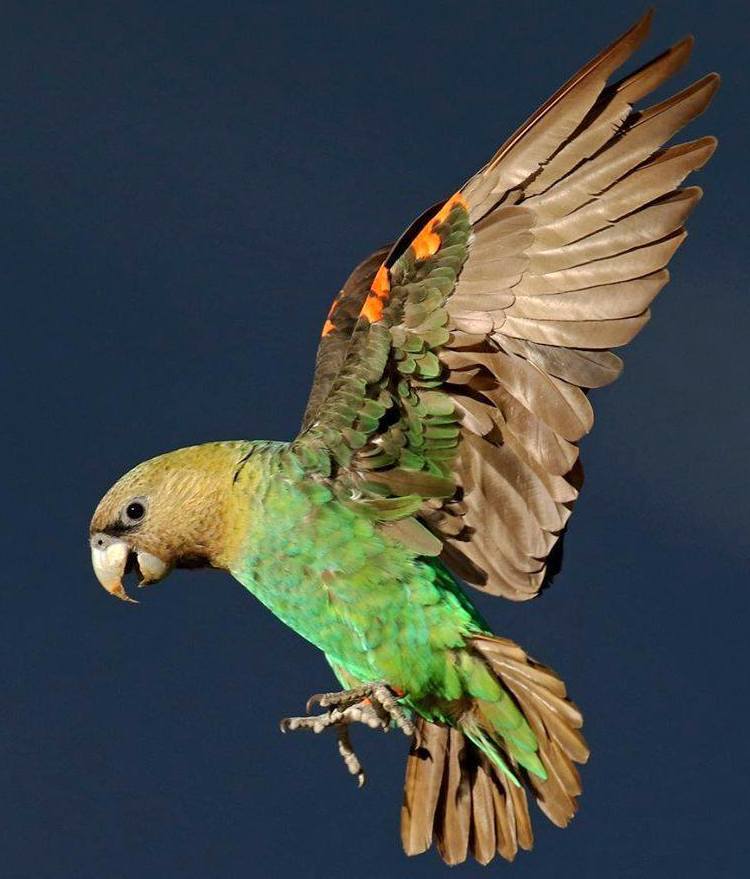
The Cape parrot (Poicephalus robustus) or Levaillant's parrot is a large, temperate forest dwelling parrot of the genus Poicephalus endemic to South Africa. It was formerly grouped as a subspecies along with the savanna-dwelling brown-necked parrot (P. fuscicollis fuscicollis) and grey-headed parrot (P. f. suahelicus), but is now considered a distinct species.
From the article Cape parrot on Wikipedia (CC BY-SA), quoted section by section
Description
The Cape parrot is a short-tailed moderately large bird with a very large beak used to crack all sorts of hard nuts and fruit kernels, especially those of African yellowwood trees (Podocarpus spp.). This contrasts with the closely related savanna species (Poicephalus fuscicollis) which feeds on a wide variety of tropical woodland trees such as marula, Commiphora spp. and Terminalia spp. These species are sexually dimorphic, with females typically sporting an orange frontal patch on the forehead. Juveniles also show a larger orange - pink patch on the forehead but lack the red on shoulders and legs of adults. These plumage characteristics vary among individuals and among the three recognized forms.
Range & habitat
The Cape parrot is endemic to South Africa. It occurs in Afromontane forests at moderate altitudes in eastern South Africa from the coastal escarpment near sea-level to the midlands at around 1000m. These forests occur as a series of small patches around the south and east of South Africa and are dominated by yellowwood trees (Podocarpus latifolius, Podocarpus falcatus and Podocarpus henkelii). Cape parrots have a disjunct distribution with the largest population around in the Amathole mountains of the Eastern Cape Province and extending east, with several large gaps, through the Mthatha escarpment and Pondoland in the Eastern Cape and the southern midlands of KwaZulu-Natal Province to Karkloof, near Pietermaritzburg. A very small population, of around 30 individuals occurs over 600 km to the north in the Magoebaskloof area of Limpopo Province. Cape parrots are absent from large areas of afromontane forests such as those along the southern coast of South Africa, near Knysna, the higher altitude Afromontane forests in the Drakensberg mountains of KwaZulu-Natal, or the moderate-altitude forests of northern KwaZulu-Natal province and Eswatini, which separate the KwaZulu-Natal midlands and Limpopo escarpment populations. All of these areas are within the dispersal range of the parrots and there are old records of Cape parrots from northern KwaZulu-Natal.
Wikipedia: “Distribution and habitat”
In human culture
Over one hundred P. robustus parrots are kept as cage birds, most of which are wild-caught birds although they do breed reasonably well in captivity. To date there have not been any successful releases of captive birds and the survival of this species is dependent on habitat conservation to maintain wild populations. Trade and export of wild-caught Cape parrots from South Africa has been made illegal by the international CITES agreement (appendix list II) and by South African law. They are regarded for their intelligence. A small trade still persists in the related Grey-headed and brown-necked parrots.
Wikipedia: “Aviculture”
Listen
Looking for field recordings…
Where it lives
Recorded sightings
—
geo-referenced records in GBIF, from museums, herbaria and field observers.
Drag the globe to turn it. Dots are where records exist, not a range map; darker means more records.
In the stacks
Searching the stacks…
Every page naming Poicephalus robustus in the Biodiversity Heritage Library →
This page is assembled live from iNaturalist, GBIF, Wikipedia, the Source Library and the Internet Archive. It is not yet part of the hand-edited codex. iNaturalist taxon 19056.