On eBird ↗
Red-fronted Parrot
Live sightings near you, the range map, bar charts of when it is seen, and Macaulay Library photos and recordings.
Red-fronted Parrot
Poicephalus gulielmi
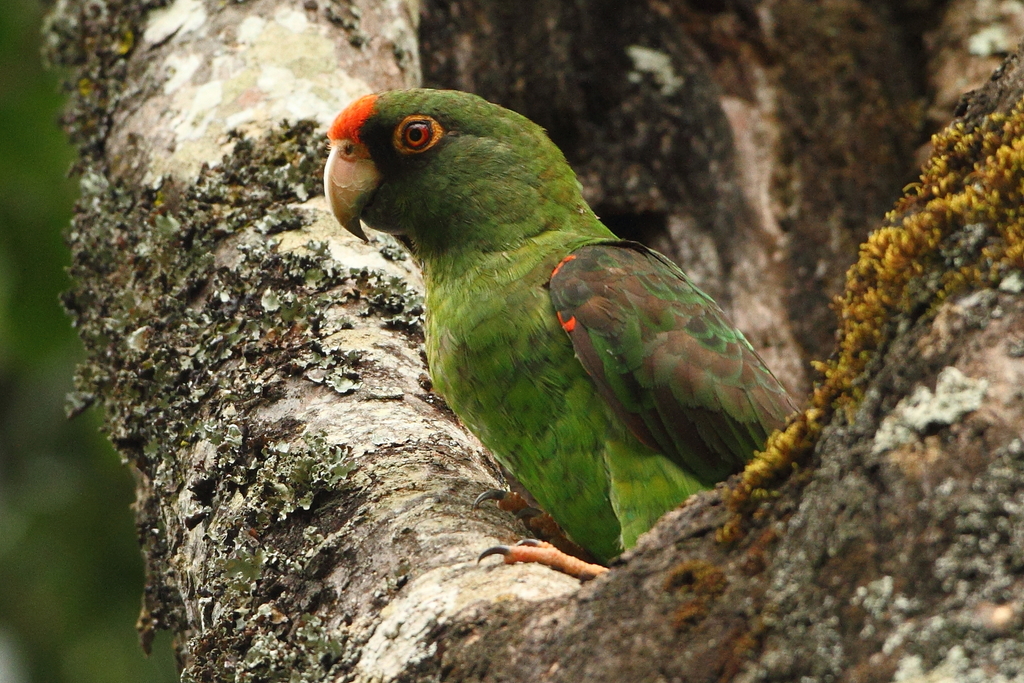
The red-fronted parrot (Poicephalus gulielmi), also known as Jardine's parrot, is a medium-sized mainly green parrot distributed across wide areas of Africa. It has three subspecies. The extent and shade of the red or orange plumage on its head, thighs, and bend of wings vary depending on the subspecies.
They are popular as pets, partly because of their ability to mimic speech and copy sounds. Trapping of wild birds for the pet trade is a potential threat to wild populations; however, they are protected by CITES (appendix II) making the trade, import and export of all wild-caught parrots illegal.
From the article Red-fronted parrot on Wikipedia (CC BY-SA), quoted section by section
Description
The red-fronted parrot is 28 cm (11 in) long. It is mostly green and has a short black squarish tail. Black feathers on the head, neck, back, and wings have lighter green edges giving a scalloped appearance. The lower mandible is dark grey and the upper mandible has a horn coloured base and a dark grey tip. The irises are red-orange, the eyerings are pinkish-grey, and the legs are grey-brown. The amount of red or orange on the forecrown, the bend of the wing, and thighs varies in the three subspecies but is absent in all young birds – juveniles having a dark smokey appearance above a paler beak and brown irises. The adult male and female are identical in external appearance. Sex determination of chicks is normally carried out by breeders using DNA analysis of a feather sample or by internal examination of the cloaca. The latter method is cheaper and quicker but does cause some distress to the bird.
What it does
They fly swiftly making noisy calls above the forest in pairs or small groups between their night-time roosts and feeding grounds. They feed quietly in the upper canopy of trees, where they are well camouflaged.
Wikipedia: “Feeding”
Listen
Looking for field recordings…
Where it lives
Recorded sightings
—
geo-referenced records in GBIF, from museums, herbaria and field observers.
Drag the globe to turn it. Dots are where records exist, not a range map; darker means more records.
In the stacks
Searching the stacks…
Every page naming Poicephalus gulielmi in the Biodiversity Heritage Library →
This page is assembled live from iNaturalist, GBIF, Wikipedia, the Source Library and the Internet Archive. It is not yet part of the hand-edited codex. iNaturalist taxon 19053.