On eBird ↗
Senegal Parrot
Live sightings near you, the range map, bar charts of when it is seen, and Macaulay Library photos and recordings.
Senegal Parrot
Poicephalus senegalus
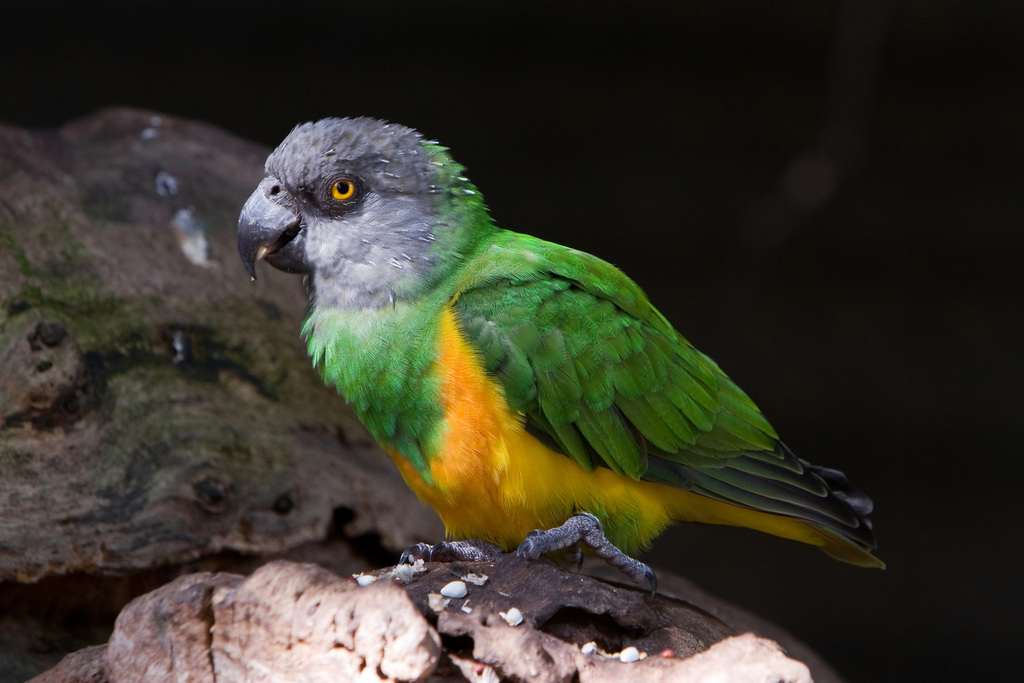
The Senegal parrot (Poicephalus senegalus) is a Poicephalus parrot which is a resident breeder across a wide range of west Africa. It makes migrations within west Africa, according to the availability of the fruit, seeds and blossoms which make up its diet. It is considered a farm pest in Africa, often feeding on maize or millet. It is popular in aviculture.
From the article Senegal parrot on Wikipedia (CC BY-SA), quoted section by section
Description
Senegal parrots are about 23 centimetres (9.1 inches) long, weigh about 120 to 170 grams (4.2 to 6.0 ounces). They have a relatively large head and beak for their overall size, and feathers form a short broad tail. Adults have a charcoal grey head, grey beak, bright yellow irises, green back and throat, and yellow underparts and rump. The yellow and green areas on a Senegal parrot's front form a V-shape resembling a yellow vest worn over green. Young juveniles have dark grey, almost black, irises, which change to light grey. Senegal parrots are not sexually dimorphic, but there are some hypotheses which sometimes might help to determine the sex of adult birds:
The V-shape of the vest is usually longer in females; in females the green area extends down over the chest to between the legs, whereas in males the tip of the green area ends midway down the chest. The female's beak and head are generally slightly smaller and narrower than the male's. The under-tail covert feathers (short feathers under the base of the main tail feathers) are generally mostly yellow in the male and generally mostly green in the female. Males are generally, but not always, larger and heavier than female birds. DNA testing is another way to determine the sex. Senegal parrots are birds of open woodland and savanna. They flock most commonly in countries in West Africa. …
What it does
Senegal parrots nest in holes in trees, often oil palms, usually laying three to four white eggs. The eggs are about 3 centimetres (1.2 inches) long by 2.5 centimetres (1 inch) wide. The eggs are incubated by the female, starting after the second egg has been laid, for about 27 to 28 days. Newly hatched chicks have a sparse white down and they do not open their eyes until about two to three weeks after hatching. They are dependent on the female for food and warmth who remains in the nest most of the time until about four weeks after hatching when the chicks have enough feathers for heat insulation. During this time the male brings food for the female and chicks, and guards the nest site. From about two to four weeks after hatching the female also begins to collect food for the chicks. The chicks fly out of the nest at about 9 weeks and they become independent from their parents at about 12 weeks after hatching.
Wikipedia: “Behaviour”
Listen
Looking for field recordings…
Where it lives
Recorded sightings
—
geo-referenced records in GBIF, from museums, herbaria and field observers.
Drag the globe to turn it. Dots are where records exist, not a range map; darker means more records.
In the stacks
Searching the stacks…
Every page naming Poicephalus senegalus in the Biodiversity Heritage Library →
This page is assembled live from iNaturalist, GBIF, Wikipedia, the Source Library and the Internet Archive. It is not yet part of the hand-edited codex. iNaturalist taxon 19052.