On eBird ↗
Rufous-fronted Parakeet
Live sightings near you, the range map, bar charts of when it is seen, and Macaulay Library photos and recordings.
Rufous-fronted Parakeet
Bolborhynchus ferrugineifrons
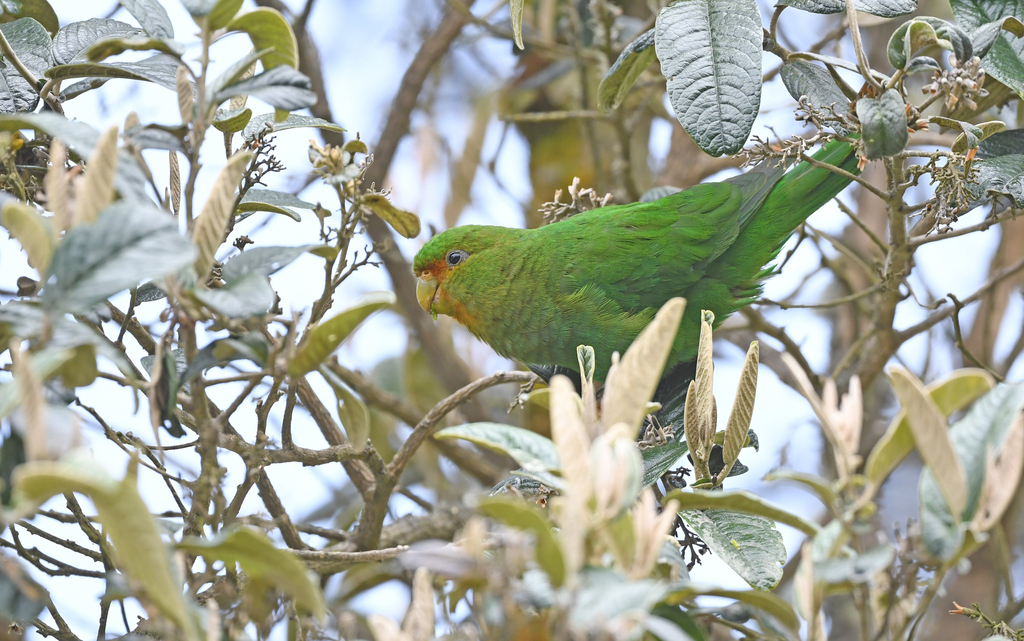
The rufous-fronted parakeet (Bolborhynchus ferrugineifrons) is a species of parrot in the family Psittacidae. Endemic to Colombia, its natural habitats are high-altitude shrubland, high-altitude grassland and arable land. It is threatened by habitat destruction and is classified as "vulnerable" by the International Union for Conservation of Nature.
From the article Rufous-fronted parakeet on Wikipedia (CC BY-SA), quoted section by section
Description
This parakeet grows to a length of about 18 cm (7 in) and the sexes are similar. This is a robust, small species with dull green plumage above and bluish-green wings. The lores and a narrow band on the forehead are brownish-red, and the cheeks, throat, breast and belly are yellowish-green. The short, pointed tail is green above and bluish-green below. There is a grey ring round the eye, the iris is brown, the beak is yellowish-horn and the feet are grey.
Range & habitat
The species is endemic to Colombia where it is found in two areas of the High Andes at altitudes between about 3,000 and 4,000 m (10,000 and 13,000 ft). The largest population is on the Volcán Ruiz-Tolima massif in the Central Cordillera but there is a smaller population on Puracé Volcano in the Cauca Department, and the bird's range may well include the intervening area. Its typical habitat is páramo, a high altitude grass and shrub ecosystem lying between the high snow-capped mountains and the montane forest below, and sub-páramo. It is also present in montane shrublands, and even agricultural land at high elevations.
Wikipedia: “Distribution and habitat”
What it does
The rufous-fronted parakeet is gregarious, forming small flocks of 10 to 100. It feeds mostly on the ground, eating grass seed, flowers and fruits. It roosts on cliffs and also nests there, but little is known of its reproductive habits.
Wikipedia: “Ecology”
Listen
Looking for field recordings…
Where it lives
Recorded sightings
—
geo-referenced records in GBIF, from museums, herbaria and field observers.
Drag the globe to turn it. Dots are where records exist, not a range map; darker means more records.
In the stacks
This page is assembled live from iNaturalist, GBIF, Wikipedia, the Source Library and the Internet Archive. It is not yet part of the hand-edited codex. iNaturalist taxon 19035.