On eBird ↗
Mealy Amazon
Live sightings near you, the range map, bar charts of when it is seen, and Macaulay Library photos and recordings.
Mealy Amazon
Amazona farinosa
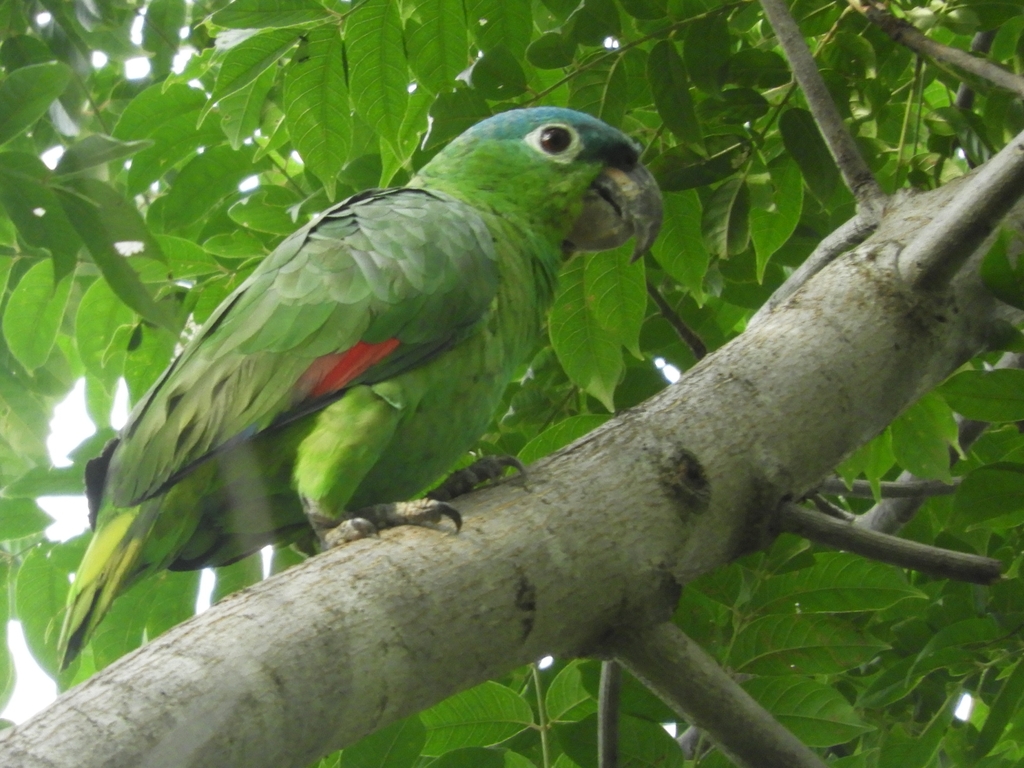
The southern mealy amazon or southern mealy parrot (Amazona farinosa) is among the largest parrot in the Amazona genus, the amazon parrots. It is a mainly green parrot with a total length of 38–41 cm (15–16 in). It is endemic to tropical Central and South America. This species and the northern mealy amazon were previously considered conspecific. Some taxonomic authorities (including the American Ornithological Society, continue to lump them together.
From the article Mealy amazon on Wikipedia (CC BY-SA), quoted section by section
Description
The mealy amazon has a total length of about 38–41 cm (15–16 in) and weighs 540–700 g (19–25 oz). Captives commonly are heavier. It is among the largest parrots in the Americas, mainly being surpassed by the large macaws. It has a relatively short and square shaped tail, as do the other members of the Amazona genus.
The mealy amazon is mainly green. The back and nape often have a whitish tinge; almost as if it had been covered in a thin layer of flour ("meal"; hence its name). The distal half of the tail is paler and more yellow than the basal half, thus resulting in a distinctly bi-colored look. In flight it shows a bluish-black trailing edge to the wing and a conspicuous red speculum. Occasionally a few yellow feathers are apparent on the top of the head. In South America, it is commonly confused with the yellow-crowned amazon, but can be recognized by its larger size, less yellow to the crown (not entirely reliable, as some yellow-crowned may show almost none), the whitish tinge to its plumage, broader white eye-ring, and red of the leading edge of the wing placed near the phalanx (not near the radiale), but this is often difficult to see (especially on perched birds). Their voices are also strikingly different.
Range & habitat
The mealy amazon occurs in tropical Central America and South America. It frequents humid to semi-humid forest (only rarely in deciduous forest) and plantations. In regions dominated by open/dry habitats it is restricted to gallery forest or completely absent.
Wikipedia: “Distribution and habitat”
What it does
The mealy amazon is social and can be found in pairs or in large flocks. They are even known to interact with other parrots, such as macaws. They are usually quiet but can be loud at dusk and dawn. In captivity, they are known as one of the gentlest and calmest of all amazons.
Breeding. After mealy amazons reach sexual maturity they usually form monogamous relationships with a single partner. Each year courtship usually begins in early spring, and the female will usually lay three or four white eggs in a tree-cavity nest. The female incubates the eggs for about 26 days. The male regurgitates food for the female during the incubation period, and later for the chicks in the nest as well. The chicks leave the nest about 60 days after hatching.
Food and feeding. The diet of the mealy amazon consists mostly of fruits, seeds, berries, nuts, blossoms, and leaf buds.
Wikipedia: “Behaviour”
Listen
Looking for field recordings…
Where it lives
Recorded sightings
—
geo-referenced records in GBIF, from museums, herbaria and field observers.
Drag the globe to turn it. Dots are where records exist, not a range map; darker means more records.
In the stacks
Searching the stacks…
Every page naming Amazona farinosa in the Biodiversity Heritage Library →
This page is assembled live from iNaturalist, GBIF, Wikipedia, the Source Library and the Internet Archive. It is not yet part of the hand-edited codex. iNaturalist taxon 19005.