On eBird ↗
Yellow-headed Amazon
Live sightings near you, the range map, bar charts of when it is seen, and Macaulay Library photos and recordings.
Yellow-headed Amazon
Amazona oratrix
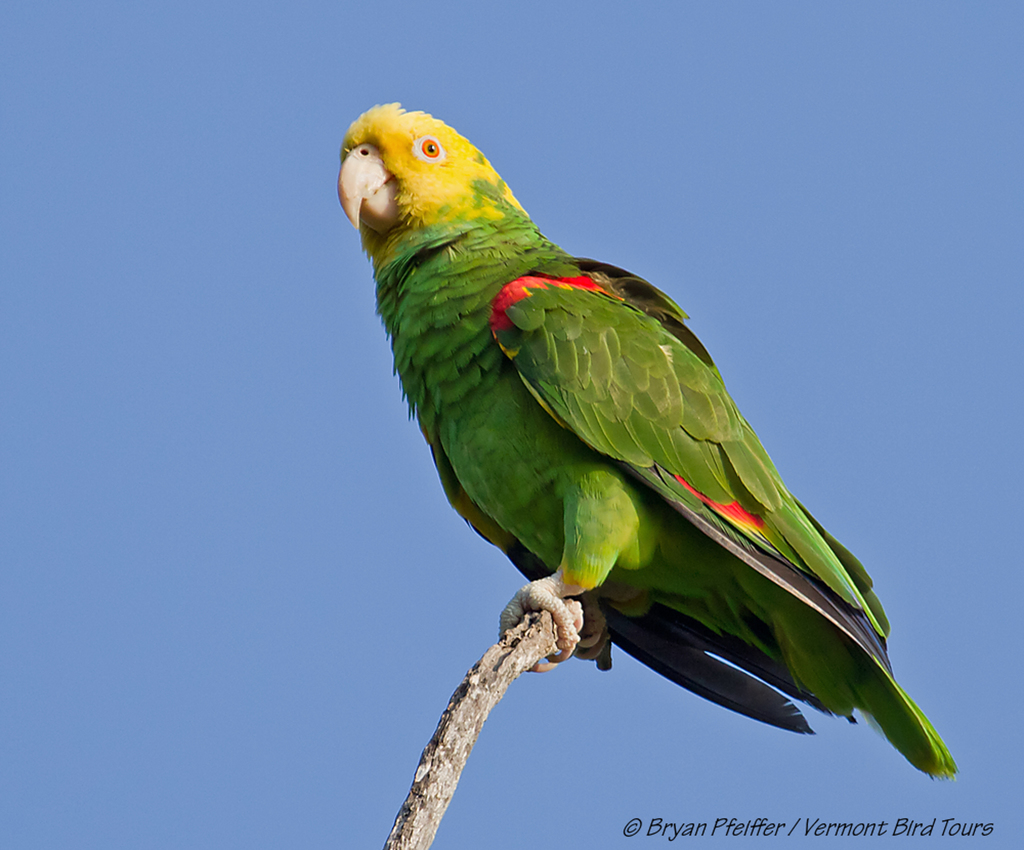
The yellow-headed amazon (Amazona oratrix), also known as the yellow-headed parrot and double yellow-headed amazon, is an endangered amazon parrot of Mexico and northern Central America. Measuring 38–43 centimetres (15–17 in) in length, it is a stocky short-tailed green parrot with a yellow head. It prefers to live in mangrove forests or forests near rivers or other bodies of water. It is sometimes considered a subspecies of the yellow-crowned amazon (Amazona ochrocephala). It is a popular pet and an excellent talker. Poaching for the international pet trade has driven the species to near-extinction in the wild; around half of all wild-caught birds are thought to die in the process.
From the article Yellow-headed amazon on Wikipedia (CC BY-SA), quoted section by section
Description
The yellow-headed amazon averages 38–43 centimetres (15–17 in) long. The shape is typical of amazons, with a robust build, rounded wings, and a square tail. The body is bright green, with yellow on the head, dark scallops on the neck, red at the bend of the wing, and yellow thighs. The flight feathers are blackish to bluish violet with a red patch on the outer secondaries. The base of the tail also has a red patch, which is usually hidden. The outer tail feathers have yellowish tips.
The bill is horn-colored (gray), darker in immatures of the Belizean subspecies. The eye ring is whitish in Mexican birds and grayish in others. The most conspicuous geographical difference is the amount of yellow. In adults, the head and upper chest are yellow in the subspecies of the Tres Marías Islands (tresmariae); just the head in the widespread subspecies of Mexico (oratrix); just the crown in Belize (belizensis); and the crown and nape in the Sula Valley of Honduras (hondurensis, which thus resembles the yellow-naped parrot). Immatures have less yellow than adults; they attain adult plumage in 2 to 4 years. The variety "Magna" (or "Magnum") is bred for more yellow and commands a premium price as a pet. …
Range & habitat
This species lives in riparian forest and areas with scattered trees, as well as evergreen forest in Belize and mangroves in Guatemala. A notable ecoregion of occurrence is the Belizean pine forests. It occurs singly or in pairs, in small groups, and occasionally in big flocks. The range formerly included both coastal slopes of Mexico from the Tres Marías Islands and Jalisco to Oaxaca and from Nuevo León to northern Chiapas and southwestern Tabasco, as well as a disjunct area including most of Belize, and another comprising a small part of northeastern Guatemala and northwestern Honduras. However, their numbers have been reduced drastically—by 90%, to 7,000, from the mid-1970s to 1994, and by 68% from 1994 to 2004—because of capture for the pet trade and habitat destruction. Introduced populations can be found in Stuttgart, Germany, where a recent population of over 50 individuals resides. Smaller introduced populations are to be found in coastal neighborhoods of San Diego, California, including Coronado, Ocean Beach, Pacific Beach, Point Loma, La Jolla, and Imperial Beach; they are also found in Santa Ana, Loma Linda and Pasadena, all also in Southern California. In addition, introduced—and apparently breeding— populations have been reported in Puerto Rico.
Wikipedia: “Distribution and habitat”
In human culture
The origin of the common epithet "double yellow-headed" is that this species is differentiated from the others in the yellow-headed amazon complex by possessing both the yellow nape and yellow crown of its two close relatives, hence a "double-yellow" head.
Wikipedia: “Etymology”
Listen
Looking for field recordings…
Where it lives
Recorded sightings
—
geo-referenced records in GBIF, from museums, herbaria and field observers.
Drag the globe to turn it. Dots are where records exist, not a range map; darker means more records.
In the stacks
Searching the stacks…
Every page naming Amazona oratrix in the Biodiversity Heritage Library →
This page is assembled live from iNaturalist, GBIF, Wikipedia, the Source Library and the Internet Archive. It is not yet part of the hand-edited codex. iNaturalist taxon 18998.