On eBird ↗
Himalayan Cuckoo
Live sightings near you, the range map, bar charts of when it is seen, and Macaulay Library photos and recordings.
Himalayan Cuckoo
Cuculus saturatus
The Himalayan cuckoo or Oriental cuckoo (Cuculus saturatus) is a brooding parasitic bird that is part of the Cuculidae family. The species breeds from the Himalayas eastward to southern China and Taiwan. It migrates to southeast Asia and the Greater Sunda Islands for the winter.
It was formerly known as "Oriental cuckoo" and contained several subspecies found over most of Asia. In 2005, it was determined that this "species" consists of three distinct lineages:
From the article Himalayan cuckoo on Wikipedia (CC BY-SA), quoted section by section
Description
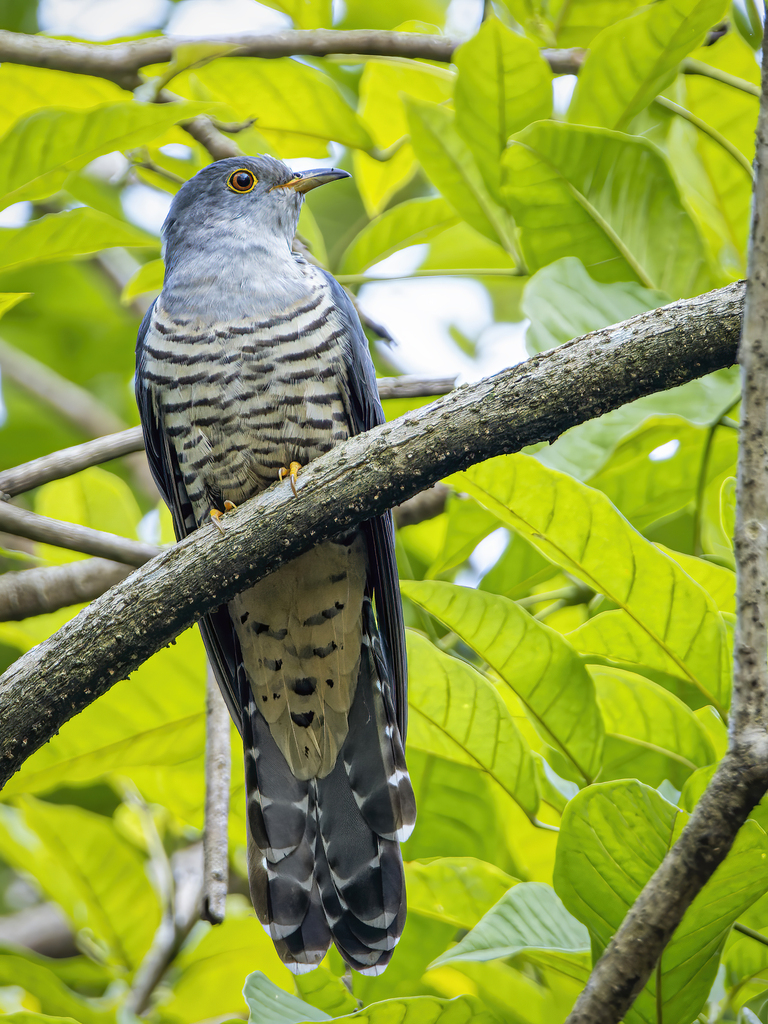
Adult male Himalayan cuckoos are dark ashy-grey above with a brown, almost black, tail that is whitely spotted and tipped. Legs and feet range between yellow and orange. The area from their chins to the breast is ash-grey, with their lower breast and abdomen being white with black bars, and a white to milky orange vent with varying bars. The eye-ring is yellow with yellow to brown irises—darker orange has been seen in males. Bills are black with an orange-yellow or green-yellow base. Their size approximately 30–35 cm and 70–140 g. Females are almost the same, but with rufous tinge to breast, and sometimes the rump and upper tail-coverts rufous with dark bars. Seen with dark-barred rufous upperparts, head, tail and wings, former with white tips. The sides of the head to breast are off-white with dark bars. The rest of underparts are white with black barring. Juveniles have brown irises and are slate grey above with white edges, barred white and black below, and have a black throat with white bars. There are two plumage morphs in both sexes of which are grey and hepatic, their irises changing to a creamy grey to blackish brown color, with a dully-colored bill.
Wikipedia: “Appearance”
Range & habitat
The Himalayan cuckoo can be found throughout northeast Pakistan, the northern Indian subcontinent to southern China in warm weather, spotted along Thailand, Taiwan, Nepal, Assam, Kashmir, and Burma. In the winters, it ranges from southeast Asia to northern Australia, including Malaysia, the Philippines, Indonesia and New Guinea in the months of October to May. With C.optatus looking nearly identical to saturatus and having its winter range overlapping much of the same regions, this is another reason why the two species are often misidentified with each other. When it is breeding season, the cuckoo favors the Oriental Region and the Himalayas through southeast Asia to east China and Taiwan and is rarely found above 1000m. The best breeding areas for C.saturatus in the summer is from late April to August in the Kashmir region and March through September surrounding Nepal. During the non-breeding season, it will be seen in southeast Asia, the Greater Sundas and the Philippines.
Wikipedia: “Range and migration”
What it does
The diet of a Himalayan cuckoo consists mainly of insects—especially caterpillars, both hairless and hairy alike across several families, such as Arctiidae, Lasiocampidae, Sphingidae, Saturnidae, and Noctuidae. Before consumption of the caterpillar, the cuckoo removes the gut content. Apart from caterpillars, they eat grasshoppers, large beetles, spiders, stick-insects, crickets, mantids, flies, and ants. Outside of the insectivore diet, they have also been found to feed on certain fruits, pine shoots and needles, and occasionally, eggs that have been removed from other birds' nests and the chicks within them, i.e. Asian Stubtail (Urosphena squameiceps) and the Grey-cheeked Fulvetta (Alcippe morrisonia). The species tends to generally forage arboreally, but has been known to forage on the grounds of forest floors and open areas like grassy landscapes and lawns. They prefer to seek food alone and may even perform short aerial sallies for prey, but small groups will form when the food source is abundant and will remain until the quantity is completely diminished. An extreme case was found during an infestation of teak moths (Hyblaea puera) in New Guinea that caught the attention of at least 300 individuals.
Wikipedia: “Feeding”
Listen
Looking for field recordings…
Where it lives
Recorded sightings
—
geo-referenced records in GBIF, from museums, herbaria and field observers.
Drag the globe to turn it. Dots are where records exist, not a range map; darker means more records.
In the stacks
Searching the stacks…
Every page naming Cuculus saturatus in the Biodiversity Heritage Library →
This page is assembled live from iNaturalist, GBIF, Wikipedia, the Source Library and the Internet Archive. It is not yet part of the hand-edited codex. iNaturalist taxon 1899.