On eBird ↗
Yellow-naped Amazon
Live sightings near you, the range map, bar charts of when it is seen, and Macaulay Library photos and recordings.
Yellow-naped Amazon
Amazona auropalliata
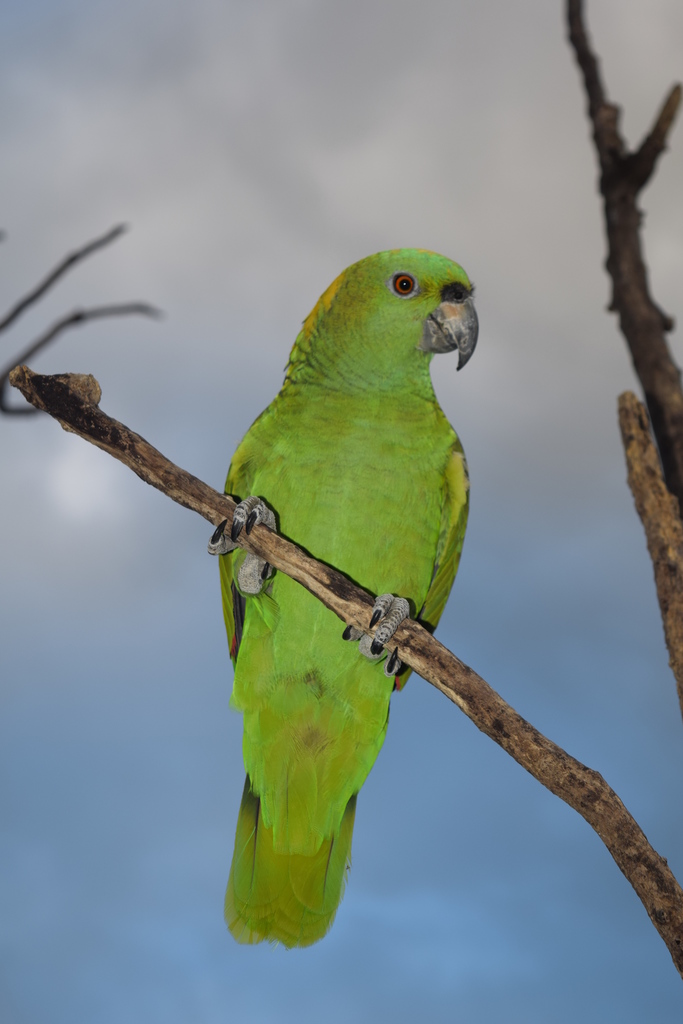
The yellow-naped amazon or yellow-naped parrot (Amazona auropalliata) is a widespread amazon parrot sometimes considered to be a subspecies of the yellow-crowned amazon (Amazona ochrocephala). It inhabits the Pacific coast of southern Mexico and Central America. It has recently been reclassified as Critically Endangered by the IUCN Red List due to a dramatic decline across the extent of its range. Yellow-naped amazons have lost more than 92% of their population over the last three generations.
The primary cause for their population decline are deforestation and illegal removal of young for the parrot trade. This parrot readily mimics sounds, and in captivity, this includes human speech, which is probably the reason it is popular in aviculture. Like all parrots, however, mimicking abilities vary greatly between individuals. Recent surveys of the Costa Rican population across an 11-year time span found a significant decline in their population. Despite this decline, the Costa Rican population is considered to be the stronghold for the species.
From the article Yellow-naped amazon on Wikipedia (CC BY-SA), quoted section by section
Description
The yellow-naped amazon is distinguished by its green forehead and crown and a yellow band across the lower nape (back part of neck) and hindneck. The eyes are orange, beak is dark gray and is paler towards the base of the upper mandible. The feet are also dark gray. Yellow-naped amazons inhabit dry forest and mangrove habitat of the tropics, and nest in naturally occurring cavities Although yellow-naped amazons will not excavate cavities, they will chew the entrance. The parrots will nest in a wide variety of trees, although dead Coyols (palm trees) are one preferred species. During the breeding season, pairs are monogamous, and pairs defend small breeding territories around the nest by duetting with their partners. Breeding success is low (89%), and the majority of nests fail due to poaching The vocal behavior of yellow-naped amazons has been more extensively studied than in any other wild parrot. Yellow-naped amazons, like all parrots, exhibit vocal learning behavior in the wild. This behavior manifests in the form of vocal dialects, in which the repertoire of calls that parrots vocalize change at discrete geographic boundaries, similar to how humans have different languages or dialects. These dialects also are meaningful to the parrots; they are less responsive to calls that are not their own dialect. …
Range & habitat
It is found along the Pacific Coast from southern Mexico south to northern Costa Rica. Recent census efforts have indicated declining populations throughout much of the range, with reduced populations in Costa Rica and Nicaragua and vanishingly small populations in Honduras, Mexico and Guatemala (Dupin et al. 2020, Wright et al. 2018). The Mesoamerican Parrot Census Network, with support of the World Parrot Trust, has been engaging volunteers to assess the status of yellow-naped amazons across their range to assist with conservation.
In common with many parrot species, it feeds on nuts, berries, seeds, and fruit.
Wikipedia: “Range and habitat”
Listen
Looking for field recordings…
Where it lives
Recorded sightings
—
geo-referenced records in GBIF, from museums, herbaria and field observers.
Drag the globe to turn it. Dots are where records exist, not a range map; darker means more records.
In the stacks
Searching the stacks…
Every page naming Amazona auropalliata in the Biodiversity Heritage Library →
This page is assembled live from iNaturalist, GBIF, Wikipedia, the Source Library and the Internet Archive. It is not yet part of the hand-edited codex. iNaturalist taxon 18984.