On eBird ↗
Red-tailed Amazon
Live sightings near you, the range map, bar charts of when it is seen, and Macaulay Library photos and recordings.
Red-tailed Amazon
Amazona brasiliensis
The red-tailed amazon (Amazona brasiliensis), also known as the red-tailed parrot, is a species of parrot in the family Psittacidae. It is native to the Serra do Mar coastal forests. The bird has been threatened by habitat loss and capture for the wild bird trade, and is a symbol of the efforts to conserve one of the Earth's most biologically diverse ecosystems. Consequently, it is considered Near Threatened by BirdLife International and the IUCN. In 1991–92, the population had fallen below 2000 individuals. Following on-going conservation efforts, a count and estimate from 2015 suggests a population of 9,000–10,000, indicating that this species is recovering from earlier persecution. A recent study shows that the population of this species is stable at Paraná state, Southern Brazil, revealing population trend fluctuation during the last 12 years.
From the article Red-tailed amazon on Wikipedia (CC BY-SA), quoted section by section
Description
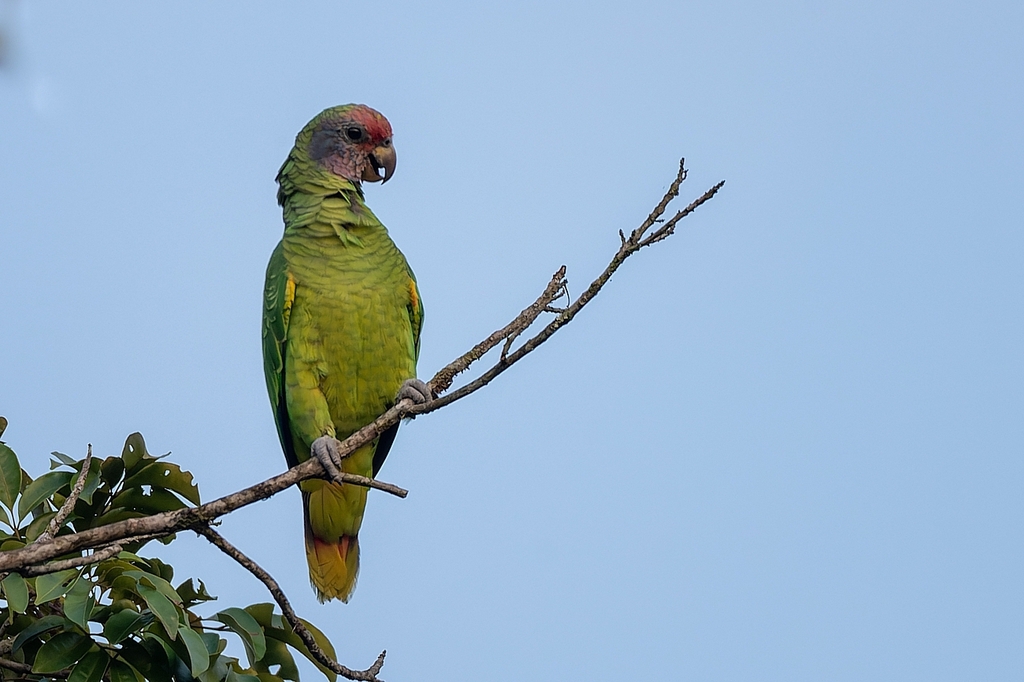
Red-tailed amazons weigh around 425 g (15.0 oz) and are approximately 35 cm (14 in) long. As expected from its common name, it has a broad red band on its tail, but as it largely is limited to the inner webs of the feathers, it is mainly visible from below or when the tail is spread open. Additionally, the tail has a broad yellow tip, and the outer rectrices are dark purplish-blue at the base. The remaining plumage is green, while the throat, cheeks and auriculars are purple-blue, the forecrown is red, and the rectrices are broadly tipped dark blue. It has a yellowish bill with a blackish tip to the upper mandible, a pale gray eye ring, and orange irises. Juveniles have a duller plumage and brown irises.
Range & habitat
The red-tailed amazon is native to the Serra do Mar coastal forests. This species is almost entirely restricted to lowlands, typically occurring at altitudes below 200 meters (660 feet) above sea-level, though sometimes reaching altitudes up to 700 m (2,300 ft).
Wikipedia: “Habitat”
What it does
Red-tailed amazons are usually found in pairs or flocks, which occasionally may number several hundred individuals in the non-breeding season. It primarily roosts and breeds on coastal islands, but most of the foraging takes place on the nearby mainland, where the birds forage mainly for fruits, but their diet also includes seeds, flowers, nectar, and rarely, insects.
Breeding. The red-tailed amazon breeds in mangrove and coastal forests on islands. The breeding season lasts from September to February, when the parrots lay three or four eggs in a natural tree-cavities. The incubation period is 27 to 28 days, and the fledging period an additional 50 to 55 days.
Wikipedia: “Behavior”
Listen
Looking for field recordings…
Where it lives
Recorded sightings
—
geo-referenced records in GBIF, from museums, herbaria and field observers.
Drag the globe to turn it. Dots are where records exist, not a range map; darker means more records.
In the stacks
Searching the stacks…
Every page naming Amazona brasiliensis in the Biodiversity Heritage Library →
This page is assembled live from iNaturalist, GBIF, Wikipedia, the Source Library and the Internet Archive. It is not yet part of the hand-edited codex. iNaturalist taxon 18980.