On eBird ↗
Sunda Cuckoo
Live sightings near you, the range map, bar charts of when it is seen, and Macaulay Library photos and recordings.
Sunda Cuckoo
Cuculus lepidus
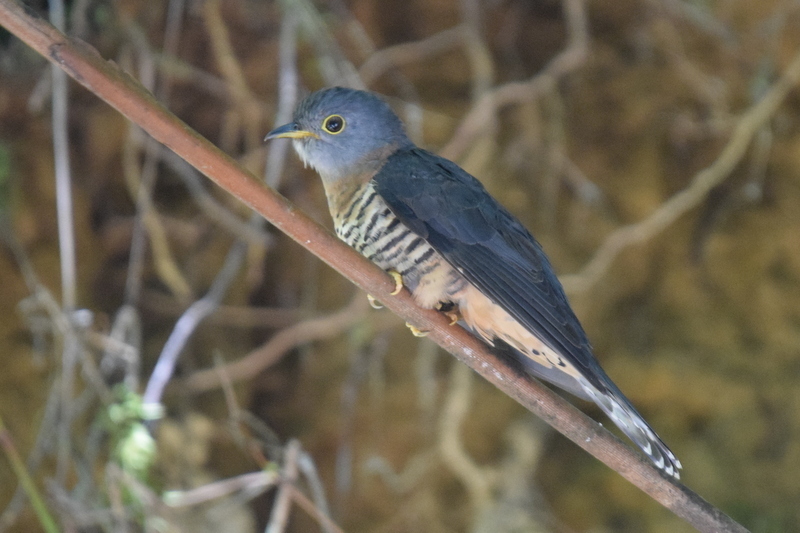
The Sunda cuckoo or Sunda lesser cuckoo (Cuculus lepidus) is a South-east Asian bird belonging to the genus Cuculus in the cuckoo family, Cuculidae. It was formerly classified with the Himalayan cuckoo (C. saturatus) and Oriental cuckoo (C. optatus) in a single species, C. saturatus, but is now often regarded as a separate species based on differences in voice, size and plumage.
From the article Sunda cuckoo on Wikipedia (CC BY-SA), quoted section by section
Description
It is 29–30 cm long. The upperparts, throat and upper breast are dark grey. The rest of the underparts are buff with black bars. The tail is blackish with white spots. The female also occurs in a rufous form which has reddish-brown upperparts, paler underparts and black barring both above and below. The Himalayan cuckoo and Oriental cuckoo are similar to the Sunda cuckoo but paler with less buff-coloured underparts and narrower black bars. The song of the Sunda cuckoo usually consists of a short first note followed by two or three longer and lower "hoop" notes. The whole song is higher-pitched than that of the Himalayan cuckoo which gives three or four "hoop" notes.
Range & habitat
Its range covers the Malay Peninsula, Borneo, Sumatra, Java, Bali, Seram and the Lesser Sunda Islands east to Timor. It is non-migratory unlike the Himalayan and Oriental cuckoos which overlap in range with it during the northern winter. It occurs in forests, mainly in mountainous areas. It is found at altitudes of 950–1700 m in the Malay Peninsula, 1300–2700 m in Borneo and above 1000 m in Java, Sumatra and Wallacea. It is believed to be slowly declining in numbers but still has a sizable range and population so its status is classed as Least Concern by BirdLife International.
Wikipedia: “Distribution and habitat”
What it does
It feeds mainly on insects, particularly caterpillars, and will also eat fruit. It is a secretive bird which is hard to find except when calling. It is a brood parasite, laying its eggs in the nests of other birds. It has been recorded using the nests of the chestnut-crowned warbler in the Malay Peninsula, mountain leaf warbler and yellow-breasted warbler in Sabah and mountain leaf warbler, Sunda warbler and Sunda bush warbler in Java. The eggs are whitish with brown spots.
Wikipedia: “Behaviour”
Listen
Looking for field recordings…
Where it lives
Recorded sightings
—
geo-referenced records in GBIF, from museums, herbaria and field observers.
Drag the globe to turn it. Dots are where records exist, not a range map; darker means more records.
In the stacks
Searching the stacks…
Every page naming Cuculus lepidus in the Biodiversity Heritage Library →
This page is assembled live from iNaturalist, GBIF, Wikipedia, the Source Library and the Internet Archive. It is not yet part of the hand-edited codex. iNaturalist taxon 1898.